


68% of homeowners are now actively planning to invest in their outdoor living spaces, yet the average builder is still losing 90% of their web traffic before a single phone call is made. You’ve likely felt the sting of wasting hours on site visits for prospects who aren’t ready to buy or watching your cost-per-lead climb while your conversion rates stall. It’s a common cycle that keeps you from dominating the local market in Brisbane or Melbourne. You want a business that runs on a predictable pipeline, not one that relies on the luck of the draw.
We’re going to fix that by showing you how to master the patio customer journey to turn casual browsers into your most profitable construction projects. You’ll learn exactly how to build a digital sequence that filters out the tire-kickers and prepares high-value clients to sign your contracts. We’ll examine the 2026 path to high-ticket leads, from the first Instagram click to the final on-site quote, so you can finally cut through the noise and scale your revenue with confidence.
Key Takeaways
- Map the 2026 patio customer journey to move beyond “lucky” leads and build a predictable pipeline of high-ticket construction projects.
- Leverage visual discovery platforms like Pinterest and Instagram to capture homeowners during the critical awareness phase when they first start dreaming of a backyard upgrade.
- Conduct a digital “Trust Audit” to ensure your website and social profiles provide the authority signals high-value clients demand before they pick up the phone.
- Streamline your decision-phase sequence with friction-free inquiry forms and lead qualification filters to protect your time and boost your site-to-quote conversion rates.
- Transition from a “leaky” marketing strategy to a results-oriented approach that prioritizes long-term stability and ROI over vanity metrics.
What is the Patio Customer Journey in 2026?
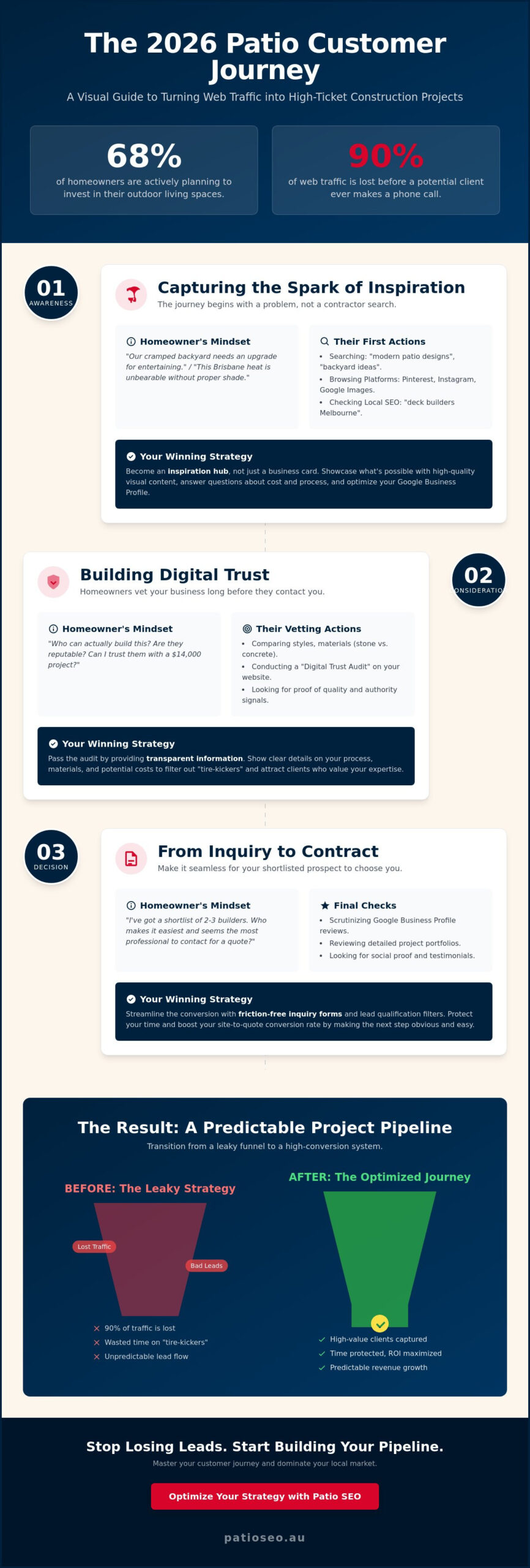
The patio customer journey in 2026 is the end-to-end psychological and digital process a homeowner follows from their initial backyard frustration to the final contract sign-off. It isn’t a straight line. It’s a complex web of research, inspiration, and vetting that happens long before you arrive for a site visit. In a market where 68% of homeowners are planning to invest in their outdoor spaces this year, simply having a website isn’t enough. You need to map the specific path they take to ensure you’re the only builder they want to hire.
The 2026 journey is defined by a massive shift in how trust is built. Gone are the days when a simple local ad or a basic “patios” page would suffice. Today’s customers are looking for an outdoor living partner, not just a contractor. They’re spending hours on visual discovery platforms and local search results, looking for authority and proof of quality. Because a custom patio can cost anywhere from $2,000 to over $14,000, the perceived risk is high. This high-ticket reality means your digital presence must act as a 24/7 salesperson that handles objections and builds rapport before you even speak.
The Four Pillars of the Modern Journey
To dominate your local market, you have to understand the four distinct stages your prospects move through:
- Awareness: The homeowner identifies the need for a lifestyle upgrade or a functional entertaining space.
- Consideration: They compare styles, materials like natural stone or poured concrete, and local builders.
- Decision: They vet a shortlist through GMB reviews, detailed portfolios, and social proof.
- Conversion: The seamless transition from a digital lead to a signed construction contract.
Why ‘Tire-Kickers’ Are a Journey Problem, Not a Lead Problem
Most builders complain about “bad leads,” but the truth is usually a broken journey. When your website lacks transparent information about costs, permits, or your specific process, you attract people who aren’t ready to buy. Using educational content to set expectations early filters out the price-shoppers and attracts clients who value your expertise. If your marketing doesn’t answer their questions, they’ll keep looking until they find someone who does. Ultimately, the patio customer journey is a structured trust-building exercise designed to eliminate doubt before a shovel ever hits the ground.
The Awareness Phase: Capturing the Spark of Inspiration
The spark of inspiration rarely starts with a search for a contractor. It usually begins with a specific frustration. A homeowner might be sitting in a 35-degree Brisbane backyard with no shade, or perhaps they’re hosting a cramped family BBQ in Melbourne and realize their current setup is failing them. At this point, they aren’t looking for you; they’re looking for a solution to their discomfort. They start by searching for “modern patio designs” or “backyard renovation ideas” on Pinterest, Instagram, and Google Image search. This is the official entry point into the patio customer journey.
To capture this early-stage interest, your website must function as an inspiration hub rather than a static business card. If a prospect lands on your site and only sees a “Contact Us” form, they’ll bounce. They want to see what’s possible. They want to see how a $2,000 gravel space compares to a $14,000 custom-poured concrete masterpiece. By providing high-quality visual content that addresses these initial questions, you position yourself as the authority. Understanding the specific touchpoints that most influence their decisions allows you to intercept them before they even consider your competitors.
Dominating Local Search for Early-Stage Queries
Success in 2026 requires more than just ranking for your brand name. You need to dominate high-intent local keywords like “deck builders Melbourne” or “patio designs Brisbane” to be visible when that first spark hits. This is where SEO for patio builders becomes your most powerful lead-generation tool. Creating blog content that answers pragmatic questions, such as “How much does a patio cost in 2026?”, builds immediate transparency. It proves you aren’t hiding behind a “black box” of pricing, which is a major pain point for modern consumers.
The Power of the Google Business Profile (GMB)
Your GMB is often the first stop in the awareness phase. It’s the digital shopfront where homeowners perform a quick “vibe check.” High-quality project photos aren’t just a nice addition; they’re essential for driving click-through rates. To stand out, update your GMB weekly with “In Progress” shots. These raw, behind-the-scenes photos show activity and reliability. They prove you’re a hardworking team actually getting dirt under your fingernails, which builds more trust than a dozen stock photos ever could. If you want to ensure your business is the first thing they see when that spark hits, it’s time to look at a results-oriented digital strategy that cuts through the noise.
The Consideration Phase: How Homeowners Vet Your Business
Once the homeowner has a vision, they move into the most critical part of the patio customer journey: the Trust Audit. This is where they stop looking at designs and start looking at you. They aren’t just checking if you can build a roof; they’re verifying if you’re a reliable business that won’t leave them with a half-finished mess and a drainage nightmare. High-ticket construction projects are emotional investments. Because a custom patio can range from $5 to $50 per square foot depending on materials, the financial stakes are high enough to trigger intense scrutiny.
Prospects often find themselves caught in a loop of comparing SEO vs. Social Media for contractors to determine who is the real deal. While Instagram might show them a pretty picture, your organic search presence and local authority prove you have staying power. Optimising Your Strategy with Patio SEO ensures that every digital touchpoint reinforces your status as a local expert. It’s about proving that a new patio isn’t just an expense, but a strategic asset that adds genuine value to their property.
Building a High-Converting Project Gallery
Generic stock photos will kill your credibility instantly. In the consideration phase, homeowners want to see real work in their own backyard. Organize your galleries by suburb and style so a prospect in Coorparoo or Frankston can see exactly what you’ve built nearby. This localization builds immediate trust. A gallery should tell a story of transformation, moving from a muddy patch of grass to a functional outdoor sanctuary, rather than just showing a finished product.
Case Studies as Trust Accelerators
Australian homeowners appreciate a “no-nonsense” approach. They don’t want marketing fluff; they want to know how you handled a 15-degree slope or a complex permit requirement. Move beyond generic testimonials and create case studies that highlight specific problem-solving. Use video testimonials to humanise your brand and let your previous clients do the selling for you. Being transparent about timelines and material choices, like explaining why natural stone might cost $35 per square foot compared to $15 for poured concrete, builds the rapport needed to move them toward a contract.
The Decision Phase: Converting Inquiries into Contracts
The decision phase is the “make or break” moment of the patio customer journey. At this point, the homeowner has vetted your portfolio and checked your reviews; they’re now ready to cross the line from observer to inquirer. However, this is where many builders fail. If your contact form is a 15-field interrogation, you’ll lose them. Conversely, if you don’t ask the right questions, you’ll end up with a calendar full of dead-end appointments. Success in 2026 requires a friction-free entry point paired with a rigorous backend filter.
Wasting time on site visits for people who only have a $500 budget is a fast track to burnout. Learning how to qualify contractor leads is the difference between a profitable month and a month spent chasing ghosts. Your digital presence should do the heavy lifting by setting expectations around the $5 to $35 per square foot reality of modern construction. By the time you arrive for an on-site consultation, the prospect should already be 80% sold on your expertise and your price bracket. If you’re still struggling with bad leads for contractors draining your schedule, a structured digital funnel is the most effective way to filter out low-budget inquiries before they reach your calendar. For a comprehensive approach to attracting only high-value prospects, the lead generation for outdoor living contractors 2026 ROI playbook outlines exactly how to shift from volume-based marketing to a filtration-first strategy that fills your pipeline with clients ready to invest.
Optimising the Conversion Path
Not every visitor is ready for a full quote immediately. Forcing a “Request a Quote” button on someone who is still in the early decision window can be too high-friction. Offer a “Soft Lead” alternative, such as a “2026 Patio Planning Guide,” in exchange for an email address. This allows you to use automated follow-ups to stay top-of-mind. Additionally, ensure your website design is perfectly mobile-responsive. Most Aussie homeowners perform these final checks on their phones while sitting in the very backyard they want to renovate.
The Role of the Consultation in Closing the Journey
The site survey is your final opportunity to justify a high-ticket price point. Transition from a simple measurement session to a professional presentation of authority. Using 3D renders during or shortly after the visit solidifies the vision and removes the “imagination gap” that often stalls contracts. Follow this up with a fast, professional digital quote. In a competitive market, the builder who provides a clear, transparent breakdown within 24 to 48 hours usually wins the project. If you want to refine this entire process and stop losing leads at the finish line, it’s time to optimise your conversion rate with a strategy built for growth.
Optimising Your Strategy with Patio SEO
A leaky patio customer journey is a silent revenue killer for your construction business. If you’re generating traffic but failing to sign contracts, you have a structural problem in your digital funnel that no amount of extra ad spend will fix. Many builders suffer from a high cost-per-lead because their marketing is designed to attract “browsers” rather than “buyers.” We focus on plugging those holes. By aligning every digital touchpoint with the psychological stages of an Australian homeowner, we turn your website into a high-performance sales asset. This isn’t about vanity metrics; it’s about the bottom line and your bank balance.
Patio SEO specialises in the outdoor living niche because generalist agencies simply don’t understand the nuance of a $10,000 plus construction sale. They treat a custom patio build like a low-cost retail purchase. We know your customers need more touchpoints, deeper technical information, and significantly higher levels of trust before they commit. Our ROI-driven approach means we measure success by the number of qualified, high-ticket leads that actually turn into site visits and signed contracts. This allows you to scale your business with a predictable pipeline while we handle the technical heavy lifting in the background.
Custom Website Design for Patio Contractors
Your website is the foundation of your entire digital presence. Building a website design for patio contractors that converts requires a precise mix of visual storytelling and technical SEO. We integrate Local SEO and GMB management to ensure you dominate your specific service area, whether you’re targeting the coastal suburbs of Brisbane or the established neighbourhoods of Melbourne. The “Straight-Shooting” advantage of working with us is simple: we speak your language and understand the trade. We don’t hide behind “black box” mystery; we deliver proven growth through transparent data.
Ready to Fix Your Customer Journey?
Generalist agencies often fail because they apply the same tired templates to every industry they touch. They don’t understand the difference between natural stone and poured concrete, nor do they care about your local permit regulations. Fixing your patio customer journey requires a partner who understands the long-term value of a sustainable, organic growth strategy. We get our hands dirty with the data to ensure your business stays stable and profitable for years to come. It’s time to stop guessing and start growing. Contact Patio SEO today for a no-nonsense audit of your digital journey.
Take Control of Your Local Market Dominance
The 2026 market is ripe for growth, but you won’t capture your share by accident. Mastering the modern patio customer journey requires a strategic shift from being a passive builder to an active outdoor living partner. You’ve seen how visual discovery fuels initial interest and how a rigorous trust audit on your website separates professionals from fly-by-night operators. By the time you reach the decision phase, your digital presence should have already handled the heavy lifting of qualifying leads and setting price expectations.
We specialize in the Australian outdoor living niche, offering ROI-focused strategies that cut through the noise of impersonal agencies. You deserve a partner who provides no-nonsense, straight-shooting expert advice instead of technical jargon. Don’t let your competitors in Brisbane or Melbourne claim the most profitable projects while you’re stuck quoting tire-kickers. Stop wasting time on bad leads, get a custom SEO strategy from Patio SEO and start building a predictable pipeline today. You’ve got the skills to build the projects; we have the data to find the clients who want them.
Frequently Asked Questions
What is the most important stage of the patio customer journey?
The consideration phase is the most critical part of the patio customer journey because it’s where the homeowner performs their “Trust Audit.” While awareness gets you on the list, consideration is where prospects spend 70% of their time vetting your previous work and reviews. If your digital presence doesn’t prove your reliability during this stage, you’ll never make it to the on-site quote.
How long does the average homeowner take to decide on a patio builder?
Most homeowners take between 4 and 12 weeks to move from initial inspiration to a signed contract. Because a custom patio is a high-ticket investment ranging from $2,290 to over $14,000, it’s rarely an impulse purchase. You need a strategy that keeps your brand top-of-mind through automated follow-ups and educational content during this multi-month decision window.
Why am I getting leads that can’t afford my services?
You’re likely attracting low-budget leads because your website lacks price transparency and qualification filters. If you don’t mention that high-end materials can cost up to $50 per square foot, you’ll continue to attract “tire-kickers” with unrealistic expectations. Using educational content to set clear budget boundaries early in the patio customer journey protects your time and improves lead quality.
Does social media actually help in the patio customer journey?
Social media is essential for the Awareness Phase where 68% of homeowners start their research on visual platforms like Instagram and Pinterest. It functions as a digital portfolio that captures the “spark of inspiration” before they search for specific local builders. Regular updates with “In Progress” shots prove your team is active and reliable, which builds early-stage trust.
How can I improve my conversion rate from website visitor to lead?
Improving your conversion rate requires reducing friction on your contact forms and offering “soft lead” magnets. Instead of only having a “Request a Quote” button, offer a “2026 Patio Planning Guide” to capture email addresses from those not yet ready for a site visit. This approach can increase your lead volume by 20% to 30% by engaging prospects earlier in their research.
What role does Google Ads play in the customer journey?
Google Ads provides immediate visibility for high-intent search terms like “patio builder Melbourne” or “decking contractor Brisbane.” It’s a shortcut to the top of the search results, ensuring you capture homeowners who are ready to move from the consideration phase to the decision phase. When paired with a strong SEO strategy, PPC creates a dominant local presence that’s hard for competitors to ignore.
Is a professional website really necessary for a local patio business in 2026?
A professional website is mandatory in 2026 because it acts as your 24/7 salesperson and primary trust-builder. Over 90% of modern customers will vet your website before they ever pick up the phone to request a quote. Without a mobile-responsive site that showcases your local authority and specific project galleries, you’re essentially invisible to the most profitable homeowners in your area.
How do I know if my marketing is actually generating an ROI?
You measure ROI by tracking how many digital leads actually convert into signed construction contracts. Don’t get distracted by vanity metrics like “likes” or “impressions” that don’t pay the bills. A truly ROI-focused strategy uses data to identify which keywords and platforms are driving your most profitable projects, allowing you to scale your revenue with total transparency.