


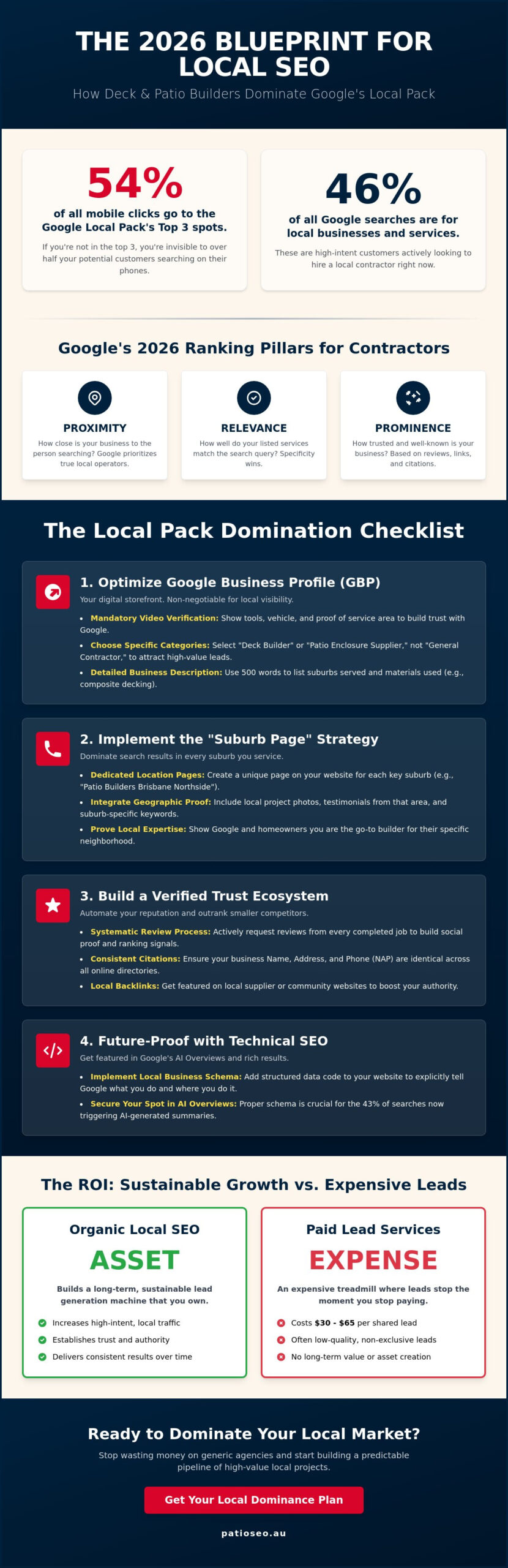
Did you know that the Google Local Pack now captures 54% of all clicks on mobile devices? If you aren’t in those top three spots, you’re effectively invisible to the 46% of Google searchers looking for local builders right now. Most Australian deck and patio builders are tired of wasting $2,000 a month on generic agencies that don’t understand the difference between a pergola and a portal frame. Mastering local seo for contractors in 2026 isn’t about gaming the system. It’s about building a verified trust ecosystem that Google’s AI and your local homeowners can verify instantly.
You’ve likely felt the frustration of seeing a smaller competitor with half your experience outrank you just because they have more recent reviews. It’s a waste of time fielding calls from three suburbs away while your local neighbours hire someone else. This guide provides a no-nonsense roadmap to reclaim your territory and turn local searches into high-value projects. We’ll break down the exact 2026 checklist you need to dominate the Local Pack, from navigating mandatory video verification to securing your spot in the 43% of searches now triggering AI Overviews.
Key Takeaways
- Learn how to verify and optimise your Google Business Profile to capture the 54% of mobile search clicks that currently go to the Local Pack top three.
- Discover why successful local seo for contractors hinges on selecting high-intent business categories that attract premium deck and patio projects instead of low-value repairs.
- Master the “Suburb Page” strategy to dominate local search results by integrating geographic identifiers that prove your expertise to both Google and local homeowners.
- Establish a systematic review and citation process to build a verified trust ecosystem that automates your lead generation and outranks smaller competitors.
- Future-proof your online presence using Local Business Schema to ensure your contracting business is accurately featured in 2026 AI Overviews and search summaries.
What is Local SEO for Contractors and Why Does It Matter in 2026?
Local search isn’t just a technical buzzword; it’s the digital shopfront for your building business. For Australian tradies, local search engine optimization (local SEO) is the strategic process of tuning your online presence to attract homeowners in your specific service area. It ensures that when someone in your suburb needs a new deck, your name is the first one they see. This isn’t about reaching the whole world. It’s about owning your backyard.
The “Local Pack” is the map section showing the top three local businesses in Google search results. In 2026, this space is the primary engine for contractor revenue. Recent data shows the Local Pack receives 54% of all mobile clicks. If you aren’t in that top three, you’re effectively invisible to more than half of your potential customers. Dominating this space requires a mastery of local seo for contractors, moving beyond basic keywords to build a profile that Google trusts implicitly.
Google’s 2026 algorithm prioritises three core pillars: proximity, relevance, and prominence. Proximity is how close you are to the searcher. Relevance is how well your services match their needs. Prominence is how much the internet trusts you. While buying leads from third-party platforms might seem like a quick fix, it’s an expensive treadmill. In early 2026, general contractors are paying between $30 and $65 per lead through paid services. Investing in organic local SEO creates a sustainable asset that delivers high-quality enquiries without the per-click tax.
The ROI of Local Visibility for Trade Businesses
Local searchers have significantly higher intent than general browsers. They aren’t looking for “deck inspiration”; they’re looking for someone to dig the holes. With “near me” searches growing 400% since 2020, appearing for terms like “patio builders Brisbane” is the fastest way to fill your calendar. Statistics from April 2026 show that 76% of consumers who search for a local business on a smartphone visit a business within 24 hours. Organic local rankings provide long-term stability that pay-per-click ads simply can’t match.
Local SEO vs. National SEO: Knowing the Difference
You don’t need to rank in Sydney if you only build in Perth. National SEO focuses on broad information, but local seo for contractors is a geo-fenced marketing strategy designed for service-based businesses. It relies on geo-modifiers—specific suburb or city names—to connect you with local homeowners. This targeted approach means you aren’t competing with every builder in the country, only the ones in your immediate area. It’s a more efficient, cost-effective way to dominate your local market.
The Google Business Profile (GBP) Optimisation Checklist
Your Google Business Profile isn’t just a digital listing; it’s your most powerful sales tool. In May 2026, verification processes are more stringent than ever. Video verification is now the default method for new listings. You’ll need to record a continuous video showing your business vehicle, your professional tools, and proof of your service area to gain Google’s trust. This verification is the foundation of any successful strategy for local seo for contractors, as it signals to Google that you’re a legitimate operator rather than a lead-gen ghost site.
Choosing the right primary category is a high-stakes decision. Many deck builders default to “General Contractor,” but this is often too broad. If your revenue comes from outdoor living, “Patio Enclosure Supplier” or “Deck Builder” should be your primary choice. You can then use secondary categories to capture broader terms. For a deeper look at how these signals interact, this comprehensive guide to local SEO explains the technical weight Google gives to category relevance. Aligning your “Products” and “Services” sections with your website’s core offerings ensures that Google’s AI can accurately match your profile to high-intent homeowners.
Step 1: Maximising Your Profile Information
Accuracy beats cleverness every time. Your business name must match your legal entity. Adding keywords like “Best Deck Builder” to your name is a fast track to a profile suspension in 2026. Instead, focus your energy on a 500-word business description. Use this space to name-drop the specific suburbs you serve and the high-ticket materials you use, like Australian hardwoods or composite decking. Set your service area radiuses strictly. If you won’t drive more than 50 kilometres for a quote, don’t tell Google you serve the entire state. This prevents “dead-end” leads and keeps your conversion rate high.
Step 2: Visual Proof and Regular Updates
Homeowners buy with their eyes. We recommend the “Fortnightly Photo Rule”: upload at least three new, high-resolution project photos every two weeks. Don’t just show the finished patio. Include “Behind the Scenes” shots of your team on-site. This builds immediate personal trust and proves you’re actually working in the suburbs you claim to serve. Use Google Updates to announce recently completed decks or seasonal offers. These posts show Google that your business is active and engaged. If you’re struggling to find the time for these technical updates, consider a tailored local SEO strategy to handle the heavy lifting for you.
On-Page Local SEO: Suburb Pages and Content Strategy
Ranking for a broad city term is a start, but the real money is in the suburbs. Suburb pages allow you to cast a wider net across your service area without diluting your main site’s authority. For a builder in Perth, ranking for “Scarborough” or “Cottesloe” is often more valuable than fighting for the generic “Perth” keyword. Effective local seo for contractors requires you to embed your Name, Address, and Phone number (NAP) in the footer of every page using structured data. This simple technical step ensures Google’s crawlers can verify your physical presence across every suburb you target, turning your website into a localised lead-generation machine.
Optimising your Title Tags and Meta Descriptions is your first chance to win the click. Don’t waste this space with generic company names. Use clear, local intent phrases like “Expert Deck Builders in New Farm | 15+ Years Experience”. This tells both the homeowner and the search engine exactly who you are and where you work. Since 28% of local searches result in a purchase, according to April 2026 data, these small technical adjustments directly impact your bottom line by filtering for high-intent local traffic before they even land on your site.
How to Build High-Converting Suburb Pages
The biggest mistake contractors make is creating “cookie-cutter” pages. If you simply copy and paste the same text and swap the suburb name, Google will flag it as thin content and ignore it. To avoid this, write unique copy for every location. Mention specific local landmarks, nearby parks, or even the typical architectural style of the area. Include a project gallery and testimonials from clients in that specific suburb to build immediate local trust. For a deeper dive into these tactics, check out our SEO for Patio Builders in 2026 guide. It’s about proving you’ve actually had boots on the ground in that neighbourhood.
Talking the Local Language: Keyword Integration
Stop writing for search engines and start writing for your neighbours. In 2026, Google’s AI understands context without you stuffing robotic keywords. Use natural phrases like “best patio builder in Scarborough” instead of “Scarborough patio builder contractor”. With “near me” searches growing by 35% annually, your site must be mobile-optimised and lightning-fast. You can also show expertise by addressing local council regulations or climate requirements. Mentioning “cyclone-rated patios” for North Queensland or “bushfire-compliant decks” for the Blue Mountains proves you aren’t just a builder; you’re a local expert who understands the specific challenges of the area. If you operate in Victoria, targeting the keywords for deck builders Melbourne that reach high-value homeowners in suburbs like Brighton or Toorak can be the difference between fielding repair inquiries and landing full-scale premium builds. This level of detail is exactly what local seo for contractors should achieve: building trust through local relevance.
Building Trust: Reviews, Citations, and Local Backlinks
Trust isn’t just a feeling; it’s a data point that Google measures with clinical precision. In 2026, building a localised trust ecosystem is the difference between a busy crew and an empty calendar. Local seo for contractors relies on social proof and digital breadcrumbs that prove your physical presence and reliability. According to the BrightLocal Consumer Survey 2026, 88% of consumers trust online reviews as much as personal recommendations. If your profile is a ghost town of old feedback, you’re losing high-ticket projects to competitors who actively manage their reputation.
Google’s AI now looks beyond simple star ratings. It analyzes the sentiment of your reviews and how you interact with your customers. Responding to every review—even the difficult ones—demonstrates a level of professionalism that builds automatic trust with homeowners. It shows you’re a real person who stands by their work. Beyond direct reviews, “unlinked mentions” in local news or community Facebook groups still signal authority. Google sees these mentions and associates your brand with a specific geographic area, strengthening your local relevance without needing a traditional backlink.
The Review Acquisition System
Don’t leave your reputation to chance. You need a systematic approach to capture the “Goldilocks” moment: that window immediately after handover when the homeowner is admiring their new patio. Simplify the process by placing QR codes on your business cards or project signs. This removes the friction of searching for your business name. Google values the frequency and recency of reviews as much as the rating, so a steady stream of monthly feedback is better than a sudden burst of twenty reviews followed by silence. If you want to see where your reputation stands, get a professional audit of your local trust signals today.
Australian Directories and Local Citations
NAP (Name, Address, Phone) consistency is the bedrock of local search. For Australian contractors, this means dominating the “Big Three”: Yellow Pages, True Local, and HiPages. You must ensure your details are identical across every platform. Cleaning up “Zombie Citations”—old phone numbers or previous office addresses—is essential to stop confusing search engines and damaging your rankings. Local sponsorships also offer a massive advantage. Supporting a local footy club or community garden often results in a high-value local backlink. These links are incredibly difficult for national competitors to replicate, giving you a distinct edge in your specific suburb.
The 2026 Edge: AI Search and Technical Local SEO
The finish line for local seo for contractors has moved. In 2026, it’s no longer enough to just have a website and a few reviews. You need to be visible in the AI Overviews that now trigger in 43% of local searches, according to data from April 7, 2026. These summaries aggregate your business data, reviews, and project details into a single conversational answer for the homeowner. If your site isn’t technically sound, you’re giving the AI a reason to pass you over for a competitor who has their technical house in order. Before you can fix these gaps, you first need to identify them with a thorough seo audit for contractors that reveals exactly where your leads are leaking.
Mobile-first indexing is now the absolute standard for trade businesses. Since the Local Pack captures over half of all mobile clicks, your site’s performance on a smartphone is your primary revenue bottleneck. A slow site doesn’t just annoy users; it signals to Google that you aren’t a top-tier service provider. Voice search is also a major player. Homeowners are increasingly asking Siri or Google Assistant for the “best deck builder near me” while they’re on the go. These queries are conversational and highly local. Your content needs to answer these specific questions directly to win the “position zero” spot in voice results.
Schema Markup: The Secret Language of Search Engines
Think of Schema markup as a digital translator for search engines. By implementing LocalBusiness Schema, you tell Google exactly where you’re located, what hours you’re on-site, and the specific services you provide. This technical clarity is how you ensure your business details are pulled correctly into AI summaries and the Local Pack. We also use Review Schema to help those 5-star ratings show up directly in organic search results. This visual social proof increases your click-through rate before a user even visits your site. For a broader look at how this fits into your business growth, refer to our Marketing for Patio Builders template to align your technical SEO with your sales goals.
Preparing for AI-Driven Local Discovery
Google is moving toward “Entity” search. This means it wants to recognise your brand as a specific, trusted entity in the outdoor living niche. You achieve this by creating long-form, authoritative content that answers the exact questions homeowners are asking in 2026. Don’t just list services. Explain the pros and cons of composite decking versus Australian hardwoods. Detail how local council approval works in your specific region. By structuring this data clearly, you make it easy for AI bots to extract your expertise and present it as the definitive answer. This isn’t just about ranking; it’s about being the most verified, trusted choice in a crowded digital landscape.
Dominate Your Local Territory Starting Today
The 2026 digital landscape doesn’t reward participation; it rewards authority. You’ve seen how a verified Google Business Profile and strategic suburb pages capture the 54% of mobile clicks currently flowing into the Local Pack. Mastering local seo for contractors isn’t just about rankings. It’s about constructing a lead-generation asset that works as hard as your best site crew. From technical Schema markup to a systematic review process, these steps turn digital noise into high-value patio and deck projects.
Stop letting smaller competitors outrank you because of better digital hygiene. We specialise exclusively in the Australian outdoor living niche, providing no-nonsense, ROI-driven strategies that deliver real business outcomes. Our proven track record with patio and deck builders means we understand the technical data and the trade reality. It’s time to claim your territory and build a professional presence that earns trust automatically. Book your free Local SEO audit with Patio SEO today and take the first step toward sustainable local growth.
Frequently Asked Questions
How long does it take for local SEO to start generating leads for a contractor?
Lead generation from local seo for contractors typically takes 3 to 6 months to hit full stride. While technical fixes can show minor results in 30 days, building the prominence required to secure a permanent spot in the Local Pack is a marathon. It’s about consistent data and long-term trust building rather than quick, unstable wins.
Is a Google Business Profile free, or do I have to pay for local SEO?
Creating your profile is free, but staying competitive in 2026 usually requires an investment. Comprehensive local SEO campaigns for single-location businesses average between $1,000 and $2,000 per month. If you choose the “pay-to-play” route with Google Guaranteed, you’ll also pay between $30 and $65 per lead for general contracting services.
Can I do local SEO myself, or do I need to hire a specialised agency?
You can handle basic tasks like uploading photos and responding to reviews. However, a specialised agency manages the technical heavy lifting like Local Business Schema and navigating the 2026 video verification requirements. If you’re building decks all day, you likely don’t have the time to monitor the algorithm shifts that impact your revenue.
What is the most important factor for ranking in the Google Maps 3-pack?
Proximity to the searcher remains a primary factor, but relevance and prominence are where you win. In 2026, the frequency and recency of your reviews are vital. Profiles that upload high-resolution project photos every fortnight and maintain a steady stream of fresh reviews are rewarded with higher visibility in the top three spots.
How do I handle negative reviews on my Google Business Profile?
Respond immediately and professionally without getting defensive. Address the specific issue and offer to take the conversation offline to resolve it. Since 88% of homeowners trust online reviews as much as personal recommendations, your response is actually a sales pitch to every potential customer who reads it later.
Do I need a separate website page for every suburb I service in Australia?
Yes, unique suburb pages are essential for capturing local intent. They allow you to rank for specific “near me” queries in areas like New Farm or Cronulla. Just ensure each page has original content and local project photos to avoid “thin content” penalties that can damage your overall site authority.
What is NAP consistency and why should I care about it?
NAP stands for Name, Address, and Phone number. It’s the digital fingerprint of your business across the web. If your details vary between your website, HiPages, and True Local, Google loses trust in your location. This confusion directly leads to lower rankings in the Local Pack and fewer calls from your service area.
How does solar (napelemes) integration or other niche features affect my local SEO?
Specific niche features like solar-ready patios or sustainable decking act as powerful “entities” for search engines. These details help your business show up in the 43% of searches that now trigger AI Overviews. Highlighting unique expertise proves to both the algorithm and the homeowner that you aren’t just another generic builder.