


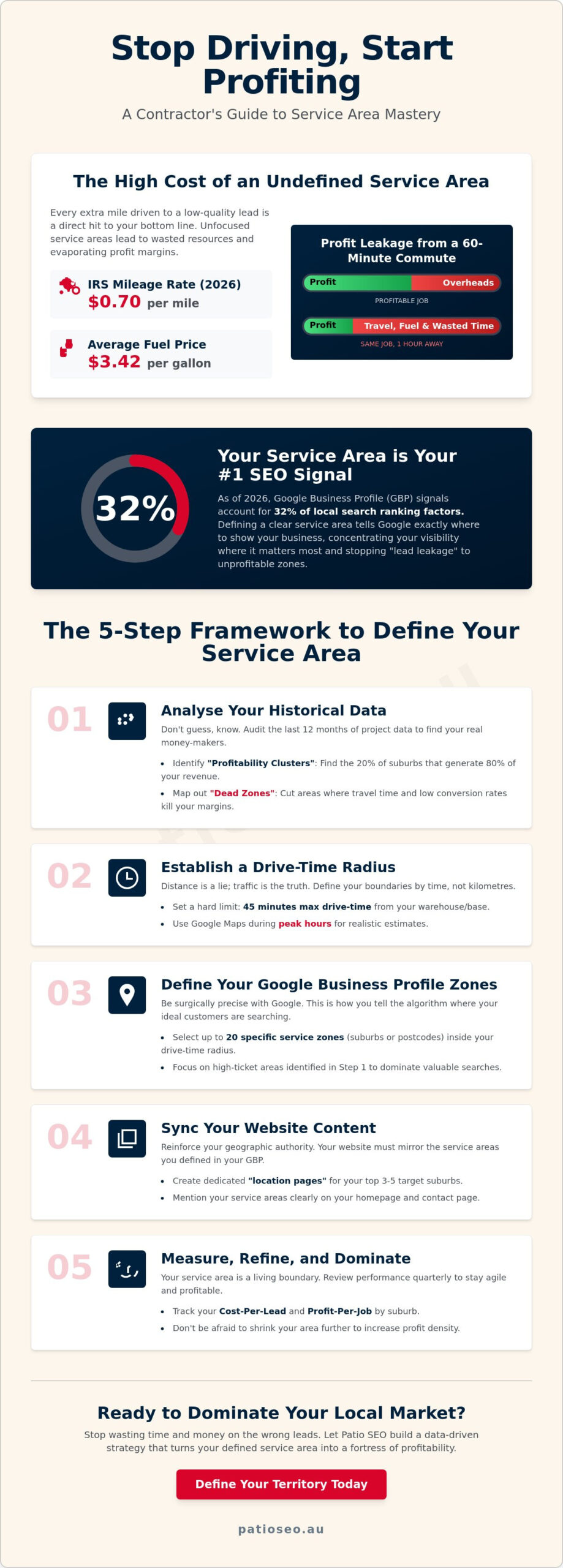
With the IRS standard business mileage rate hitting $0.70 per mile in 2026 and average gasoline prices climbing to $3.42 per gallon, every extra mile you drive to a quote isn’t just an inconvenience; it’s a direct hit to your bottom line. You likely feel the sting of spending three hours in traffic just to visit a “tyre kicker” in a suburb you never wanted to work in anyway. It’s frustrating to watch your profit margins evaporate before you even pick up a shovel. To fix this, you must learn how to strategically define contractor service area boundaries so your business works for you, not the other way around.
We’re here to help you stop the bleed. By narrowing your focus, you can slash travel overheads and ensure your marketing spend only targets high-ticket patio leads in the postcodes that actually pay. Since Google Business Profile signals now account for 32% of local ranking factors, where you draw your line on the map dictates your entire revenue trajectory. This guide provides a no-nonsense roadmap to tightening your radius, boosting visibility in wealthy suburbs, and lowering your cost-per-lead through smarter geographic targeting.
Key Takeaways
- Identify your “profitability clusters” by auditing the last 12 months of project data to see where you actually make money versus where you just drive.
- Use our 5-step framework to define contractor service area boundaries that balance warehouse proximity with lead quality.
- Sync your Google Business Profile and website content to boost local SEO rankings in the specific suburbs you value most.
- Learn why reducing your geographic footprint can paradoxically increase your total annual net profit by slashing overheads and travel time.
- Master the art of selecting up to 20 specific service zones within Google’s ecosystem to dominate high-ticket patio searches without overextending your crew.
What is a Contractor Service Area and Why Does It Matter?
A service area is more than a circle drawn on a map; it’s the geographic boundary that dictates your total profitability. When you define contractor service area parameters, you’re essentially choosing where you want to win. For patio builders, this is the bedrock of your local SEO strategy. If you don’t set these boundaries, Google won’t know which local searches are relevant to your business. This leads to “lead leakage,” where you waste marketing budget on enquiries from suburbs that are too far away to service without losing money on every job.
Google Business Profile signals account for 32% of the ranking factors for the “Local Pack” as of April 2026. This means your geographic settings aren’t just a suggestion; they are a primary instruction to Google’s AI moderators. If your profile isn’t active with new photos or updates every 30 days, your visibility in your chosen area will drop. By concentrating your efforts, you make it easier to maintain this “freshness” signal for a specific cluster of high-value suburbs rather than trying to be everywhere at once and failing.
The Difference Between a Storefront and a Service Area Business (SAB)
Most patio contractors don’t have customers walking into an office every day; you go to them. Google classifies this as a Service Area Business (SAB). If you have a physical showroom where clients can view materials, you’re a “Hybrid” business. This distinction is critical for your digital presence. SABs often hide their exact street address to prevent random walk-ins, instead specifying their reach through postcodes. Think of your service area like a Business Improvement District where resources are concentrated to maximise local returns. Getting this right ensures you appear in the “Map Pack” for the right neighbourhoods without confusing Google’s algorithm.
Impact on Your Bottom Line: Travel Time vs. Revenue
Spreading yourself too thin is a fast way to go broke. In 2026, the IRS standard business mileage rate is $0.70 per mile. Combine that with average fuel prices of $3.42 per gallon, and a 60-minute commute to a quote becomes a massive liability. It’s not just fuel; it’s the opportunity cost of your crew’s time. A quote 15 minutes away has a significantly higher ROI than one an hour away, simply because the “hidden costs” of vehicle wear and lost labour hours are lower. When you define contractor service area limits based on data rather than ego, your crew scheduling becomes tighter and your profit per job spikes. You stop being a driver who builds patios and start being a profitable contractor who owns their local market. To ensure every dollar you spend on reaching those local customers is actually working, understanding marketing ROI for contractors is the essential next step.
How to Define Your Service Area: A 5-Step Framework
Defining your territory isn’t about how far you can drive; it’s about where your business thrives. Start by writing a single sentence that defines your core service radius based on your primary warehouse or showroom. For example: “We service high-ticket patio projects within a 45-minute drive-time of our Campbelltown facility.” This clarity is the first step to ensuring your marketing spend targets the right postcodes. When you align your digital strategy with these physical boundaries, your cost-per-lead drops because you aren’t fighting for visibility in suburbs you don’t actually want to visit.
Step 1: Analyse Your Historical Project Data
Don’t guess where your money comes from. Review your project data from the last 12 months to find your “profitability clusters.” You’ll likely find that 80% of your revenue comes from 20% of your service area. Map these out. Identify the “dead zones” where travel time, fuel at $3.42 per gallon, and vehicle maintenance ate your margins. If your conversion rate for quotes in a specific suburb is below 10%, that area is a drain on your resources. It’s time to cut it loose. Focus on the suburbs where your Ideal Customer Profile (ICP) lives and where your past successes speak for themselves.
Step 2: Establish Your Drive-Time Radius
Distance is a lie. In Sydney, 30 kilometres can mean 90 minutes in traffic. In regional Queensland, that same 30 kilometres is a 20-minute breeze. This is why you must define contractor service area boundaries by drive-time, not kilometres. Use Google Maps to calculate travel times during peak hours for your crews. If a site visit takes more than 45 minutes each way, you’re losing 1.5 hours of billable labour per person, per day. Setting a hard limit protects your profit margins and prevents staff burnout. It also ensures you can respond to the 76% of people who conduct a local search on their smartphone and visit a business within 24 hours, as reported in April 2026.
Step 3: Align with Local Government Areas (LGAs)
In Australia, council boundaries matter for more than just bins. Each LGA has different permit requirements and building codes for patios. Specialising in two or three specific councils allows you to navigate the red tape faster than a competitor coming from across the city. This expertise becomes a powerful marketing advantage. You can mention specific council regulations in your local marketing strategies to build trust with homeowners. For a deeper dive into turning this geographic focus into revenue, check out our guide on Marketing for Patio Builders: The 2026 ROI-Driven Growth Template. By dominating a few LGAs, you build local authority that impersonal, nationwide agencies can’t touch.
Optimising Your Service Area for Local SEO and Google Business Profile
Once you physically define contractor service area boundaries for your crews, you must translate those limits into your digital presence. Google’s algorithm prioritises proximity above almost everything else for local map pack results. If a homeowner in Cronulla searches for “patio builder,” Google looks for the business closest to them first. Consistency between your Google Business Profile (GBP) and your website is a top-tier ranking factor in 2026. If your website claims you service the whole state but your GBP only lists three suburbs, Google sees a trust gap. This mismatch can cause your rankings to tank, leaving you invisible to the high-ticket leads you actually want.
Setting Up Your Google Business Profile Correcty
Your GBP dashboard allows you to select up to 20 specific service areas. Don’t waste these slots on tiny hamlets or “keyword stuffing” your list with every minor street name. Focus on the core cities and postcodes where you’ve found those profitability clusters. Most patio builders should operate as a Service Area Business (SAB). This means you hide your home address to protect your privacy while defining your reach through specific regions. Be careful not to set your area too wide. If you claim a 200-kilometre radius, Google often “thins” your authority. You’ll end up ranking nowhere because the algorithm assumes you aren’t truly “local” anywhere. For a deep dive into these technical settings, read about Local SEO for service area businesses to understand how Google’s AI moderators view your territory.
Creating High-Converting Service Area Pages
Winning the “Map Pack” is only half the battle. You need dedicated landing pages for every major suburb you target. A generic “Services” page won’t cut it in 2026. Each page needs to feel hyper-local. Include photos of patio projects completed in that specific suburb, reviews from local residents, and mentions of nearby landmarks. This local relevance signals to Google that you are an active, trusted member of that community. When you define contractor service area parameters on your website through these dedicated pages, you build the geographic authority Google craves. If you’re serious about dominating your local market, our guide on SEO for Patio Builders in 2026: The No-Nonsense Guide to Local Growth breaks down the exact page structure you need. Building these pages is an investment in long-term stability that pays dividends every time a local homeowner starts their search.
When to Expand (or Shrink) Your Contractor Service Area
Deciding when to adjust your boundaries is a pivot point for your business growth. Most contractors fall into the trap of thinking a larger territory equals more money, but the data often proves the opposite. When you define contractor service area limits, you are fundamentally choosing your profit margin. If your Cost Per Lead (CPL) in a distant suburb is 40% higher than in your home turf, you are essentially subsidising that customer’s patio with your own bottom line. Monitoring geographic segments allows you to see where the “easy wins” are and where you are simply burning diesel for the sake of a vanity metric.
In 2026, successful contractors use lead volume data to make these calls. If a specific council area is generating high-intent enquiries but your conversion rate is low due to travel delays, you have a choice: set up a local presence or cut the area entirely. Protecting your margins is more important than having your logo on every highway in the state. Pairing this geographic discipline with a clear understanding of your bankable marketing ROI for contractors ensures every decision you make is grounded in real revenue data, not guesswork.
The Case for Shrinking Your Radius
Shrinking your radius can paradoxically increase your annual net profit. By becoming the “hyper-local” authority in a 20-minute drive-time zone, you build a referral engine that does the heavy lifting for you. You aren’t just another contractor; you’re the specialist who built three patios on the same street. This proximity reduces crew burnout and vehicle maintenance costs significantly. If you focus exclusively on high-ticket suburbs where property values are consistently rising, your average project value increases while your travel overheads plummet. You stop paying for the $0.70 per mile IRS rate on long hauls and start investing that money back into high-end materials or better equipment. Pairing a tighter radius with a deliberate niche marketing strategy for contractors is the most effective way to stop competing on price and start winning on expertise.
Strategic Expansion: The “Satellite” Model
Expansion should only be on the cards once your core area is saturated or you’ve achieved total organic dominance in your local Map Pack. Don’t guess that the next Local Government Area (LGA) is worth the effort. Use the “Satellite” model to test the waters. We recommend testing a new region with Google Ads for Patio Builders: The 2026 Strategy for High-Ticket Leads before you commit to a long-term organic SEO campaign. This gives you immediate lead volume data. If the numbers stack up, consider hiring local sub-contractors in that region to handle the installs. This keeps your core team efficient while you capture new revenue without the 90-minute commute through peak-hour traffic.
Ready to see which postcodes are actually worth your time? Get a data-driven audit of your current service area and start targeting the suburbs that actually drive ROI.
Dominating Your Service Area with Patio SEO
Defining your boundaries is a critical first step, but a line on a map won’t pay the bills. You’ve done the hard work of calculating drive times and identifying your profitability clusters. Now, you need a strategy to own those postcodes. Many agencies treat digital marketing like a black box, but we prefer a straight-shooting approach. At Patio SEO, we specialise in mapping your specific territory to high-intent search traffic. We don’t just aim for “visibility” in a general sense; we target the exact suburbs where homeowners are ready to invest in high-end outdoor living. This ROI-driven focus ensures your marketing budget isn’t wasted on wide-net strategies that bring in leads from the other side of the city.
Owning your local market requires more than just a basic listing. It’s about cutting through the noise of impersonal, nationwide competitors who don’t understand the nuances of the Australian landscape. We help you build a digital presence that feels local because it is local. By focusing your organic visibility and backlink profiles on a concentrated geographic area, you build a level of authority that Google’s algorithm finds impossible to ignore. This isn’t about vanity metrics; it’s about sustainable growth and ensuring that every dollar spent on SEO brings you closer to a high-ticket patio contract.
Bespoke Local SEO for Outdoor Living Pros
Our process starts with building custom Service Area Pages that actually turn visitors into leads. These aren’t generic templates. We integrate local project photos, suburb-specific reviews, and geographic markers that signal your expertise to both Google and your potential clients. When you define contractor service area parameters on your site with this level of detail, your conversion rates spike. We also handle the heavy lifting of Local SEO and GBP Management. This includes ensuring your profile stays active with fresh content to meet Google’s 30-day activity requirements. For a complete look at how your site should be structured to capture these leads, see our Website Design for Patio Contractors: The 2026 Lead-Gen Blueprint.
Ready to Own Your Local Market?
Stop wasting your time and fuel on quotes that are too far away to be profitable. You didn’t get into the patio business to spend half your life sitting in traffic on the M1 or the Monash. It’s time to take control of your calendar and your bottom line. We’re ready to help you define contractor service area targets that make sense for your specific warehouse location and crew capacity. Let’s get your business in front of the right people in the right suburbs. We’re the partner that isn’t afraid to get our hands dirty with complex data to ensure your long-term stability. Book a strategy session with Patio SEO today and let’s start building a more profitable territory together.
Own Your Local Territory and Protect Your Profits
You’ve seen how a 60-minute drive-time isn’t just a commute; it’s a direct drain on your 2026 profit margins. By auditing your last 12 months of project data and aligning your website landing pages with your Google Business Profile, you stop “lead leakage” and start winning in the suburbs that actually pay. Decisions to define contractor service area boundaries shouldn’t be based on guesswork. They should be based on the $0.70 per mile IRS rate and your crew’s actual billable hours. Focus on your profitability clusters and let the hard data dictate your map.
Patio SEO is built specifically for the outdoor living niche. We don’t hide behind “black box” marketing jargon or vanity metrics. Instead, we provide transparent reporting and proven ROI-driven strategies for Australian tradies who want to dominate their local market. It’s time to stop driving for free and start building a more sustainable business model through smarter geographic targeting. The most effective way to complement this geographic discipline is to embrace niche marketing for contractors, which ensures you attract clients who value quality over the cheapest quote.
Get a Free Local SEO Audit for Your Patio Business and discover exactly where your next high-ticket lead is waiting. Let’s get to work.
Frequently Asked Questions
How many service areas can I list on my Google Business Profile?
Google allows you to list a maximum of 20 service areas on a single profile. These can be defined by city names, postcodes, or broader regions. While it’s tempting to use all 20 slots, filling them with distant locations can thin your geographic authority; it’s usually more effective to select 10 core areas where your historical project data shows the highest profit margins.
Should I list every suburb I might go to, or just the main ones?
Stick to your primary “profitability clusters” to ensure you attract high-quality leads. Listing every tiny suburb attracts “tyre kickers” from areas that aren’t worth the $0.70 per mile travel cost. Focus your Google Business Profile on the top 10 to 15 suburbs where you’ve successfully built patios before, as this helps Google’s AI summaries accurately represent your business to the right homeowners.
Will shrinking my service area hurt my overall SEO rankings?
No, narrowing your focus actually improves your local search relevance. When you define contractor service area boundaries more tightly, you signal to Google that you’re the go-to specialist for those specific postcodes. This geographic concentration often leads to a higher ranking in the “Map Pack” for your most valuable suburbs because Google prioritises proximity and local prominence over broad, thin coverage.
How do I handle leads that come from just outside my defined area?
Qualify these leads based on project value before you commit to a site visit. If a project is 15 minutes outside your zone but carries a high-ticket price tag, it’s worth the drive. For smaller maintenance or repair jobs, you should implement transparent, zone-based pricing to cover fuel costs and the lost labour hours spent in transit between quotes.
What is the best way to prove to Google that I serve a specific suburb?
Regularly uploading geo-tagged photos of completed patio projects in that suburb is the most effective method. You should also encourage customers from those specific areas to leave reviews. Since Google blocked 292 million policy-violating reviews in 2025, they value authentic, location-based activity more than ever. This real-world data proves your presence to Google’s Gemini-powered moderation tools.
Can I have multiple Google Business Profiles for different service areas?
You can only have multiple profiles if you have a staffed, physical office at each location. Creating “ghost” listings for different suburbs is a violation of Google’s Maps User Generated Content Policy and can lead to a permanent suspension. If you don’t have a second warehouse, focus on building high-converting service area pages on your main website instead of risking your primary profile.
How often should I review and update my contractor service area?
Review your geographic performance every six months to stay ahead of rising overheads. If fuel prices jump another 4.2% like they did in early 2026, your current outer-limit jobs might no longer be profitable. Use your actual lead conversion data and the latest IRS mileage rates to decide if you need to pull back your radius or expand into a new, higher-value suburb.
Does my service area affect my Google Ads cost-per-click?
Yes, your geographic settings directly influence your ad competition and Quality Score. Targeting wealthy, high-demand suburbs usually results in a higher cost-per-click due to increased competition from other builders. By narrowing your Google Ads to only your most profitable zones, you improve your ad’s relevance to the searcher, which can lower your overall cost-per-lead and improve your ROI.