

Throwing money at generic lead-gen platforms in 2026 is the fastest way to set your hard-earned margins on fire. You’ve likely felt the sting of paying for “exclusive” leads only to find out five other builders are chasing the same tyre-kicker who just wants the lowest price. It’s exhausting to watch your bank balance dip while your calendar lacks the high-ticket deck and patio projects you actually want to build. Deciding how much to spend on marketing for a small construction business shouldn’t feel like a high-stakes gamble at the casino.
We agree that your marketing should be a predictable investment, not a recurring headache. This guide provides a no-nonsense framework to calculate a budget that secures high-margin leads while protecting your bottom line. Since research from industry analysts shows that 72% of Australian homeowners now vet outdoor construction companies online before making a single phone call, we’ll show you how to strategically split your A$ spend between SEO and Google Ads. You’re about to learn how to track every dollar and build a marketing engine that scales alongside your crew without the usual guesswork.
Key Takeaways
- Stop relying on generic benchmarks and learn why the standard 7-8% SBA recommendation often fails Australian contractors in the current market.
- Discover exactly how much to spend on marketing for a small construction business using a “no-nonsense” 3-step framework tied to your A$ revenue goals.
- Master the three core pillars of spend-Search, Conversion, and Awareness-to ensure every dollar targets high-ticket patio and deck leads.
- Identify and plug the “invisible leaks” in your budget that cause most small trade businesses to waste margins on low-quality, tyre-kicking leads.
- Learn how to transition from vanity metrics to an ROI-driven strategy that cuts through industry noise and secures long-term business stability.
The 2026 Baseline: What Australian Construction Businesses Actually Spend
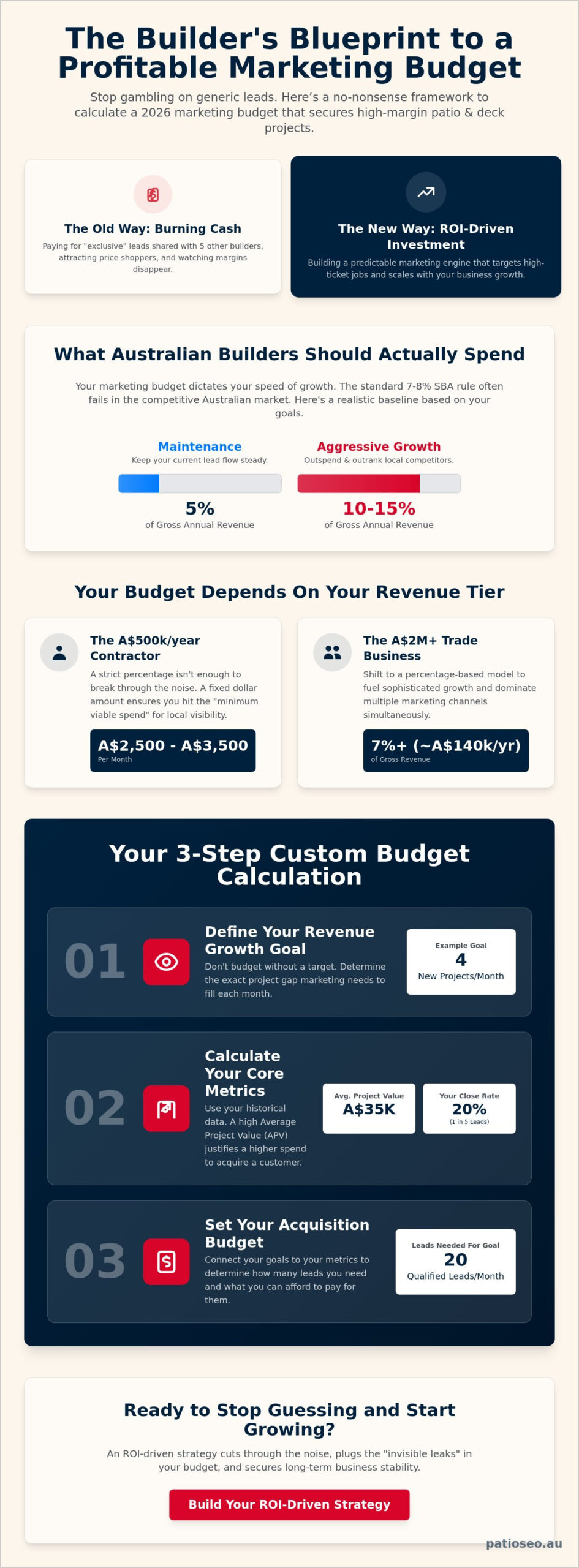
Marketing isn’t a luxury or a “business cost” to be cut when things get quiet. For a sustainable trade business, your marketing budget is a strategic investment calculated as a percentage of your gross annual revenue. In the current 2026 landscape, most Australian contractors fall into two camps. They either spend too little and wonder why the phone isn’t ringing, or they throw money at “black box” agencies without a clear ROI target. To get this right, you need to understand that your budget dictates your speed of growth. A 5% allocation is your “Maintenance” baseline, designed to keep your current lead flow steady. If you want to scale, an “Aggressive Growth” budget of 10-15% is required to outspend and outrank local competitors.
The SBA Rule vs. the Australian Reality
The U.S. Small Business Administration (SBA) often cites a 7-8% benchmark for small businesses. While it’s a decent starting point, it’s not a law of nature, and it often fails small Aussie contractors. This figure doesn’t account for the unique pressure of the Australian market, including 10% GST and the high cost-per-click in competitive hubs like Brisbane or Melbourne. You need a comprehensive marketing plan that factors in these local variables rather than relying on international generalities. Market share in your local area is the specific percentage of total search traffic and lead volume your business captures compared to every other contractor in your suburb.
Revenue-Based Benchmarks: Where Do You Fit?
Deciding how much to spend on marketing for a small construction business requires looking at your current revenue tier. The strategy for a solo operator is worlds apart from a multi-crew outfit.
- The A$500k/year Contractor: At this level, a strict 5% percentage (A$25,000) often isn’t enough to break through the noise. A fixed dollar amount, typically between A$2,500 and A$3,500 per month, is usually more effective to ensure you hit the “minimum viable spend” for local SEO visibility.
- The A$2M+ Patio or Trade Business: Once you cross the A$2 million mark, shifting to a percentage-based model provides the fuel needed for sophisticated growth. A 7% allocation (A$140,000) allows you to dominate multiple channels simultaneously.
Your specific suburb’s market maturity also dictates your spend. If you’re a builder in a high-growth corridor in South East Queensland, your minimum viable spend will be higher than a contractor in a regional town with zero digital competition. We call this “Bespoke Budgeting.” It’s about ignoring industry averages and looking at the raw data of what it costs to win a customer in your specific postcode. Don’t guess your numbers when your competitors are using data to take your leads.
The 3-Step Framework to Calculate Your Custom Marketing Budget
Marketing shouldn’t be a “black box” where you throw money in and hope for the best. At Patio SEO, we use a no-nonsense calculation framework to strip away the mystery. Deciding how much to spend on marketing for a small construction business shouldn’t rely on gut feel or what your competitor is doing. It must be a deliberate calculation tied directly to your specific revenue targets and historical data. Transparency is the foundation here; when you see the numbers, you understand exactly how your investment converts into signed contracts.
Step 1: Define Your Revenue Growth Goals
You can’t build a budget without a target. Start by identifying how many new patio or deck projects you need each month to hit your growth milestones. Most established builders get a baseline of work from word-of-mouth. If your current capacity is six projects a month but referrals only bring in two, marketing must fill that four-project gap. Your “North Star” metric should always be total profit rather than just top-line revenue. High-volume, low-margin work often costs more in overhead than it’s worth.
Step 2: Calculate Your Average Project Value (APV)
Your historical data is your most valuable asset. A business specializing in A$35,000 custom deck builds requires a different lead acquisition strategy than a handyman doing A$1,500 repairs. You also need to factor in your close rate. If you close one out of every five leads, you need to buy five leads to secure one job. The relationship between APV and Customer Acquisition Cost (CAC) is simple; higher project values allow for a larger marketing spend per lead while maintaining healthy margins. This clarity helps you build a sustainable growth engine that doesn’t eat your profits.
Step 3: Factor in Your Local Service Area
Geography dictates your costs. Dominating a 20km radius in a suburban area costs significantly less than trying to rank for “deck builder” across the entire Melbourne CBD or Scarborough. High competition in these metropolitan hubs drives up your Cost Per Click (CPC) on paid platforms. You also need to adjust for the Australian climate. While Queenslanders might build year-round, Victorian builders often see a 30% dip in search volume during the colder months. A smart budget accounts for these seasonal fluctuations, allowing you to push harder when the sun is out and maintain visibility when the weather cools down.
Allocating the Spend: Where the Money Actually Goes
Marketing isn’t a cost; it’s an investment in your pipeline. To get it right, you need a disciplined framework that prevents waste. Most successful Australian contractors follow the 70/20/10 rule. You put 70% of your budget into proven channels like Google, 20% into scaling growth areas, and 10% into testing new ideas. This keeps your lead flow stable while ensuring you don’t get left behind. When deciding how much to spend on marketing for a small construction business, you must split your A$ into three specific pillars: Search, Conversion, and Awareness.
- Search (The Pull): Capturing people actively looking for a builder right now.
- Conversion (The Engine): Turning that interest into a booked site visit.
- Awareness (The Push): Staying top-of-mind for homeowners who aren’t ready to build yet but will be in six months.
Focusing on the “Action-Benefit” of every dollar spent ensures you stay focused on ROI. If an activity doesn’t have a direct line to a lead or a sale, it shouldn’t be in your 70% proven bucket.
High-Intent Search: SEO & Google Ads
Google is the Yellow Pages of 2026. If a homeowner in Sydney or Brisbane wants a new deck, they search for it. High-intent search captures people at the exact moment they are ready to buy. A strategic mix of Google Ads for patio builders provides immediate traction, allowing you to “buy” your way to the top of page one while your organic presence builds.
The long-term ROI comes from SEO for patio builders and Google Business Profile management. Dominating “near me” searches is essential because these prospects are often the most qualified. Local SEO builds a digital asset that works 24/7 without a daily ad spend, providing a sustainable foundation for your business growth.
The Conversion Engine: Website & CRO
Your website is your virtual showroom. A “cheap” website is the most expensive mistake a contractor can make because it burns the traffic you paid for. If your site looks dated or loads slowly, potential clients will bounce to a competitor within three seconds. You must allocate budget for professional project photography and video walkthroughs. High-quality visuals prove your craftsmanship and build trust before you even pick up the phone.
Conversion Rate Optimisation (CRO) is the final piece of the puzzle. By refining your contact forms, adding clear calls-to-action, and showcasing social proof, you lower your cost per lead. When figuring out how much to spend on marketing for a small construction business, remember that doubling your website’s conversion rate has the same impact as doubling your ad budget, but it costs significantly less in the long run.
Hidden Costs: Why a 5% Budget Often Fails Contractors
Most builders approach us with the same frustration: “I spent money on marketing and it didn’t work.” Usually, the failure isn’t the amount of money spent, but a failure to account for hidden leaks in the business model. When you are calculating how much to spend on marketing for a small construction business, a flat 5% of revenue often ignores the reality of technical debt. If your website was built in 2016, your ad spend is effectively subsidising your competitors because your site cannot convert the traffic you are buying. Sending paid traffic to an outdated website is like trying to fill a bucket with a hole in the bottom. You pay for the water, but none of it stays.
Content production, specifically detailed case studies and project breakdowns, should be viewed as a capital investment rather than a monthly expense. These assets live on your site forever. They build trust and SEO authority long after a specific ad campaign ends. A straight-shooting assessment of your digital foundation is the first step to ensuring your budget actually returns a profit. You cannot build a modern, high-growth business on a broken digital foundation.
The Cost of Quoting Bad Leads
The “Invisible Leak” in most Australian construction businesses is the time spent on low-quality enquiries. Chasing every lead is a recipe for burnout and thin margins. A higher marketing spend directed at “qualification” rather than just “volume” can save you 10 hours a week in the ute. By budgeting for CRM tools or automated lead filtering, you stop acting as a free estimating service for tyre-kickers. Opportunity Cost is the revenue lost from a A$250,000 project because you were too busy quoting five A$5,000 jobs that were never going to happen. If your marketing doesn’t filter out the budget-shoppers before they call you, it’s failing its primary job.
Photography and Social Proof
Grainy, poorly lit iPhone photos are costing you A$50,000 projects. In the Australian market, high-end residential and commercial clients expect a polished portfolio before they even pick up the phone. You must budget for professional photography for every major project completion. These high-quality visuals do more than look good; they are a core component of technical SEO. Large, unoptimised files from a phone slow down your site, while professional imagery improves page speed and user experience.
High-quality visuals also have a massive impact on your Google Ads performance. Professional photos increase click-through rates by up to 45% because people buy with their eyes. Google rewards sites that keep users engaged, and nothing keeps a homeowner on a page longer than a high-resolution gallery of a recent renovation. Investing in professional assets ensures your brand matches the quality of your craftsmanship and keeps your digital presence competitive.
Scaling Your Business with an ROI-Driven Partner
Deciding how much to spend on marketing for a small construction business is only half the battle. The other half is ensuring every A$1 invested returns a measurable profit. Generalist agencies often fail because they don’t understand the specific nuances of the outdoor living sector. They treat a deck or patio build like a simple retail product, ignoring the long sales cycles and high-ticket nature of Australian construction projects. This lack of industry knowledge leads to wasted budgets and low-quality leads that never convert into actual jobs.
Patio SEO cuts through the noise of the marketing industry. We don’t hide behind a “black box” of technical jargon or confusing spreadsheets. Instead, we provide a “No-BS” monthly reporting structure that focuses on lead quality and conversion rates. You’ll see exactly where your money goes and how it impacts your bottom line. We prioritize revenue over vanity metrics like impressions or clicks that don’t result in signed contracts. Our goal is to make your marketing spend the most profitable part of your business operations.
The Niche Advantage: Why Specialisation Matters
We understand patio leads better than a generalist agency in Sydney because we live and breathe this industry. There is a massive difference between a homeowner looking for a basic timber pergola and one researching a high-end, motorised louvered roof system. Our team knows these differences. This allows us to target high-intent customers who are ready to build today. This specialisation ensures your budget isn’t wasted on “tire-kickers” who aren’t a fit for your services. We focus on sustainable, long-term growth that builds your brand’s organic visibility across the Australian market, providing a stable foundation that doesn’t rely on expensive, temporary ad spikes.
Your Next Steps to a 2026 Growth Plan
Transitioning from a word-of-mouth referral model to a predictable lead machine requires a shift in mindset. When you stop wondering how much to spend on marketing for a small construction business and start viewing it as a scalable asset, your growth potential changes. During the first 90 days of a professional strategy, we audit your current digital footprint and fix the technical leaks in your sales funnel. Expect a focus on data-backed adjustments that stabilise your lead flow and improve lead quality. By the end of this period, your marketing will feel less like an overhead and more like a reliable engine for new business.
Are you ready to stop guessing and start growing? We invite you to a free strategy session to audit your current marketing spend and build a bespoke plan for your business. We’ll show you exactly how to reach your 2026 revenue goals with a transparent, ROI-driven approach that delivers real results for Australian builders.
Build a High-Performance Marketing Engine for 2026
Marketing isn’t an overhead expense; it’s the fuel for your job site. By 2026, relying on outdated 5% budget rules will likely leave you behind competitors who use a data-driven framework to capture the Australian outdoor living market. You’ve seen the baseline numbers and the hidden costs that sink generic campaigns. Success now depends on precise allocation and tracking every A$ spent against actual revenue generated.
Deciding how much to spend on marketing for a small construction business shouldn’t feel like a gamble. At Patio SEO, we cut through the noise with transparent reporting and a specialized focus on the patio and outdoor living niche. We’re a results-heavy Australian agency that treats your growth as our own, ditching “black box” metrics for clear, ROI-focused strategies that put more boots on the ground.
Stop leaving your lead flow to chance. Get a No-Nonsense Marketing Audit for Your Patio Business today. Let’s build a strategy that works as hard as your crew does.
Frequently Asked Questions
Is 5% of revenue really enough for a new construction business?
No, 5% is usually too low for a new business trying to gain market share. If you’re asking how much to spend on marketing for a small construction business that’s just starting, aim for 12% to 20% of your target revenue. This higher initial investment builds the foundation your brand needs to compete with established local builders. Once you’ve secured a steady stream of leads, you can scale back to a maintenance level of 5% to 10%.
Should I spend more on SEO or Google Ads starting out?
You should split your budget, but prioritize Google Ads if you need leads immediately. Ads provide instant visibility on the search results page, while SEO is a long-term play that takes 6 to 12 months to mature. A 70/30 split in favour of Ads works well for the first 90 days. This strategy generates cash flow from quick wins while your organic presence builds strength in the background.
How long does it take to see a return on my marketing investment?
Expect to see initial lead activity from paid ads within 48 hours, but a true return on investment usually takes 3 to 6 months to stabilize. Construction has a longer sales cycle, often lasting 30 to 90 days from the first click to a signed contract. You need to track your data over two full sales cycles to accurately measure if your marketing spend is converting into profitable projects.
Do I need to budget for social media management as a patio builder?
You don’t need a high-priced agency for daily social posts, but you must budget for high-quality project photography. In the Australian patio industry, 80% of customers want to see finished local work before they call. Spend your money on a professional photographer once a month instead of paying for generic social media management. Post those real photos yourself to show off your craftsmanship and build genuine trust with locals.
What is a “good” cost per lead for a deck or patio project in Australia?
A healthy cost per lead for Australian patio builders typically ranges between A$50 and A$150 depending on your location. If you’re in a competitive metro area like Sydney or Brisbane, expect to be at the higher end of that scale. Focus on your lead-to-sale conversion rate rather than just the cost per lead. A A$150 lead that turns into a A$30,000 project is far better than five A$30 leads that never pick up the phone.
Can I do my own marketing to save money while I am small?
You can handle basic social media and Google Business Profile updates, but professional help is vital for technical SEO and paid ad management. Many owners wonder how much to spend on marketing for a small construction business when doing it themselves; the answer is usually your time. If you’re spending 10 hours a week on bad ads instead of on-site building, you’re losing money. Outsource the technical tasks so you can focus on quoting.
How do I know if my current marketing agency is wasting my budget?
Your agency is wasting money if they can’t show you a direct link between spend and signed contracts. Demand a report that shows cost per lead and total leads rather than vanity metrics like impressions or clicks. If they hide behind jargon or won’t give you access to your own Google Ads account, they’re likely underperforming. Transparency is the only way to ensure your marketing budget actually grows your bottom line.