

If your building company isn’t appearing in the top three results on Google Maps, you’re effectively invisible to the 46% of local searches that carry specific local intent according to recent industry benchmarks. It’s a common frustration to watch competitors with half your experience secure high-ticket renovations in your local suburb simply because they’ve nailed their digital presence. You’ve worked hard to build a reputation on-site, but that reputation won’t pay the bills if your phone isn’t ringing.
You’ve likely wondered how to get my building company on google maps without wasting hours on technical busywork or getting bogged down in “service area” versus physical address confusion. This guide provides a no-nonsense, step-by-step process to claim your spot and outrank local competitors for the projects that actually impact your bottom line. We’ll start by fixing your profile’s foundation and then move into the tactical shifts required to dominate the local search 3-pack throughout 2026.
Key Takeaways
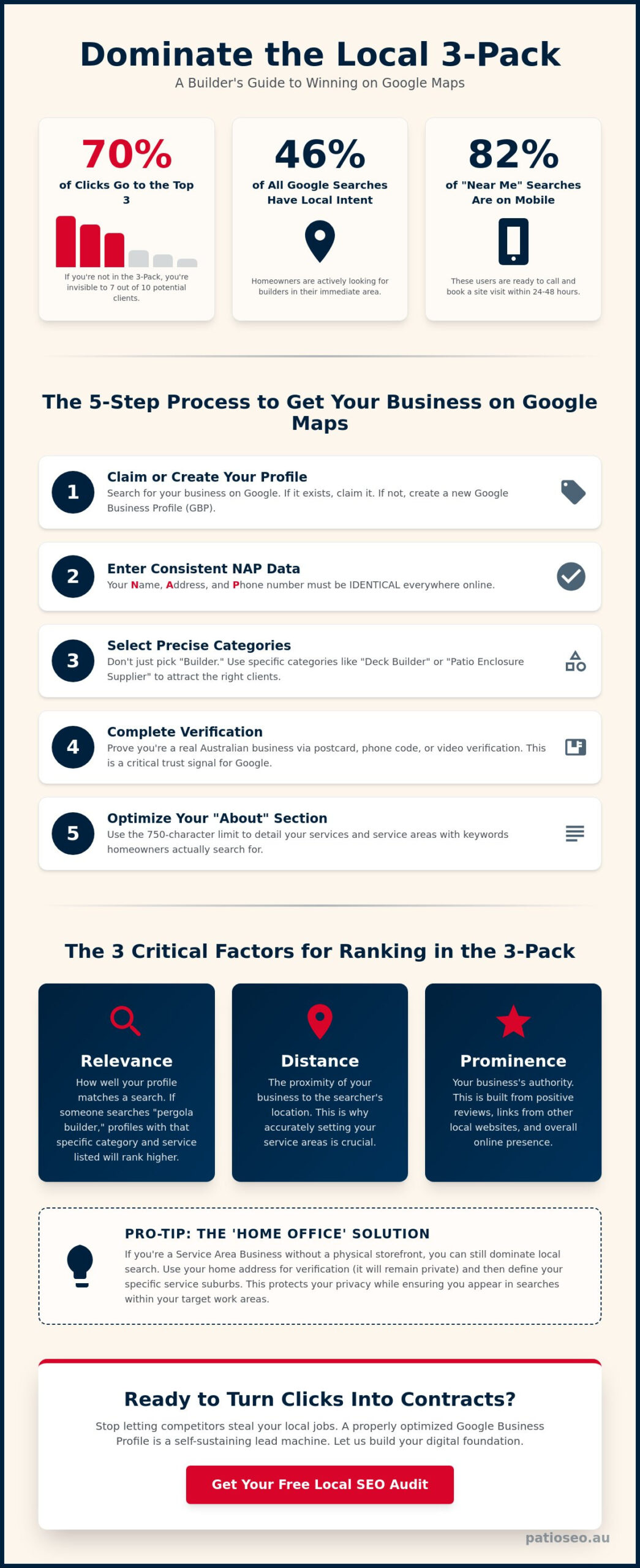
- Understand why the Local 3-Pack is the new “Yellow Pages” for Australian builders, capturing 70% of clicks for high-ticket residential searches.
- Follow a proven 5-step process to get my building company on google maps and ensure your firm’s data is primed for maximum visibility.
- Learn the “Home Office” workaround to protect your privacy while still dominating local search results as a legitimate Service Area Business.
- Identify the three critical ranking factors-Relevance, Distance, and Prominence-to consistently outrank local competitors for “near me” searches.
- Scale your presence into a self-sustaining lead machine by aligning your website’s service area pages with strategic Google Business updates.
Why Google Maps is the #1 Lead Source for Australian Builders in 2026
The phone book is dead. In 2026, over 90% of Australian homeowners start their renovation journey with a local search. When a prospect types “builders near me” into their smartphone, they aren’t looking for a generic directory. They’re looking for immediate proof of quality and proximity. If you’ve been trying to get my building company on google maps, it’s because you’ve realised that this is where high-intent traffic lives. The Google Maps platform has evolved into a high-conversion engine that does far more than show directions. It filters for reputation and reliability in seconds.
The “Local 3-Pack” is the primary gateway to your business. This refers to the top three map results that appear at the very top of the search engine results page. Industry data shows these three spots capture roughly 70% of all clicks. If your building company isn’t in that bracket, you’re invisible to 7 out of 10 potential clients. This isn’t just about traffic; it’s about capturing leads when their intent is at its peak. Mobile discovery has accelerated this shift. Recent data indicates that 82% of “near me” searches for trade services happen on a mobile device. These users aren’t just browsing. They’re often ready to book a site visit within 24 to 48 hours.
The ROI of Local Map Visibility
Traditional print ads in local papers can cost anywhere from A$500 to A$2,500 per month with zero guarantee of engagement. In contrast, a dominant map presence delivers a significantly lower cost-per-lead because you only appear when someone is actively searching for your specific trade. For high-ticket projects like custom patios or decks, this visibility shortens the sales cycle. Seeing your business repeatedly creates a “Billboard Effect.” Even if they don’t click today, your brand becomes the familiar, safe choice when they’re finally ready to sign a contract.
Winning the Trust of Local Homeowners
A verified Google Business Profile (GBP) acts as a digital badge of legitimacy. Homeowners feel a psychological sense of security when they see your project photos pinned to a physical location in their own suburb. Proximity builds immediate rapport. A client in a specific council area wants to see that you’ve successfully completed builds nearby. When you get my building company on google maps, you provide immediate social proof through reviews and local context. Your star rating carries more weight than any marketing slogan. It transforms your business from a random contractor into a trusted local expert that the community has already vetted.
The 5-Step Process to Get Your Building Company on Google Maps
Setting up a Google Business Profile (GBP) isn’t just about ticking a box; it’s about claiming your digital real estate. If you want to get my building company on google maps, you need to follow a precise sequence to avoid being flagged or buried in the search results. Start by visiting Google’s official guide to initiate your claim or create a new listing from scratch. This foundation determines whether you show up when a local homeowner searches for your services.
- Step 1: Claim or Create. Search for your business name on Google. If it exists, claim it. If not, create a new profile using a dedicated business email.
- Step 2: Enter NAP Data. Your Name, Address, and Phone number must be identical across your website, social media, and GBP.
- Step 3: Select Categories. This is critical for visibility. Don’t just pick “Builder” if you specialise. Precise categories like “Patio Enclosure Supplier” or “Deck Builder” narrow the competition.
- Step 4: Verification. Google must prove you’re a real Australian business. This usually involves a postcard, phone code, or video walkthrough.
- Step 5: Optimise the ‘About’ Section. Use the 750-character limit to describe your specific services and service areas using high-intent keywords.
Setting Up Your Profile for Success
Your business name must match your legal ASIC registration exactly. Google’s 2023 algorithm updates are aggressive against keyword stuffing; adding “Best Deck Builders Sydney” to your name when it’s not your legal entity is a fast track to suspension. Choosing the right primary category defines 80% of your search relevance. If you build pergolas but select “General Contractor,” you’ll lose leads to more specific competitors. Always use a local Australian landline or mobile number. A local 02, 03, or 07 prefix builds more trust and local signals than a generic 1300 number.
The Verification Hurdle: Tips for Tradies
Verification is where many building firms stall. If you’re on a job site in Scarborough, video verification is your best option. You’ll need to show your branded ute, your tools, and your current project site to prove you’re an active contractor. If your verification postcard hasn’t arrived at your Melbourne office after 14 days, don’t wait. Request a new one or contact support immediately. Ensure your website is fully functional and professional before starting this process. Google’s manual reviewers often check your site to see if your physical address and services align with your profile claims. If this technical setup feels like a distraction from your actual building work, we can help you dominate the local map pack with a proven, data-led strategy.
Physical Address vs. Service Area: The ‘Home Office’ Solution for Builders
The biggest mistake I see Australian builders make is listing their private residence as a public business location. You want high-value leads, not a surprise visit from a subcontractor at your front door during dinner. If you operate from home, Google provides a specific setting called a Service Area Business (SAB). This allows you to verify your business at your residential address while keeping that specific street number hidden from the public. You maintain the map visibility without the privacy breach.
When you look to get my building company on google maps, you must define where your utes actually go. A common trap is selecting a massive radius, such as “All of Queensland” or “New South Wales.” This dilutes your local authority. Google rewards relevance and local density. If you’re a custom home builder based in Geelong, trying to rank for searches in Northcote is a waste of digital energy. Stick to the postcodes where you actually have active sites.
- Hide the house: Toggle the “No” option when Google asks if you have a location customers can visit.
- Verify anyway: You still need to receive a verification code at your home address to prove your business is legitimate.
- Stay realistic: Keep your service radius within a 50-kilometre limit to maintain ranking strength.
Optimising Your Service Area
Select specific suburbs or postcodes rather than broad regions. If you have teams in both Brisbane and the Gold Coast, you can list multiple service areas in your profile. Don’t overreach. Data indicates that local pack visibility drops significantly when a builder claims a service area more than 45 kilometres from their home base without a secondary office. Focus on the 15 suburbs that drive your highest profit margins. This precision helps you get my building company on google maps for the right audience.
The Proximity Paradox
Google prioritises the “Proximity” factor above almost everything else. This means a homeowner in Paddington will see builders located in or near Paddington first. It’s a paradox because your best projects might be two hours away, yet Google thinks you’re less relevant to that distant lead. Proximity accounts for approximately 25% of the local pack ranking weight according to the 2023 Whitespark Local Search Ranking Factors report. To counter this, use project-specific signals. Mentioning a recent $750,000 renovation in a specific suburb on your profile helps signal your reach to the algorithm. You can’t move your house, but you can prove your local activity through consistent updates and reviews from those target postcodes.
Winning the Local 3-Pack: How to Outrank Other Building Companies
Securing a spot in the top three results on Google Maps isn’t about luck; it’s about mastering three specific pillars: Relevance, Distance, and Prominence. Relevance measures how well your listing matches a searcher’s intent. Distance is the physical gap between your office and the user. Prominence is your digital authority. If you want to get my building company on google maps and keep it there, you must dominate the prominence factor through consistent local citations.
Google looks for your NAP (Name, Address, Phone number) across the web to verify you’re a legitimate local operation. Inconsistencies act like red flags. You need your details to be identical on TrueLocal, Yellow Pages, and HiPages. A 2023 industry study showed that businesses with consistent citations across 30+ directories saw a 16% lift in map rankings within six months. Accuracy builds trust with the algorithm.
Review velocity is another critical metric. A sudden surge of 50 reviews followed by months of silence looks like spam. Google rewards “freshness.” Aim for a steady flow of two to three reviews every week rather than a one-time blast. This consistent activity signals that your building company is active, reliable, and currently completing projects in the local area.
The Power of Project Photos
“Before and After” shots are your highest-converting assets. They provide visual proof of your craftsmanship and keep users on your listing longer, which boosts your ranking. High-quality images of a completed deck in Cronulla or a patio renovation in Glen Waverley tell a story of competence that text cannot match. You should explain the technical process of geo-tagging your project photos to embed GPS coordinates into the image metadata, which signals to Google exactly where your work was performed. Don’t do all the heavy lifting yourself. Encourage your clients to upload their own photos when they leave a review. User-generated content carries 2.4 times more weight with potential customers than brand-created imagery.
Managing Your Digital Reputation
Reputation management requires a no-nonsense framework: acknowledge, address, and action. Respond to every single review within 24 hours. For positive feedback, thank the client and mention the specific service. For negative reviews, stay professional, offer to move the conversation offline, and never get defensive. This transparency builds massive trust with 97% of consumers who read business responses. You can naturally boost your SEO by using keywords in your replies. Instead of saying “Thanks for the review,” try “Thanks for choosing us for your custom patio build in Sydney.” This reinforces your service area and specialty without looking like a bot. To make this work, set up a system to ask for the review the moment the final nail is driven. Most builders wait too long; the best time to ask is when the client is standing on their brand-new deck for the first time.
Ready to dominate your local market and stop losing jobs to the competition? Let’s optimise your building company’s digital presence for maximum ROI.
Scaling Your Map Presence into a Consistent Lead Machine
Claiming your profile is just the starting line. To truly get my building company on google maps as a dominant local force, you need to treat your Google Business Profile (GBP) as a living asset. Static profiles get buried by competitors who stay active. Use Google Business Posts to showcase your latest projects. A quick photo of a completed timber deck or a 15-second clip of a frame going up keeps your profile fresh. Aim for at least one update per week. Mentioning seasonal offers, such as “Pre-Summer Pergola Inspections” in September, helps capture demand before the peak season hits.
Your website plays a silent but critical role in how Google ranks your map pin. Your ‘Contact’ and ‘Service Area’ pages must be clear and consistent. If you serve the Gold Coast but your website only mentions Brisbane, you’ll struggle to appear in local searches for Surfers Paradise. Ensure your Name, Address, and Phone number (NAP) match your GBP exactly. This consistency builds the trust Google needs to push you into the top three results.
Tracking your progress is the only way to ensure ROI. Stop looking at “Views” and start looking at “Actions” in your GBP Insights. These are the metrics that matter:
- Calls: Direct leads from people clicking the “Call” button.
- Directions: Potential clients checking how far you are from their site.
- Website Clicks: High-intent traffic moving from your map pin to your landing pages.
If your direction requests are high but calls are low, your phone number might be hard to find or your office hours might be listed incorrectly. Professional management becomes necessary when you’re too busy on-site to respond to reviews or update your project gallery. Transitioning from DIY to pro management usually happens when a builder wants to scale from 2 organic leads a month to 20.
Integrating Maps with Your Broader SEO Strategy
Your map listing doesn’t exist in a vacuum. Effective SEO for patio builders ensures your entire digital footprint supports your map visibility. We link your profile to high-converting landing pages designed specifically for the Australian building industry. If you need immediate results, Google Ads for patio builders allows you to jump the queue. By using Local Services Ads (LSAs), you can appear above the standard map results with a “Google Guaranteed” badge, which significantly increases trust with homeowners.
The Patio SEO Advantage for Builders
Generic marketing agencies often fail because they don’t understand the nuance of the outdoor living niche. They treat a patio builder like a plumber or a florist. We don’t. Our “Straight-Shooting” approach focuses on transparent ROI for Australian contractors. We provide data you can actually use to grow your business, not just fancy charts. We’ve seen builders increase their lead volume by 45% within the first 90 days of a focused local strategy. Ready to dominate your local area? Get a free GMB audit from Patio SEO today.
Secure Your Lead Pipeline for 2026
A high-ranking Google Maps presence is the difference between a full project pipeline and a quiet yard. Recent industry data indicates that the Local 3-Pack captures over 44% of total clicks for building services in Australia. You now have the roadmap to verify your profile and the specific service area strategies needed to protect your privacy while staying visible. Taking the intentional step to get my building company on google maps isn’t just a technical task; it’s a direct investment in your company’s long-term stability.
Stop letting local competitors take the projects that should be yours. We specialise in the outdoor living niche, delivering proven ROI-driven strategies for Australian builders without the typical marketing fluff. You’ll receive no-nonsense, transparent reporting that tracks real project enquiries, not just vanity metrics. Scale your building company with Patio SEO’s local growth experts and start turning local searches into signed contracts today. Your future growth starts with a single pin on the map.
Frequently Asked Questions
Can I get on Google Maps if I don’t have a physical office or showroom?
Yes, you can register as a Service Area Business (SAB) to hide your residential address while still appearing in local searches. This setup allows you to define service boundaries by listing up to 20 specific suburbs or a 50km radius around your base. It’s a standard practice for Australian builders who work on-site rather than in a showroom. You’ll still get all the benefits of local visibility without needing a commercial shopfront.
How long does it take for my building company to show up on Google Maps?
Expect your profile to go live within 3 to 7 business days after successful verification. The verification process itself usually involves a physical postcard sent to your address, which takes about 14 days to arrive via Australia Post. Once you enter the code, your listing starts appearing in local searches. If you’re looking to get my building company on google maps quickly, ensure your data is 100% accurate before requesting the code.
What should I do if a competitor is using a fake address to rank near me?
Report the fraudulent listing through the “Suggest an edit” feature on Google Maps or submit a formal Business Redressal Complaint. Google’s spam team investigates these reports to maintain map integrity. Provide clear evidence, such as photos showing the address is a residential home or a vacant lot. Cleaning up local spam can increase your own visibility by removing illegitimate competition from the top three results.
Is it free to list my building business on Google Maps?
Creating and maintaining a Google Business Profile costs A$0 in platform fees. It’s a free tool provided by Google to help local businesses connect with customers. While the listing itself is free, many builders choose to invest in professional SEO services to ensure they outrank competitors. This investment focuses on optimising your profile to capture a larger share of the local market and drive more enquiries.
How many photos should I upload to my Google Business Profile?
Start with a minimum of 20 high-resolution photos of your completed projects and team. Data from BrightLocal shows that profiles with more than 100 images receive 520% more phone calls than the average listing. Upload 3 to 5 new project photos every month to keep your profile active. This consistency signals to Google that your business is operational and provides proof of your craftsmanship to potential clients.
What is the best primary category for a patio and deck building company?
Select “Deck builder” as your primary category if that is your main revenue driver. You should then add “Patio enclosure supplier” or “Paving contractor” as secondary categories to capture broader searches. Choosing the right primary category is vital because 84% of profile views come from discovery searches. This means customers are looking for the service first, rather than your specific brand name.
How do I get more 5-star reviews from my past building clients?
Send a direct link to your review form via SMS or email within 24 hours of completing the final handover. Statistics show that 70% of customers will leave a review if you simply ask them. Make it easy by creating a QR code for your site supervisors to show clients on their phones. High-quality reviews with photos from customers are a heavy ranking factor for local search and build immediate trust.
Does my website affect how high I rank on Google Maps?
Your website’s SEO health directly influences your position in the Google Map Pack. Google looks for “prominence,” which is partly determined by the strength of your website’s backlink profile and local content. If your site ranks well organically for “builder in Brisbane,” your Maps listing will likely follow suit. Ensure your NAP (Name, Address, Phone number) data on your website matches your Google Business Profile exactly to avoid confusion.