

Most Australian patio builders are currently gambling their hard-earned revenue on “marketing cowboys” who hide behind technical jargon and vanity metrics. If you’ve been burnt before, you know the sting of paying for “reach” while your phone stays silent and your inbox remains empty. Knowing the right questions to ask marketing agency teams is the only way to stop the bleed and ensure your budget actually results in high-ticket patio projects rather than just flashy reports.
You deserve a partnership built on transparency rather than mystery. This guide provides a no-nonsense framework to help you vet potential partners and secure a measurable return on every A$1 you invest. We’ve identified 21 critical benchmarks for 2026 that will help you maintain full ownership of your digital assets, website, and ad accounts. You’ll learn how to cut through the noise, avoid the “black box” trap, and finally start generating the quality leads your business needs to scale sustainably without losing control of your brand.
Key Takeaways
- Identify “marketing cowboys” by testing their specific knowledge of the Australian outdoor living niche to ensure they can actually deliver high-ticket patio leads.
- Master the essential questions to ask marketing agency candidates to shift the focus from vanity rankings to hard metrics like CPL and ROI.
- Avoid the “Ownership Trap” by learning how to secure full control of your website, domain, and ad accounts from the very start of the partnership.
- Decode complex commercial terms to spot hidden fees and understand why performance-based retainers beat restrictive lock-in contracts.
- Protect your A$ marketing budget by vetting who is actually doing the work, ensuring your campaigns are handled by senior strategists rather than outsourced juniors.
Why Most Contractors Get Burnt: The Importance of Vetting Your Agency
The Australian construction niche is currently flooded with “marketing cowboys.” These are agencies that emerged during the 2023-2024 building boom, promising high-end leads but delivering nothing but empty pockets. For a patio builder, hiring the wrong team isn’t just a minor setback. It is a financial disaster. A poorly managed campaign can easily burn A$10,000 in wasted ad spend within a single month while you miss out on the peak spring and summer seasons. Success in 2026 requires moving away from the “beauty pageant” pitch where you choose the agency with the flashiest slides. You need a results-based partnership built on transparency.
To protect your margins, you must have a list of specific questions to ask marketing agency representatives before you sign any long-term contracts. Many firms operate as “black boxes,” hiding their lack of industry knowledge behind technical jargon. They focus on clicks because clicks are easy to get. However, clicks don’t pay for materials or labour. You need an agency that understands that a A$30,000 patio build is a high-consideration purchase, not an impulse buy. If they don’t know the difference between a council permit requirement and a design approval, they aren’t qualified to manage your brand.
The Problem with Generalist Marketing Agencies
Generalist agencies struggle because they try to apply a “one-size-fits-all” strategy to specialised trades. A strategy that works for a local dental clinic will fail miserably for a patio contractor. The patio customer journey in Australia often spans 60 to 90 days. It involves research, quoting, and significant financial planning. Generalists often ignore this timeline, leading to “cheap” leads that never convert into signed contracts. You should never be an agency’s “guinea pig” while they try to learn the nuances of the Australian construction industry on your dime. Demand a partner who has already mastered the local market conditions. Understanding why a niche marketing agency for contractors outperforms generalist firms is the first step toward protecting your budget from costly trial-and-error campaigns.
Defining Your Goals Before the First Meeting
Before you start interviewing, you must define what success looks like for your business. Stop measuring vanity metrics like website traffic or “likes” on a post. Instead, focus on the metrics that impact your bottom line. Use these criteria to ground your search:
- Lead Quality over Quantity: Ten qualified leads seeking A$20,000+ projects are worth more than 100 leads looking for basic repairs.
- Geographic Precision: Clearly define your service area to avoid paying for leads in suburbs you don’t service.
- Target Project Value: Articulate the specific types of builds that keep your crews busy and your profit margins healthy.
Knowing the right questions to ask marketing agency teams will help you filter out those who don’t respect these business realities. My primary revenue driver for 2026 is the installation of high-margin, custom-designed insulated roofing systems for residential homeowners in the South East Queensland region.
Strategic Rigour: Questions About Their Niche Expertise
You shouldn’t have to pay for an agency’s education. If a digital partner doesn’t know the difference between a louvred opening roof and a standard skillion patio, they’ll spend the first three months of your A$3,000 monthly retainer just learning the basics. This is why niche expertise is a non-negotiable part of your questions to ask marketing agency shortlist. You need a team that understands why a homeowner in Brisbane searches for “insulated patio roofing” while someone in Melbourne might prioritise “enclosed outdoor rooms” for year-round use.
Generalist agencies often struggle to identify high-intent keywords because they rely on broad volume metrics rather than industry nuance. A specialist knows that “cheap pergolas” attracts DIY tyre-kickers, whereas “custom timber deck and patio builders” attracts ready-to-buy clients. Ask them to demonstrate how they’ve handled local market dynamics in your specific city. Their answer should include data on seasonal search trends and a clear understanding of the council approval hurdles that often delay contractor projects. Before committing to any partner, reading verified patio seo reviews from real contractor clients can reveal whether an agency’s niche claims hold up against actual results.
“Do You Specialise in the Outdoor Living Industry?”
A niche-specific agency delivers a faster return on investment because they arrive with a pre-built library of high-performing keywords and ad copy. They’ve already tested what works for patio builders in the Australian market. This reduces the learning curve on your dime, ensuring your budget goes toward lead generation from day one. Ask for specific examples of patio-related success. If they can’t show you a 25% increase in qualified leads for a similar contractor business within the last 12 months, they’re likely just guessing with your money.
“How Do You Handle Local SEO and GMB Management?”
Local visibility is the lifeblood of any construction business. If you aren’t appearing in the “Map Pack” when someone searches for builders in your suburb, you’re invisible. You should check their knowledge of Google Business Profile (GBP) optimisations, specifically how they manage service area settings and local citations. They should have a clear strategy for gathering and showcasing authentic client reviews that build trust before the first phone call is even made.
To see what a high-performing strategy looks like, read our guide on local seo for contractors. It breaks down the exact technical steps required to dominate your local area. When vetting an agency, ask how they maintain NAP (Name, Address, Phone) consistency across the web. Any hesitation here is a red flag. You want a partner who treats your digital presence with the same precision you bring to a build site. If you’re tired of the “black box” approach, you can always partner with specialists who speak your language and focus on real-world revenue.
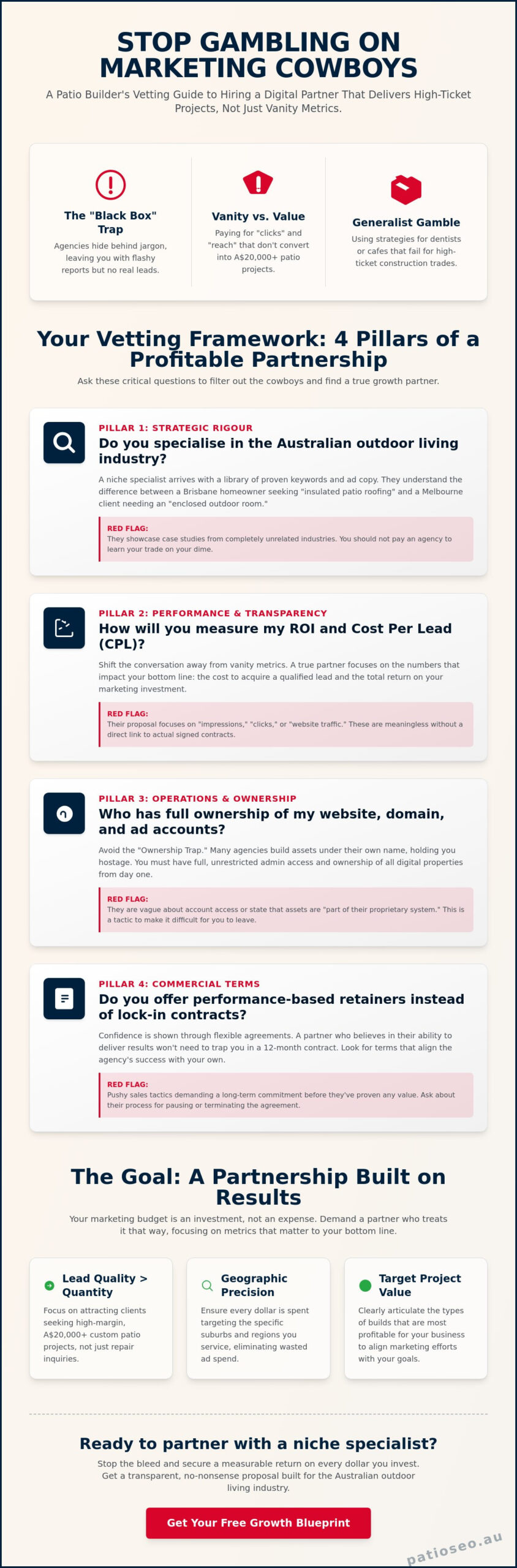
Performance & Transparency: How Will You Measure My ROI?
Ranking on page one of Google is a baseline requirement, not a final victory. If an agency focuses solely on keyword positions without mentioning your bottom line, they’re missing the point. One of the most important questions to ask marketing agency partners is how they link their efforts to your bank balance. You need to see a direct line between their work and your business growth.
A professional agency tracks specific metrics that actually matter to an Australian business owner. These include Cost Per Lead (CPL), conversion rates, and total Return on Investment (ROI). They should provide a “no-nonsense” report every month. This report shouldn’t be a 50-page PDF of confusing graphs. It should be a concise summary showing how much you spent in A$, how many qualified leads arrived, and what the projected revenue looks like. Transparency means they don’t hide behind “proprietary algorithms” when you ask why a certain campaign isn’t performing. They give you the data straight so you can make informed decisions together.
“What Is Your Process for Lead Qualification?”
Generating 100 leads is useless if 95 of them are tyre-kickers looking for a “cheap job” you don’t even offer. You need a partner who understands the difference between a junk lead and a ready-to-build client. High-quality agencies use Conversion Rate Optimisation (CRO) to refine your website forms and landing pages. This process filters out the noise and ensures only serious prospects reach your inbox. Lead volume is a vanity metric that serves no purpose if the lead quality doesn’t result in signed contracts. We focus on intent. By asking the right qualifying questions on your site, we save your sales team hours of wasted time every week.
“Can You Explain Your SEO Process Without the Jargon?”
Technical SEO is complex, but it isn’t magic. A major red flag is any agency that claims their methods are “proprietary secrets” they can’t disclose. This usually means they’re using outdated tactics or “black box” tech that could eventually get your site penalised by Google. You deserve a clear explanation of what’s happening under the hood of your website. A transparent technical audit should clearly list site speed issues, broken links, and mobile usability errors in plain English. For a clear example of how this looks in practice, you can review our seo process for contractors. We break down the strategy into actionable steps that result in more site traffic and better leads. When you’re considering which questions to ask marketing agency candidates, always demand a jargon-free roadmap. If they can’t explain their value in simple terms, they probably don’t understand it well enough themselves.
Operations & Ownership: Who Actually Controls the Assets?
Marketing is a long-term investment in your business, not a temporary rental agreement. Many Australian business owners discover too late that their agency has built a digital fortress around their brand, making it impossible to leave without losing years of progress. This “Ownership Trap” is why operations and asset control are the most critical questions to ask marketing agency candidates before signing a contract. You need to know exactly who holds the keys to your digital property and who is actually pulling the levers behind the scenes.
“Who Owns the Ad Accounts and Website Data?”
You should never let an agency run your Google Ads or Meta campaigns through their own “master account.” If you part ways, you lose your entire conversion history and quality score data. This information belongs to your business. Data portability is essential for long-term growth. If an agency refuses to grant you full administrative access to your own accounts, they are holding your results hostage. A 2024 industry report found that 38% of businesses lost access to their historical data after switching providers due to poor account setup. Ensure you have total control from day one.
- Google Ads & Meta Business Suite: You must be the primary owner; the agency should be a “Partner.”
- Google Analytics 4 & Search Console: You need full admin access to track your own ROI.
- Domain Name: Ensure the registration is in your business name, not the agency’s name.
- Website CMS: You should have “Super Admin” logins to your WordPress or Shopify site.
“Who Will Be Managing My Account on a Daily Basis?”
The “bait and switch” is a common frustration in the marketing world. A senior director with a decade of experience sells you the strategy, but a junior intern with six months of experience manages your budget. This creates a disconnect between the high-level goals and the daily execution. At Patio SEO, we use a “Straight-Shooting Expert” model. We eliminate the middleman “Account Manager” who just passes messages back and forth. You speak directly to the strategist doing the work.
This direct access is vital for technical industries like construction or engineering. A generic content creator won’t understand the nuance of structural integrity or specific Australian building codes. You need a team that takes the time to understand your technical jargon so the content actually converts. Ask your questions to ask marketing agency regarding their specific experience in your niche to avoid paying for a learning curve. When you work with experts instead of messengers, you get faster results and fewer communication errors.
Your marketing should be a transparent engine for growth, not a black box you aren’t allowed to see inside. If you want to take back control of your digital presence, book a transparent strategy audit with our team today.
Commercial Terms: Cutting Through the Noise of Contracts
Marketing contracts are frequently designed to protect the agency’s revenue rather than your business’s growth. When you’re reviewing the final paperwork, you need to look past the glossy pitch deck and scrutinize the fine print. Many Australian agencies still rely on 12 month lock-in contracts that provide them security while leaving you with all the risk. In 2026, this model is outdated. You should prioritize agencies that offer performance-based retainers or month-to-month agreements. If an agency is confident in their ability to generate leads for your patio business, they won’t need to legally trap you to keep your custom.
Hidden costs can quickly turn a “competitive” quote into a budget blowout. Watch for setup fees that exceed A$2,500 without a clear breakdown of technical deliverables. Some agencies charge extra for creative assets, third-party reporting tools, or even basic communication. Before signing, ensure the quote includes every cost required to hit your targets. Remember that the cheapest option is often the most expensive in the long run. A low-cost A$500 monthly SEO package often results in zero movement or, worse, a manual penalty from Google that costs thousands to rectify. Quality marketing requires skilled hours; if the price seems too good to be true, the agency is likely cutting corners on your strategy.
- You don’t own your Google Business Profile or ad accounts.
- Exit notice periods exceed 30 days.
- Vague “management fees” that aren’t tied to specific actions.
- The agency keeps the rights to the content or creative work you paid for.
“What Are Your Contract Terms and Exit Clauses?”
This is one of the most vital questions to ask marketing agency representatives during your final interview. We believe in earning your business every single month. If the results aren’t there, you shouldn’t be forced to keep paying. Predatory clauses often hide in the “Intellectual Property” or “Termination” sections. Some agencies will even try to hold your website hostage if you decide to leave. For a deeper dive into these traps, read our guide on seo company red flags to ensure you aren’t signing a lopsided deal.
Making the Final Decision: Niche vs. Generalist
Specialized knowledge wins every time in the patio and outdoor living industry. A generalist agency might understand “marketing,” but they don’t understand the difference between a gabled roof and a flat skillion design. They won’t know that your leads peak during specific seasonal shifts in the Australian climate. Choosing a niche marketing agency for contractors who already understand the outdoor living industry means you don’t spend the first three months paying for their education. Before you sign, do a final “gut check.” Does this agency talk about vanity metrics like “impressions,” or are they focused on your bottom line? Do they understand your specific profit margins on a standard A$20,000 deck build? If the answer is no, keep looking. Reviewing honest patio seo reviews that focus on revenue outcomes rather than star ratings is one of the most reliable ways to validate a niche agency’s real-world performance before you commit.
Choosing the right partner is the difference between a stagnant year and a record-breaking one. If you’re tired of the “black box” approach and want a partner who speaks the language of the Australian building industry, let’s talk. One of the best questions to ask marketing agency teams is how they plan to scale your specific revenue. Book a Strategy Session with Patio SEO today and let’s build a transparent, results-driven plan for your business.
Take Control of Your Marketing Future
Choosing the wrong partner in 2026 isn’t just a minor setback; it’s a direct hit to your revenue. By using these 21 questions to ask marketing agency candidates, you’re protecting your business from the “black box” mystery of digital marketing. You’ve now got the tools to demand full ownership of your assets and cut through the noise of complex contracts. Focus on finding a partner that demonstrates strategic rigour and a deep understanding of your specific niche.
At Patio SEO, we don’t do fluff. We’re a proudly Australian owned and operated team that specialises exclusively in the outdoor living industry. We provide 100% transparent reporting with direct ROI tracking, so you’ll always know exactly how many A$1,000s in new leads your marketing is generating. It’s time to partner with an expert who values your bottom line as much as you do. Your business deserves a strategy built on data, not promises.
Tired of the fluff? Get a free, no-nonsense audit of your current marketing here.
Frequently Asked Questions
How much should a patio builder actually spend on marketing in 2026?
Most patio builders should allocate between 5% and 10% of their total annual revenue to marketing in 2026. If you’re chasing aggressive growth in a competitive metro area like Sydney or Brisbane, aim for the 10% mark. This budget covers your digital presence, lead generation, and brand awareness. It ensures you aren’t just surviving but actively capturing market share from slower competitors.
What is the biggest red flag when talking to a marketing agency?
The biggest red flag is a guarantee of “Number 1 rankings” on Google within a specific timeframe. No agency controls Google’s algorithm. If they promise a top spot, they’re likely using “black hat” tactics that will eventually get your site penalised. Real experts focus on lead quality and revenue growth rather than vanity metrics. Always keep this in mind when considering questions to ask marketing agency partners during the vetting process.
Do I really need a niche-specific agency, or is a local generalist okay?
You should choose a niche-specific agency because they already understand the seasonal trends and high-value keywords of the outdoor living industry. A generalist spends your billable hours learning what a “flyover roof” or a “louvred pergola” is. Niche experts come with pre-tested strategies for patio builders. This means you get results faster and avoid paying for their learning curve.
How long does it take to see actual ROI from an SEO campaign?
You can expect to see a measurable ROI from a professional SEO campaign within 6 to 12 months. While some technical fixes provide a ranking boost in 90 days, sustainable organic growth takes time to build domain authority. We focus on long-term stability. This timeline ensures your website becomes a lead-generation asset that pays for itself multiple times over.
What happens to my website if I decide to stop working with an agency?
You must retain full ownership of your website, domain, and content if you stop working with an agency. Some agencies build sites on proprietary platforms that lock you in forever. Ensure your contract states that all assets are yours. If they refuse to hand over the keys, it’s a clear sign they’re prioritising their retention over your business’s health.
How do I know if an agency is outsourcing my work overseas?
You can identify overseas outsourcing by asking to meet the specific strategist handling your account via a video call. Check the LinkedIn profiles of their team to see if they’re actually based in Australia. If communication is delayed by 10 hours or the “senior” staff seem ghost-like, your work is likely being white-labelled to a low-cost offshore provider. This often leads to poor content quality.
Should I focus on Google Ads or SEO first for my deck building business?
Start with Google Ads to generate immediate leads while your SEO foundation builds in the background. Google Ads puts you in front of customers searching for “deck builders” today. SEO is the long game that reduces your cost-per-lead over time. Balancing both ensures you have cash flow now and a dominant market position in the future.
What is a reasonable cost-per-lead for the outdoor living industry in Australia?
A reasonable cost-per-lead for the Australian outdoor living industry ranges from A$50 to A$150 for qualified enquiries. This figure varies based on your location and the specific service, such as a basic timber deck versus a complex A$80,000 patio build. Tracking this number is vital. It allows you to calculate your exact return on ad spend and scale your marketing profitably.