


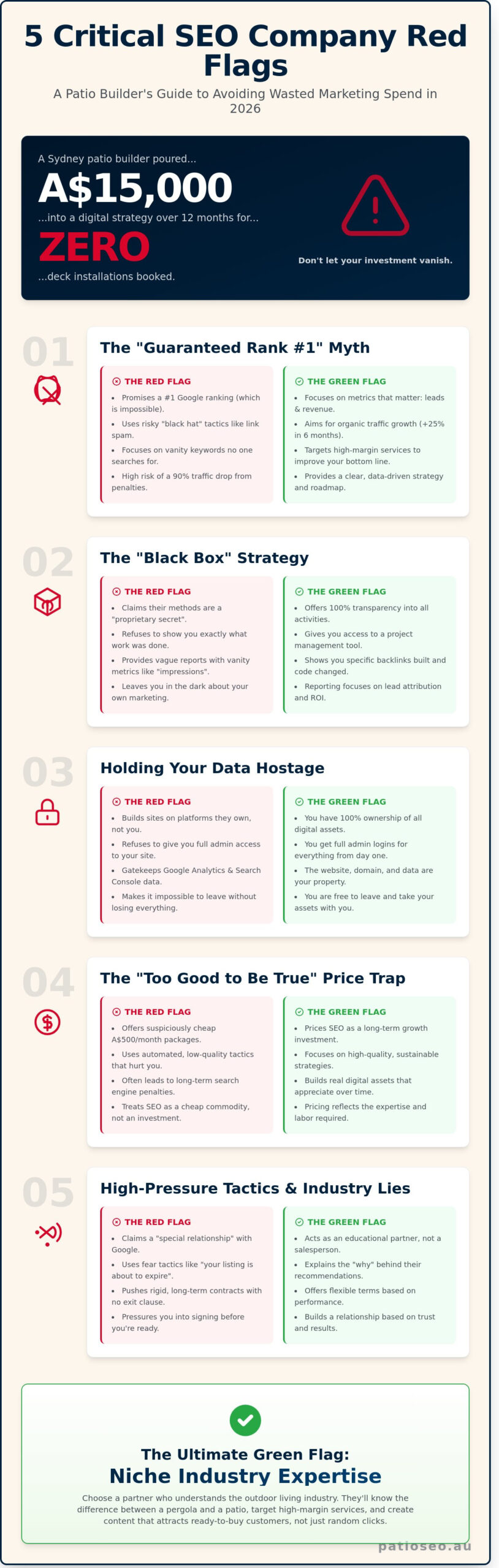
Last Tuesday, a patio builder in Sydney looked at his bank statement and realized he’d poured A$15,000 into a “premium” digital strategy over twelve months without booking a single deck installation from it. You’ve likely felt that same knot in your stomach when an agency hides behind a wall of technical jargon while your phone stays silent. It’s frustrating to pay for “visibility” when what you actually need is a packed calendar of high-value projects. Most business owners agree that the industry often feels like a black box designed to drain your budget rather than build your business.
This guide will show you exactly how to spot seo company red flags before you sign another A$2,500-a-month retainer. You’ll learn to distinguish between genuine growth partners and the marketing “cowboys” who thrive on rigid long-term contracts and zero accountability. We’re breaking down the five specific warning signs to watch for in 2026 and providing a vetting framework that ensures your marketing spend finally turns into measurable revenue. It’s time to stop guessing and start demanding transparency in your reporting so you can grow your patio business with confidence.
Key Takeaways
- Stop wasting budget on “guaranteed” rankings and understand how the 2026 algorithm actually rewards user intent over keyword stuffing.
- Protect your digital assets by identifying seo company red flags related to data gatekeeping and a lack of reporting transparency.
- See why A$500/month packages often lead to search penalties and how to value SEO as a long-term growth investment rather than a cheap commodity.
- Debunk the “insider info” myths and learn to ignore the high-pressure tactics of marketing cowboys claiming your Google listing is about to expire.
- Learn why niche expertise in the outdoor living industry is the ultimate green flag for driving real revenue to your patio or decking business.
The “Guaranteed Rank #1” Myth: Why It Is a Major Red Flag
If a consultant promises a guaranteed top spot on Google, walk away. Google explicitly states in their search documentation that no one can guarantee a #1 ranking. This isn’t just a suggestion; it’s a fundamental reality of how search works. In 2026, Google’s “Intent-First” algorithm prioritises how well a page satisfies a user’s specific need rather than how many times a keyword appears. If an agency claims they’ve cracked a secret code to bypass this, they’re likely using “black hat” tactics. These shortcuts, like private blog networks or automated link spam, often lead to a 90% drop in traffic once a manual penalty hits your domain.
Ranking for your own business name is easy. Any amateur can do it. However, ranking for “high-ticket patio leads” or “custom deck builders Sydney” is a different game entirely. One of the biggest seo company red flags is an agency that touts “number one rankings” without specifying the commercial value of those terms. They might get you to the top for a phrase no one searches for, which results in zero A$ in your bank account. Real growth comes from visibility for terms that your customers actually type when they’re ready to buy.
The Problem with Arbitrary Ranking Guarantees
Google owns the platform, not the agency. They update their core systems over 500 times a year, meaning the goalposts move daily. Your competitors are also investing in their own SEO, which means your position is never static. A “guaranteed ranking” is a red flag because it ignores the volatile nature of search auctions and suggests the agency is prioritising vanity metrics over your actual business growth.
What a Real SEO Partner Promises Instead
A transparent partner focuses on the metrics that pay the bills. Instead of a single keyword position, they aim for an increased “share of search” across your entire service category. You should expect promises built on data, such as:
- Organic Traffic Growth: Increasing the total number of qualified visitors by 25% or more over a six-month period.
- Lead Conversion: Focusing on how many visitors actually pick up the phone or fill out a quote form.
- Revenue Alignment: Ensuring SEO efforts target high-margin services that improve your bottom line.
A reputable agency treats your marketing spend like an investment. They provide a clear roadmap and explain the “why” behind every technical tweak. This approach builds long-term stability rather than a fragile, temporary win that could vanish with the next update. When evaluating seo company red flags, look for those who talk about ROI and lead volume rather than just arbitrary positions on a page. You need a partner who understands that a rank is only useful if it converts into a customer.
Decoding the “Black Box”: Transparency and Reporting Warnings
If an agency tells you their strategy is a “proprietary secret,” they are likely doing nothing at all. Real SEO is built on measurable actions, not mystery. When a provider refuses to show you the exact backlinks they built or the specific code they changed, you are looking at one of the most common seo company red flags. You aren’t paying for a magic trick; you’re paying for labor and expertise that should be visible in your project management tool every single month. Transparency isn’t a bonus feature; it is the foundation of a professional partnership.
Ownership of Assets and Data
Your digital presence is your property. Some agencies build websites on proprietary platforms that lock you into a monthly subscription forever. If you try to leave, you can’t take the site with you. This is a trap. You must insist on 100% ownership of your domain, your website, and your local SEO for contractors assets from day one. Demand full administrative access to Google Search Console and Google Analytics. If an agency gatekeeps this data, they’re holding your business hostage to prevent you from seeing a lack of progress. If you don’t own the login, you don’t own the lead flow.
Regardless of where your business is based, working with a professional agency like Webexpand ensures you receive a high-quality, bespoke website that you own completely, avoiding the technical debt often left by low-cost providers who use proprietary platforms.
Reporting That Actually Matters to a Business Owner
Don’t get distracted by “vanity metrics” like impressions or total keyword counts. A 45% increase in impressions means nothing if your phone isn’t ringing. High-quality reporting focuses on lead attribution. You need to know exactly how many A$10,000 projects came directly from your organic search traffic. This level of detail is how you separate a real partner from another seo company red flags warning sign. A transparent partner will show you:
- Specific Work Logs: A list of every blog post published and technical fix implemented during the billing cycle.
- Backlink Quality: The exact URLs where your business was mentioned so you can verify the authority of the source.
- Conversion Tracking: Hard data showing which keywords led to a form submission or a recorded phone call.
Communication should be proactive and regular. If the only time you hear from your account manager is when the invoice is due, your campaign is likely on autopilot. We believe you should be an informed partner in this process, which is why we focus on clear ROI-driven communication that cuts through the industry fluff. If your current reports are 20 pages of automated charts that you don’t understand, it’s time to ask hard questions about where your A$2,000 monthly retainer is actually going. Reliable agencies have nothing to hide and will walk you through the data until you’re confident in the results.
The Price Trap: Why “Cheap SEO” is a Liability, Not an Investment
Let’s be blunt about the numbers. In Australia, a senior SEO specialist’s hourly rate sits between A$150 and A$250. If an agency offers a full-service package for A$500 a month, you’re buying roughly two hours of their time. It’s impossible to perform a technical audit, write high-converting content, and build authoritative links in 120 minutes. To make a profit, these “churn and burn” firms rely on automation and low-quality offshore labor. They treat your business like a ticket in a queue, not a partnership. This lack of transparency is one of the most dangerous seo company red flags.
These agencies often use “black hat” techniques to show quick, hollow results. They buy 500 spammy backlinks for A$20 from link farms. While your rankings might jump for a week, Google’s “Penguin” and “SpamBrain” algorithms eventually catch up. The result? A manual penalty that wipes your site from search results entirely. Recovering from this damage often costs upwards of A$5,000 in specialist clean-up fees. Cheap SEO isn’t just ineffective; it’s a financial landmine.
Comparing Low-Cost vs. ROI-Driven SEO
Low-cost SEO focuses on vanity metrics like “total keyword rankings” for terms that don’t actually sell patios. Quality SEO focuses on intent. Consider the math. A “cheap” agency might get you 1,000 clicks for “free patio design ideas.” Zero sales follow. An ROI-driven strategy targets “custom insulated patio builders Sydney.” You might only get 20 clicks, but two of those turn into A$25,000 projects. One high-ticket project pays for an entire year of expert SEO. Choosing the latter means you’re investing in revenue, not just noise.
- Cheap SEO: Uses AI-spun content that sounds robotic and fails to build trust with homeowners.
- Quality SEO: Produces niche-specific content that positions you as the local authority.
- Cheap SEO: Relies on generic templates that look like every other builder’s site.
- Quality SEO: Implements a bespoke strategy tailored to your specific service area and profit margins.
Calculating the Real Value of a Lead
Every dollar you spend should have a clear path back to your bank account. Generic marketing firms don’t care about your conversion rate; they only care about their monthly retainer. A bespoke strategy involves deep-diving into your specific margins and local competition. By tracking your ROI with precision, you move from “hoping” for growth to “predicting” it. This data-first approach ensures your marketing spend is a scalable asset. Ignoring the data is one of the seo company red flags that leads to wasted budgets and stagnant growth. If you want to understand the exact steps behind a transparent, results-focused approach, our seo process for contractors breaks down the four-stage framework we use to turn quiet websites into consistent lead-generating machines.
This principle of a systematic approach to client intake isn’t unique to the building trade. Other high-value service industries, like legal practices, rely on specialized platforms to manage their lead flow and ensure retainers are profitable. For those interested in how other sectors handle this, retainerengine.com provides a solid example of a dedicated client acquisition system.
The “Special Relationship” with Google & Other Industry Lies
If an agency claims they’ve got a direct line to the Google algorithm team, they’re lying. No one at Google takes calls from SEOs to “fix” organic rankings. It’s one of the most common seo company red flags that signals a fundamental lack of integrity. Google’s search team is notoriously siloed; even their own support staff for other products don’t have influence over organic results.
You should also be wary of cold callers claiming your “Google listing is about to expire.” Google Business Profiles are free and they don’t expire. These scammers often try to charge Australian business owners A$99 or more for a service that doesn’t exist. It’s a high-pressure tactic designed to exploit busy tradies who don’t have time to check the facts.
SEO isn’t a sprint. For a patio builder in Brisbane or Perth, you’re competing for high-ticket projects that require trust. Expecting page one rankings in 48 hours is a fantasy. Real SEO is a 6 to 12-month marathon. If a company promises “instant results,” they’re likely using “Secret Sauce” tactics they won’t disclose. Usually, this means they’re buying low-quality links that will eventually lead to a manual penalty and a total loss of visibility.
The Myth of the Google Insider
Many agencies flash a Google Partner badge to imply they have special organic search powers. This is deceptive. Google Partners are certified in Google Ads, the paid side of the platform. There is no “Partner” program for organic search. The algorithm isn’t a state secret; it’s public knowledge for those who study the 500 to 600 updates Google makes annually. Claiming “insider info” is almost always a cover for outdated tactics that haven’t worked since 2014.
Identifying “Black Hat” Tactics Before They Kill Your Rank
Cheap SEO often relies on Private Blog Networks (PBNs) or link farms. These are groups of low-quality websites built solely to link to other sites. While they might provide a temporary boost, Google’s AI-detection is now sophisticated enough to spot these patterns. The March 2024 core update resulted in a 45% reduction in unhelpful, automated content in search results. If your agency uses “Content Spinning” to churn out dozens of low-quality pages, your site is a sitting duck.
Sustainable growth requires a focus on qualifying contractor leads through authentic, human-led content. Authentic content builds authority; automated fluff just builds risk. Don’t let a “budget” agency destroy a domain you’ve spent years building. Transparency is the only way to ensure your investment leads to actual revenue rather than a blacklisted URL.
Want a transparent strategy that actually grows your bottom line? Book a strategy session with Patio SEO today.
Choosing a Result-Driven Partner for Your Patio Business
Finding an agency that understands the outdoor living industry is the ultimate green flag. Most generalist agencies spend your first three months of fees just trying to understand your business model. You shouldn’t have to pay for their education. A specialized partner knows that a lead for a basic timber deck has a different profit margin than a high-end opening roof system. Identifying these nuances is how you avoid the most common seo company red flags that drain budgets without delivering a return on investment.
Our approach cuts through the marketing fluff that many agencies use to hide a lack of results. We don’t care about vanity metrics like “keyword rankings” if those rankings aren’t putting more tradies on tools. We focus on the numbers that actually impact your bank account. By speaking the language of pergolas, decking, and council approvals, we ensure your digital presence reflects the quality of your physical craftsmanship.
The Power of Niche Expertise
Generalist agencies often struggle to find high-intent keywords for tradies because they don’t understand local terminology. In Australia, the search intent behind “patio” versus “verandah” can shift significantly based on state lines. A generalist might rank your site for “outdoor design ideas,” which brings in 2,000 visitors who are just looking for inspiration. We focus on “insulated patio installers,” which might only bring 60 visitors, but 15 of them will request a quote. Using proven frameworks built specifically for the building trade, we’ve seen conversion rates jump by 31% for contractors who switched from “big box” marketing firms in 2023. This efficiency ensures your A$2,500 monthly spend actually generates high-value jobs. To see exactly how this framework is structured from start to finish, explore our detailed seo process for contractors scaling outdoor living businesses and discover how we move clients from inconsistent leads to a predictable pipeline within the first 120 days.
This principle of deep specialization isn’t unique to the trades. In other professional fields, like dentistry, agencies such as Ortho Marketing thrive because they focus exclusively on one vertical, mastering the language and needs of their clients.
Similarly, in the manufacturing space, a focus on local quality allows companies like Australian Made Vision to stand out by providing premium, Australian-made optical lenses instead of competing on price with generic imports.
Questions Every Patio Builder Should Ask
Your discovery call is the best time to spot a dud. Don’t be afraid to ask hard questions. A reliable partner will give you straight answers without the “black box” mystery. If they start talking about “proprietary algorithms” instead of your bottom line, it’s time to hang up. Use this checklist to vet your next potential partner:
- “Can you show me a case study of another contractor you’ve helped scale?” Look for a builder who moved from A$80,000 to A$220,000 in monthly revenue. If they can’t show industry-specific growth, they’re just guessing with your money. Before committing, reading verified patio seo reviews that prove revenue growth rather than just star ratings is one of the most reliable ways to separate genuine specialists from generalists.
- “What happens if I want to cancel my contract next month?” Long-term lock-in contracts are one of the biggest seo company red flags in the industry. We believe in earning your business every single month through performance, not legal fine print.
- “How do you track actual job leads versus just website clicks?” You can’t pay your suppliers with clicks. You need a system that tracks phone calls and form submissions directly back to the SEO effort.
Stop wasting your marketing budget on agencies that don’t know a gable roof from a flat roof. You deserve a partner that values transparency and hard data as much as you do. If you’re still weighing up whether a specialist or generalist agency is right for your trade business, understanding why a niche marketing agency for contractors outperforms generalist firms in the 2026 Australian market will make that decision much clearer. Book a straight-shooting strategy session with Patio SEO today.
Secure Your Patio Business Growth for 2026
Don’t let a marketing “cowboy” turn your growth budget into a liability. Spotting seo company red flags early saves you from the fallout of A$500 “bargain” packages that often lead to search penalties and lost revenue. Real success in the Australian outdoor living market requires more than just vanity metrics or “guaranteed” top spots. It demands a transparent, ROI-driven approach that prioritizes your bottom line over empty promises. We’ve seen businesses lose 40% of their organic traffic overnight due to “black box” tactics, and we’re here to ensure that doesn’t happen to you.
At Patio SEO, we specialize in the Australian outdoor living niche. We provide bespoke, ROI-driven strategies and ditch the industry jargon for clear reporting that shows exactly how your investment converts into new builds. There is no “black box” reporting here; we focus entirely on your results. You get a direct line to experts who understand your specific market and the local landscape. It’s time to cut through the noise and partner with a team that values your growth as much as you do.
Get a No-Nonsense SEO Audit for Your Patio Business
Your business deserves a digital strategy that stands as solid as the structures you build.
Frequently Asked Questions
Can an SEO company guarantee #1 rankings on Google?
No, and any agency making this claim is one of the most obvious seo company red flags you’ll encounter. Google’s own documentation explicitly states that no one can guarantee a #1 ranking. Rankings depend on over 200 algorithm factors that shift daily. A reputable partner focuses on increasing qualified traffic and A$ revenue rather than chasing vanity positions that don’t actually convert into sales.
What is the most common red flag when hiring an SEO agency?
Lack of transparency regarding specific tactics is the most frequent warning sign for Australian businesses. If an agency calls their process a “secret sauce” or refuses to show you their backlink sources, they’re likely using high-risk techniques. 74% of business owners who experienced ranking penalties in 2023 cited a lack of clear methodology from their previous provider as the primary reason they felt misled.
Why do some SEO companies charge so much more than others?
Price differences usually reflect the level of senior expertise and the manual labour involved in your campaign. Cheap agencies often automate tasks or use low-quality content that costs A$15 per post. High-end firms invest in senior strategists and A$2,500 monthly tool stacks to ensure your site gains sustainable authority. You aren’t just paying for links; you’re paying for a strategy that protects your brand’s digital equity.
How long should it take to see results from a new SEO campaign?
You should expect to see measurable movement in keyword positions within 90 days, with significant revenue growth appearing between 6 and 12 months. SEO is a compounding investment, not an instant switch. Data from 2023 shows that sites hitting the first page typically require at least 180 days of consistent optimization to overcome established competitors in the Australian market.
Is it a red flag if an agency doesn’t use a contract?
Yes, operating without a formal agreement is a massive risk for your business operations. A professional contract protects both parties by defining the scope of work, ownership of assets, and confidentiality terms. Without a signed document, you have zero legal recourse if the agency disappears with your login credentials or fails to deliver the A$5,000 worth of services you paid for.
The stress of managing these business risks can take a toll, and for busy professionals, having a reliable partner for personal health is just as crucial. For those in the Melbourne area, you can learn more about The Village GP Black Rock and their approach to proactive healthcare.
Should I trust an SEO company that cold calls me?
You should be skeptical of cold callers promising “instant Google fixes” or claiming to have a special relationship with Google. Most high-performing Australian agencies grow through referrals and their own organic visibility. If a firm needs to resort to aggressive telemarketing, it often indicates they can’t rank their own site or have a high client churn rate due to poor performance.
What reporting should I expect from a reputable SEO partner?
You should receive monthly reports that connect technical metrics directly to your bottom line. A solid report includes organic traffic growth, conversion rates, and a clear breakdown of every task completed during the month. Avoid agencies that only show you “keyword improvements” without mentioning how those rankings converted into A$ sales or lead inquiries. Transparency is the foundation of a successful partnership.
Can I do my own SEO to avoid these red flags?
You can manage basic SEO tasks like keyword research or metadata updates, but scaling a business usually requires professional intervention. While 53% of all trackable website traffic comes from organic search, the technical requirements are increasingly complex. Doing it yourself saves money upfront but often results in missed opportunities or accidental penalties that cost thousands of A$ to fix later.