

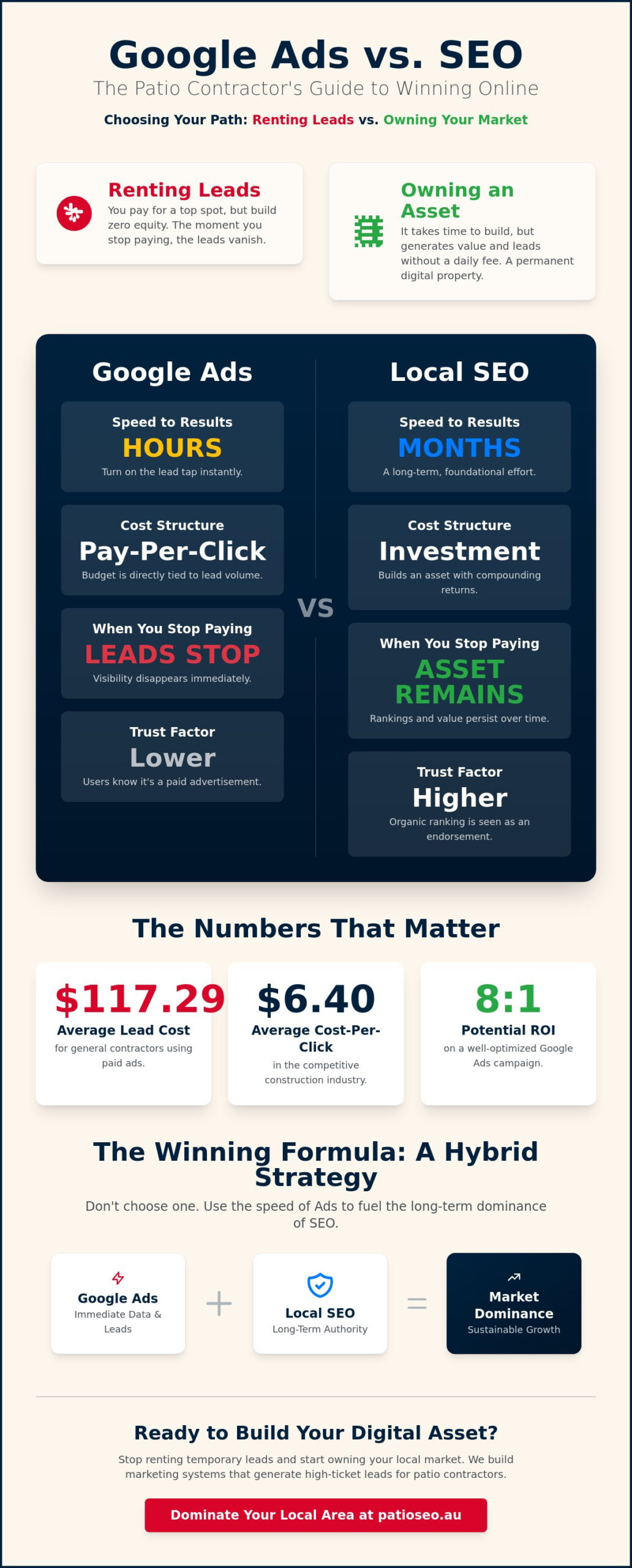
Renting your leads from Google might feel like a necessary evil, but paying an average of $117.29 per lead as a general contractor is a heavy price for a business that doesn’t own its digital assets. You’ve likely felt the frustration of high-ticket marketing budgets that seem to vanish the moment you stop paying for clicks. The debate over google ads vs seo for contractors isn’t about which one is better in a vacuum. It’s about whether you want to fuel immediate cash flow or build a permanent engine for your patio building business.
We understand that wasting money on low-quality tyre-kickers is exhausting, especially when seasonal demand fluctuates. You deserve a marketing strategy that prioritizes fiscal health over superficial metrics. This article provides a transparent, data-driven comparison to help you choose the right investment for your specific lead-gen goals and business stage. We’ll break down the 8:1 ROI potential of Google Ads and the sustainable growth of local SEO, giving you a clear path to dominating your local suburbs and maximizing your bottom line.
Key Takeaways
- Identify the difference between renting short-term leads and building a permanent digital asset that grows in value over time.
- Learn how to target specific, high-ticket suburbs to ensure your marketing spend reaches customers ready to invest in premium outdoor living.
- Discover why local search and GMB management are essential for patio builders to build trust and capture “near me” search volume.
- Evaluate the specific pros and cons of google ads vs seo for contractors to decide which investment matches your current cash flow needs.
- Master the hybrid strategy that uses immediate paid data to accelerate your long-term organic ranking and market dominance.
The Contractor’s Dilemma: Speed vs. Sustainable Asset Building
Choosing between google ads vs seo for contractors isn’t just a technical decision; it’s a financial one that dictates the health of your pipeline. For patio builders, the stakes are higher than for a local handyman. You’re selling high-ticket projects that often require months of consideration. This creates a specific tension between the need for immediate leads to pay the bills and the desire to build a business that doesn’t collapse the moment you stop spending on ads. In a 2026 market where construction CPCs average $6.40, the path you choose directly impacts your bottom line.
Understanding Rented vs. Owned Marketing
Think of Search Engine Marketing (SEM) as the broad umbrella covering both your paid and organic efforts. Google Ads functions like a rented apartment. You pay for the privilege of being at the top, but you’re building zero equity. The moment the rent isn’t paid, you’re out on the street. SEO, conversely, is like owning the land. It takes longer to clear the brush and lay the foundation, but once the structure is up, it generates value without a daily fee. For tradies looking to scale, owning your local search results is a non-negotiable asset that provides compounding returns over time.
The Trust Barrier in Outdoor Living
Trust is the primary currency for outdoor living contractors. A homeowner looking for a $40,000 patio renovation behaves differently than someone with a burst pipe. They aren’t just searchers looking for a quick fix; they’re shoppers looking for a partner. While Google Ads can put you in front of them instantly, an organic presence in the “Map Pack” or top search results carries a different level of psychological weight. It tells the prospect you’ve earned your spot through quality and longevity, rather than just buying it. This authority is what bridges the gap between a tyre-kicker and a high-ticket lead.
The invisible cost of a single-channel strategy is vulnerability. Relying only on Ads means you’re vulnerable to price hikes and platform changes. Relying only on SEO means you’re vulnerable to seasonal slumps while waiting for rankings to climb. Your business stage should dictate your primary focus. A new builder needs the lead tap of Google Ads to survive, while an established firm should be aggressively building their SEO asset to lower their long-term cost-per-lead and secure market dominance.
Google Ads for Contractors: Turning on the Lead Tap Instantly
Google Ads is the fastest way to get your phone ringing today. If you’ve just opened a new branch or need to fill a sudden gap in your schedule, waiting months for organic rankings isn’t an option. The primary advantage here is speed. You can appear at the very top of search results for “patio builders near me” within hours of launching a campaign. While understanding the difference between PPC and SEO is vital for long-term planning, the immediate draw of paid search is its surgical precision.
Precision targeting allows you to focus your budget where the money is. Instead of casting a wide net, you can target affluent suburbs like Scarborough or Brighton where homeowners have the disposable income for premium outdoor living projects. This control extends to your schedule. You can scale your spend up during the spring rush to capture peak demand or pull back during winter to maintain a steady, manageable flow. However, this is a pay-to-play environment. With average construction CPCs reaching $6.40 in late 2025, every click must count. If your campaign isn’t optimized, you aren’t just buying leads; you’re subsidizing Google’s bottom line at the expense of your own.
Strategic Bidding for High-Ticket Projects
Success in the google ads vs seo for contractors debate often comes down to keyword intent. Bidding on broad terms like “cheap pergolas” is a fast way to attract DIYers and bargain hunters who will waste your time. You want to focus on high-intent phrases like “custom patio builder” or “outdoor kitchen installation.” Using negative keywords is equally important. By excluding terms like “DIY,” “how to,” or “repairs,” you ensure your budget is reserved for people ready to sign a contract. For those looking to map out their financial commitment, reviewing a contractor google ads budget helps align your spend with your revenue goals. Crafting specific ad copy for deck builders that highlights your unique process further filters out low-quality leads before they even click.
The Importance of Landing Page Optimisation
Sending paid traffic to your homepage is a cardinal sin of digital marketing. Your homepage is a generalist; your ad is a specialist. If someone clicks an ad for “insulated patio roofing,” they should land on a page dedicated to that specific service. High-intent lead forms and clear project galleries convert “clicks” into “quotes” by providing the exact information the searcher requested. This level of detail is a core component of google ads management for contractors, ensuring your cost-per-acquisition remains sustainable. If you want to see how a high-converting page looks, exploring our Google Ads (PPC) solutions can provide a blueprint for your own campaigns.
Search Engine Optimisation: Building a Long-Term Lead Asset
While Google Ads provides the immediate spark, Search Engine Optimisation (SEO) builds the enduring fire. In the debate of google ads vs seo for contractors, the winner is usually the business that stops viewing marketing as an expense and starts viewing it as a capital investment. The math is simple. If you pay for 1,000 clicks on Google Ads, you pay the market rate for every single one. If you invest in SEO, your first 1,000 visitors might cost more upfront, but the next 10,000 are essentially free. This compounding effect is why organic search is the only way to achieve a truly sustainable cost-per-lead as you scale.
For patio builders, the “Map Pack” is the most valuable real estate on the internet. High-ticket clients want local proof. They want to see that you’ve built projects in their neighborhood and that your reputation is solid. Dominating local search through Google Business Profile (GBP) management ensures you’re the first name they see when they search for “patio installers” in their specific suburb. Unlike ads, which disappear the moment your credit card is hit, a strong organic ranking remains durable. It keeps your pipeline full even during months when you choose to pull back on your advertising spend.
The Local SEO Trifecta for Builders
Winning in the Australian market requires a hyper-local approach. You aren’t just ranking for a city; you’re ranking for the specific suburbs where your crews actually work. This requires a trifecta of Google Business Profile optimization, technical site health, and dedicated service-area pages. These pages act as local landing spots for every suburb you serve, from the coast to the hills. For a step-by-step breakdown of the technical implementation, our seo for patio builders guide offers a no-nonsense path to local growth.
Content as a Sales Tool
Detailed “how-to” guides and process explainers do more than just attract traffic; they filter out the bad leads by setting clear expectations on price and complexity before the first phone call. This transparency is vital for high-ticket contractors, aligning your digital presence with the same honesty required by the Federal Trade Commission guidelines that govern online claims. Using project galleries and deep-dive case studies builds local authority that a “Sponsored” tag simply can’t buy. This content supports your sales team by pre-educating the client, meaning your consultants spend less time defending your quote and more time discussing the design.
Side-by-Side Comparison: ROI, Timeline, and Trust
When weighing up google ads vs seo for contractors, the most obvious difference is the speed of the result. Google Ads can deliver a high-ticket lead within 24 hours of a campaign going live. Local SEO, conversely, typically requires a 3 to 6 month window before you see a significant impact on your lead volume. While the timeline for Ads is attractive, the cost per lead remains relatively stable. You pay the market rate for every click, regardless of how long you’ve been running the campaign. SEO offers exponential scalability; as your rankings climb, your cost per lead decreases because you aren’t paying for each individual visitor.
Lead quality is where the two channels truly diverge. Data from the field shows that organic leads often close at a higher percentage than paid leads. This is because a homeowner who finds you in the “Map Pack” or organic listings perceives you as a local authority. They’ve discovered you on their own terms, which builds immediate trust. A “Sponsored” tag, while effective for visibility, can sometimes signal to a savvy shopper that you’re simply the highest bidder. In the competitive Australian market, where trust is the primary driver of $50,000+ patio projects, this psychological edge is a massive advantage for your sales team.
The ROI Framework for 2026
Smart patio builders focus on profit per lead rather than just cost per click. While a Google Ad click might cost $6.40, a lead that converts into a high-margin project is worth the investment. However, you must factor in the brand equity that SEO creates. Every piece of educational content and every local suburb page you build becomes a permanent digital asset. This visibility creates a “halo effect” where people recognize your brand even if they don’t click your ad, making your overall marketing spend more efficient. If you want to build a business that isn’t entirely dependent on monthly ad spend, you need to invest in Search Engine Optimisation (SEO) as your primary growth engine.
When to Choose Which Strategy
Your choice depends on your current business stage and cash flow requirements. If you’re a new business or expanding into a new region like the Gold Coast or Western Sydney, Google Ads is a survival necessity. You need immediate revenue to cover overheads and keep your crews busy. For established players aiming for $2M+ in annual revenue, SEO is the key to market dominance. It protects your margins from rising CPC costs and ensures you own the local conversation. The “sweet spot” for most successful contractors is a hybrid approach where Ads provide the fuel for today and SEO builds the engine for tomorrow.
The Hybrid Strategy: Scaling Your Patio Business with Both
The most successful contractors don’t view google ads vs seo for contractors as a binary choice. Instead, they treat them as two parts of a single machine. For a growth-hungry business, the 70/30 Rule provides a practical framework for budget allocation. In the early stages or when entering a new territory, you might put 70% of your budget into Google Ads to secure immediate projects. As your organic presence matures over the typical 3 to 6 month window, you can gradually flip that ratio. This transition ensures your lead flow never dips while your long-term cost-per-acquisition steadily decreases.
A hybrid strategy also protects your business from market volatility. If a competitor starts bidding aggressively on your top keywords, your organic rankings act as a safety net. Conversely, if a Google algorithm update shifts the organic landscape, your paid ads keep the phone ringing. Retargeting plays a vital role here. You can use Google Ads to stay in front of homeowners who found you through an organic search but weren’t ready to book a site visit. This keeps your brand top-of-mind during the long decision-making cycles common in high-ticket outdoor living projects.
Data-Driven SEO from Ad Insights
Google Ads is the ultimate testing ground for your SEO strategy. By looking at your search term reports, you can identify “Money Keywords” that actually result in signed contracts rather than just high traffic. If “gable patio installers” has a high conversion rate in your paid campaigns, it becomes a priority for your organic content and suburb-page strategy. You can also test different headlines in your ads to see which ones get the most clicks, then use that data to write better meta titles for your organic listings. Adopting a comprehensive approach to marketing for patio builders ensures every dollar spent on ads contributes to your long-term organic authority.
The Path to $5M: Dominating Search
To reach the $5M revenue mark, you need “Total SERP Domination.” This means appearing in the top ad spots, the local Map Pack, and the first few organic results simultaneously. When a homeowner sees your brand in all three places, the perceived trust increases exponentially. This level of market saturation is only possible when you have a high-performance website design for patio contractors that can convert traffic from any source. By combining the immediate speed of Ads with the compounding value of SEO, you build a resilient business that owns its market. Book a strategy session with Patio SEO to build your custom 2026 roadmap and start dominating your local suburbs today.
Future-Proof Your Patio Building Business
The choice between renting visibility or owning your digital real estate shouldn’t be a gamble. You need a pipeline that stays full without draining your bank account on low-quality clicks. The debate of google ads vs seo for contractors is won by those who value long-term stability over volatile, short-term gains. By combining the immediate reach of ads with the enduring value of SEO, you create a business that dominates local search in every suburb you serve.
Our team specializes in the outdoor living niche, focusing on high-ticket lead quality and transparent, data-backed reporting. We avoid the mystery and focus on the results that impact your bottom line. It’s time to stop settling for tyre-kickers and start building a predictable path to expansion. Scale your patio business with an ROI-driven marketing strategy and secure your position as the leading builder in your region. Your future growth starts with a solid foundation.
Frequently Asked Questions
Is Google Ads or SEO better for a new patio business?
Google Ads is the better choice for a new business that needs immediate leads to generate cash flow. It allows you to appear at the top of search results instantly while your organic presence is still developing. You should use paid ads to fuel your initial growth and reinvest those profits into a long-term SEO strategy to secure your future market share.
Why are my Google Ads so expensive for patio keywords?
High competition and high project values drive up costs in the outdoor living niche. With an average construction CPC of $6.40 as of late 2025, you’re competing against every other builder for limited space. If your ads aren’t tightly targeted to high-intent keywords, you’ll end up paying a premium for clicks that never turn into contracts.
How long does it take for SEO to start generating contractor leads?
You can typically expect to see measurable results from local SEO efforts within 3 to 6 months. This timeline varies based on your website’s current authority and how many competitors are active in your specific suburbs. While it takes longer than ads, the leads generated through organic search often have a higher level of built-in trust.
Can I do SEO for my construction business myself?
You can handle basic tasks like requesting reviews and updating your Google Business Profile, but technical SEO is a full-time job. Most builders find that their time is more profitably spent on-site managing projects than trying to decode algorithm updates. Mistakes in your site’s structure can lead to ranking penalties that are expensive and slow to fix.
Does running Google Ads help my organic SEO rankings?
Running ads doesn’t give you a direct boost in organic rankings, but it provides invaluable data for your strategy. The search term reports from your ads show exactly which phrases lead to high-ticket quotes. You can then use this data to prioritize your content creation, making the debate of google ads vs seo for contractors less about choosing one and more about using both effectively.
What is a good monthly budget for a patio builder on Google Ads?
A typical monthly spend for small to medium-sized businesses on Google Ads is between $1,000 and $10,000. For patio builders, your budget needs to be large enough to cover the cost of several clicks per day to gather meaningful data. We recommend starting with a budget that aligns with your specific lead-gen goals and the average cost-per-lead in your region.
How do I track if my leads are coming from Ads or SEO?
You can track your lead sources accurately using Google Analytics 4 and call tracking software. By using UTM parameters on your ad links, you’ll see exactly which leads came from a paid click versus an organic search. This level of clarity is vital for protecting your fiscal health and ensuring you’re maximizing the ROI on your marketing spend.
Should I stop Google Ads once I rank #1 on Google?
You shouldn’t stop your ads just because you’ve reached the top of organic search. Dominating both the paid and organic sections of the page increases your brand’s authority and prevents competitors from siphoning off your potential customers. This “Total SERP Domination” strategy is how the most successful patio businesses in Australia maintain their lead volume year-round.