


Why are you paying $435 for a lead that doesn’t even know what service they need? You’ve likely seen the reports from agencies that talk about “brand awareness” while your bank balance stays flat. It’s a common trap, and it’s frustrating to feel like you’re just throwing money into a black box. Achieving a bankable marketing roi for contractors isn’t about chasing vanity metrics. It’s about shifting your budget toward high-performing channels like SEO, which currently delivers a 681% return on investment for the construction sector.
You probably agree that a lead is worthless if it doesn’t turn into a signed contract. This guide helps you cut through the industry noise to build a transparent tracking system that prioritizes revenue over clicks. You’ll learn how to navigate the 2026 California contract transparency laws and leverage the 20% faster growth seen by firms that track their data weekly. We’re going to show you exactly how to stop wasting time on low-quality quotes and start scaling your spend with total confidence.
Key Takeaways
- Stop measuring success by how busy you are and start tracking the ratio of net profit generated against your total marketing spend.
- Distinguish between a cheap inquiry and a profitable job by calculating your true Cost Per Acquisition (CPA) for every signed contract.
- Protect your margins by identifying the “Cost of Quoting” and avoiding the trap of high-volume, low-quality leads that waste your time.
- Implement simple call tracking and CRM tagging to gain a transparent, no-nonsense view of your marketing roi for contractors.
- Scale your business toward the $5M+ revenue mark by using ROI-driven SEO to consistently lower your long-term customer acquisition costs.
Stop Flying Blind: What Marketing ROI Actually Means for Contractors
Many contractors mistake a ringing phone for a successful business. If your team is flat out but your bank balance isn’t moving, you’ve fallen into the “busy-ness” trap. True marketing roi for contractors isn’t a measure of how many people clicked an ad or liked a photo of a finished deck. It’s the cold, hard ratio of net profit generated against the total cost of your marketing efforts. If you spend $1,000 to get a lead that results in a $10,000 profit, your ROI is clear. If you spend that same $1,000 on 50 leads that all want the “cheapest price” and eventually ghost you, your ROI is effectively zero.
In 2026, the digital landscape is more crowded than ever. With new regulations like the FTC “Junk Fee” Rule and California’s updated contract requirements, transparency is the only way to survive. You need to understand your Return on Marketing Investment (ROMI) at a granular level. This means looking past the surface-level reports provided by agencies and digging into how many dollars actually hit your account after the job is done. Calculating a precise marketing roi for contractors requires you to subtract your total job costs and marketing spend from the gross revenue of a project to see what’s actually left over.
The “Lag Time” Factor in Outdoor Living ROI
High-ticket projects like custom patios don’t happen overnight. A homeowner might click your SEO link in September, browse your gallery in October, and finally sign a contract in March. If you only look at immediate cash flow, you’ll think your September marketing failed. You must track “pipeline value” instead. This allows you to see the potential revenue sitting in your sales funnel. Successful contractors use this data to stay calm during slow months, knowing their previous spend is already working in the background to fill the autumn schedule.
Vanity Metrics vs. Revenue: Cutting Through the Noise
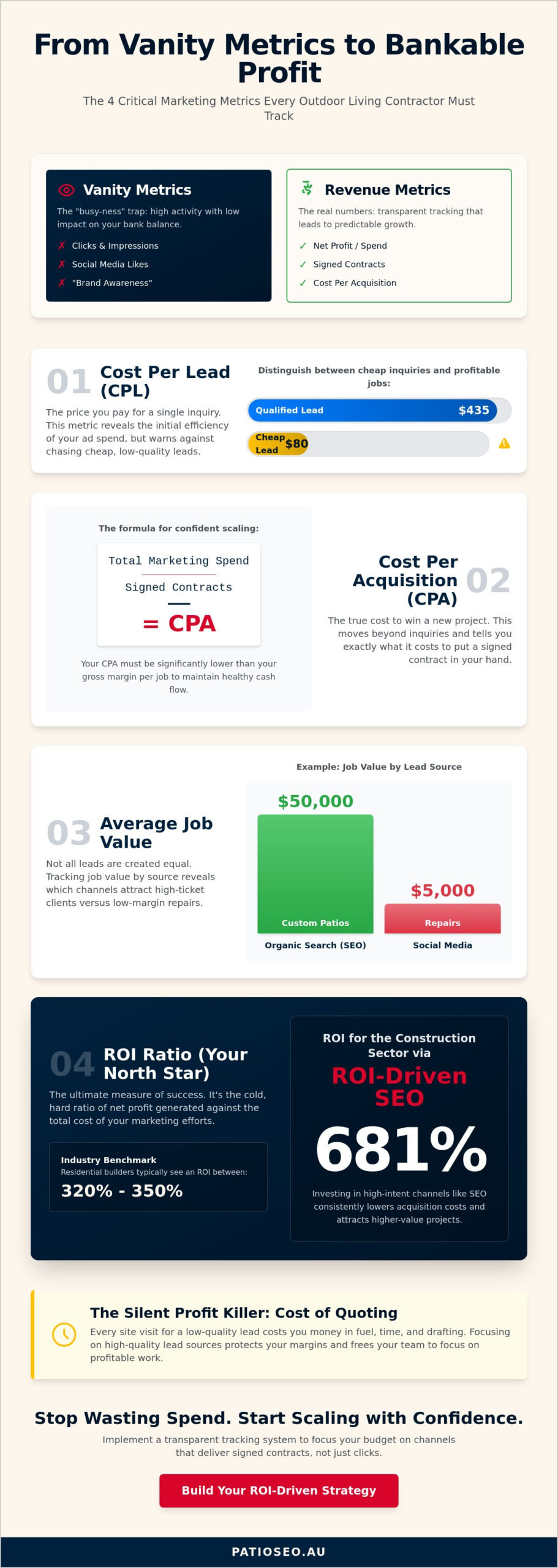
Clicks and likes are easy to get, but they don’t pay your crew. A high volume of cheap leads often indicates a failing strategy. Every time you send a rep to a site visit for a low-quality lead, you’re losing money on travel, time, and drafting. This “cost of quoting” is a silent profit killer that many ignore. Bankable ROI is revenue that survives the profit-and-loss statement after all expenses and marketing costs are deducted. Focus on the jobs with higher average values rather than just trying to keep the phone ringing for the sake of it.
The 4 Critical Metrics That Determine Your Profitability
Understanding your numbers is the difference between a scaling business and a struggling one. You need a clear way to measure your marketing efforts to ensure every dollar is pulling its weight. A bankable marketing roi for contractors relies on four specific data points that move beyond simple “likes” or “clicks.” If you don’t know these numbers, you can’t scale with confidence.
- Metric 1: Cost Per Lead (CPL). This is what you pay for a single inquiry. As of May 2026, the average cost per qualified lead in the construction industry is approximately $435. While some platforms offer leads for $80, these often lack the quality needed to justify the follow-up time.
- Metric 2: Cost Per Acquisition (CPA). This is the total marketing spend divided by the number of signed contracts. It tells you exactly what it costs to put a new project on your books.
- Metric 3: Average Job Value by Source. Not all channels attract the same client. You might find that organic search leads result in $50,000 patio builds while social media leads only inquire about $5,000 repairs.
- Metric 4: ROI Ratio. This is your ultimate North Star. Residential builders typically see an ROI between 320% and 350%. If your ratio is lower, your marketing is likely inefficient.
Calculating Your Cost Per Acquisition (CPA)
To find your CPA, take your total marketing spend over a specific period and divide it by the number of signed contracts. It’s a simple formula: Spend / Signatures. In the Australian market, your CPA must stay significantly lower than your gross margin per job to maintain healthy cash flow. If you spend $2,000 to acquire a job that only nets $3,000 in profit, your business model is at risk. High-performing contractors aim for a CPA that represents a small fraction of the total project value.
Close Rate by Lead Source: The Truth-Teller
Data shows that referral leads convert at a massive 40-60%, whereas organic search leads convert at 20-30%. Google Ads leads typically sit between 15-25%. By identifying which channels send “ready-to-buy” homeowners, you can stop wasting time on “tyre-kickers” who just want a free quote with no intention of building. Implementing a strategy for lead generation for outdoor living contractors that prioritizes high-intent search terms will always be more profitable than chasing volume. If you’re ready to stop guessing and start growing, Patio SEO can help you identify your most profitable lead sources today.
Lead Quality vs. Lead Volume: Why More Isn’t Always Better
High lead volume is often a vanity metric that masks a crumbling bottom line. If your phone is ringing 50 times a week but you’re only closing two jobs, you aren’t growing; you’re just exhausted. This is the “Bad Lead Trap.” Chasing low-intent inquiries forces your team into an endless cycle of travel, site visits, and drafting quotes for homeowners who are just “price shopping.” When you calculate the true marketing roi for contractors, you must account for the cost of your time. If a site visit takes three hours including travel, and you do five a week for leads that never close, you’ve lost 15 hours of production time before you’ve even started a build.
A sustainable strategy for marketing for patio builders prioritises intent over interest. You don’t need more leads; you need better ones. Five high-intent leads from homeowners ready to invest in a premium outdoor living space are worth more than 50 “send me a price” emails. Success comes from building a marketing budget that targets specific demographics and high-value search terms rather than casting a wide, expensive net. This focused approach ensures your marketing roi for contractors remains bankable by reducing the operational strain on your sales team.
Geographic ROI: Profitability by Postcode
Travel time is a silent margin killer that most agencies ignore. Dominating a postcode 40 minutes away might look good on a map, but the fuel costs and lost labour hours during transit will gut your profitability. You must focus your efforts on defining your contractor service area based on profit, not just proximity. Using Local SEO to own the search results in high-value neighbourhoods near your base allows you to stack jobs closer together, significantly increasing your net margin per project.
Qualifying Leads Before the Quote
Your website should act as your first line of defence against budget-shoppers. By including “starting at” pricing and a high-end project gallery, you filter out leads that don’t align with your job minimums before they ever pick up the phone. This transparency builds trust with serious clients while protecting your time. A well-designed site ensures that when a lead does reach out, they’ve already seen your quality and accepted your price bracket, making the eventual sales call a formality rather than a negotiation. Contractors who embrace niche marketing for contractors find this qualification process becomes even more powerful, as a clearly defined specialty naturally repels price-shoppers and attracts clients who value expertise.
Building Your ROI Dashboard: Simple Tracking for Busy Tradies
You don’t need a $500 a month software suite to understand your numbers. Many agencies try to sell you complex “black box” reporting that only they understand. For most Australian contractors, a simple, transparent system is far more effective. Tracking your marketing roi for contractors starts with connecting your lead sources to your bank account. If you can’t see the path from a click to a cleared invoice in Xero, you’re just guessing. You need a dashboard that accounts for the local reality of GST and Australian labor rates to see your true net margin.
- Step 1: Call Tracking. Implement dynamic number insertion to see which specific ad or search term triggered a phone call.
- Step 2: Lead Tagging. Use a CRM or a basic spreadsheet to tag the “Source” of every inquiry the moment it arrives.
- Step 3: Monthly Cadence. Review your data every 30 days. Daily checks lead to panic; monthly checks reveal real trends.
- Step 4: Financial Integration. Connect your lead data to Xero or MYOB to see the actual profit left after materials and labor.
Call Tracking and Form Attribution
Relying on the “How did you hear about us?” question is a recipe for bad data. Most homeowners will simply say “Google” or “online,” which tells you nothing about whether your SEO or your paid ads are working. Using Australian based tools like WildJar allows you to assign unique numbers to different traffic sources. This level of detail is vital because it prevents you from cutting a high performing channel just because it doesn’t “feel” busy. If you want a clear view of your lead sources without the technical headache, book an ROI audit with Patio SEO today.
The Monthly ROI Review Process
Don’t get bogged down in daily fluctuations. Look for patterns over 30 day blocks to account for the long sales cycles typical of high end patio builds. You should compare your total marketing spend against the value of work won every 30 days to ensure your margins remain healthy. If a channel shows a high cost per lead but a high average job value, it stays. If a channel sends volume but no signatures, it’s time to pivot. This disciplined approach ensures your growth remains sustainable and bankable.
Scaling Your Outdoor Living Business with ROI-Driven Marketing
Moving from $1M to $5M in annual revenue isn’t about working harder; it’s about making your money work smarter. Scaling requires a shift from “referral-only” growth to a predictable, data-backed system. Once you’ve identified your most profitable postcodes and lead sources, you can reinvest your profits into high-performing channels with total confidence. A bankable marketing roi for contractors is the foundation of this expansion. It allows you to move beyond survival mode and start dominating your local market by out-investing competitors who are still flying blind. Pairing this data-driven approach with a focused niche marketing strategy for contractors is what separates businesses that scale from those that simply stay busy.
Long-term growth relies on lowering your customer acquisition costs over time. While paid ads provide immediate traffic, SEO for patio builders builds a permanent digital asset that generates leads without a per-click fee. Industry data from May 2026 shows that SEO delivers a massive 681% ROI, far outpacing most third-party lead services. By building organic visibility, you’re investing in your own business’s future rather than just renting space on Google’s front page. At Patio SEO, we partner with you to turn these technical metrics into real-world revenue growth.
The Compound Effect of Local SEO
Organic search leads convert at 20-30%, which is significantly higher than the 10-20% seen from social media. Local SEO and GMB management are critical for capturing these high-intent homeowners. When your business appears in the “Local Map Pack” for a specific suburb, you’re tapping into a stream of leads that are already looking for your services. Because phone leads convert at 40% and generate up to 15 times more revenue than web forms, your local visibility is your most valuable sales tool.
Conversion Rate Optimisation: The ROI Multiplier
You don’t always need more traffic to increase your profit. Small, strategic updates to your website design can double your conversion rate, effectively doubling your ROI without adding a cent to your ad spend. In 2026, mobile-first design is non-negotiable. Homeowners are browsing your gallery and checking your reviews on their phones while standing in their backyards. If your site is slow or hard to navigate, you’re handing leads to your competitors. Companies using integrated CRM and analytics platforms see 15-20% higher marketing roi for contractors by simply closing the gaps in their sales funnel. If you’re ready to see the real numbers behind your growth, Book a free ROI audit with Patio SEO today.
Stop Guessing and Start Scaling
Running a contracting business is hard enough without wondering if your marketing budget is actually hitting the bottom line. You’ve seen how shifting focus from volume to high-intent lead quality protects your margins. By implementing a monthly review process and tracking your true Cost Per Acquisition, you’re no longer flying blind. Contractors who commit to tracking their metrics weekly tend to grow their revenue 20% faster than those who don’t. It’s time to demand absolute transparency from your digital presence.
A bankable marketing roi for contractors isn’t a pipe dream; it’s the result of a disciplined, data-backed strategy. We specialize in the Australian outdoor living niche, providing no-nonsense ROI reporting that cuts through the industry noise. If you’re ready to see exactly where your profit is hiding, Get a Free ROI Audit for Your Patio Business. Let’s turn your website into a high-performing asset that drives sustainable, long-term growth. You’ve got the skills to build the projects; we’ve got the data to build the business.
Frequently Asked Questions
What is a good marketing ROI for a patio contractor?
A healthy marketing ROI for residential builders typically ranges between 320% and 350%. Mid-size construction companies often see slightly higher returns of 350% to 380% due to better operational efficiencies. If your return sits below the 300% mark, it’s a clear signal that your lead quality is too low or your acquisition costs are too high. Aiming for these benchmarks ensures your marketing spend fuels sustainable growth rather than just covering overheads.
How long does it take to see a positive ROI from SEO?
You should expect to see measurable movement within 6 months, but a fully positive marketing roi for contractors through SEO usually matures over 12 to 24 months. Unlike paid ads that stop the moment you stop paying, SEO builds a permanent asset. This compounding effect is why organic search leads convert at 20% to 30%. It requires patience, but the long-term cost per acquisition is significantly lower than any other digital channel.
Should I track ROI on referrals or just paid marketing?
You must track both to understand the true health of your business. Referral leads are your most valuable asset, converting at a massive 40% to 60% rate. By tracking them alongside paid channels, you can see if your marketing is actually reaching the right people who then recommend you to others. If your referral ROI is high but your paid ROI is negative, it shows your ads are targeting the wrong demographic entirely.
How much should a contractor spend on marketing as a percentage of revenue?
Established contracting firms typically allocate 5% to 7% of gross revenue to marketing. If you’re in a dedicated growth phase aiming to scale rapidly, you should consider a higher range of 10% to 12%. While U.S. residential builders currently average 2.8% to 3.2%, these lower figures often lead to stagnation. Investing closer to the 10% mark allows you to dominate local search results and secure higher-value projects in your most profitable postcodes.
What is the most profitable marketing channel for deck builders in Australia?
SEO is consistently the most profitable channel, delivering an average ROI of 681% across the construction sector. While Google Ads provides immediate lead flow, the high cost per click in the Australian outdoor living market can eat into your margins. Organic search captures high-intent homeowners who have already decided to build. Investing in local SEO ensures you’re visible when a prospect is ready to sign, leading to much higher average job values.
Can I track marketing ROI without using a CRM?
You can definitely track your marketing roi for contractors using a simple spreadsheet if you’re not ready for a full CRM. The key is consistency in tagging every lead source and recording the final contract value. As long as you match your marketing spend from your bank statements against your “Work Won” data in your spreadsheet every 30 days, you’ll have a clear view of your profitability. Simple tracking is always better than complex systems that you never use.
How does service area location affect my marketing ROI?
Your geographic focus is a major driver of profitability. Travel time to remote jobs acts as a hidden cost that guts your ROI. By tightening your service area to high-value neighborhoods within a 20 minute radius of your base, you reduce fuel costs and lost labor hours. Dominating a smaller, wealthier area via Local SEO is always more profitable than being a “jack of all trades” across an entire state or territory.
What happens if my cost per lead is low but my ROI is negative?
This is the “Bad Lead Trap” where you’re paying for volume instead of intent. A low cost per lead means nothing if those leads don’t convert into signed contracts. If you’re paying $80 for leads that never close, you’re losing money on the “cost of quoting” and administrative time. You need to pivot your strategy toward higher-intent channels, even if the individual lead price is higher, to ensure your final ROI stays positive.