


What if your website was actually a strategic filter designed to repel the bargain hunters and attract only the high-ticket projects? Most builders treat website design for patio contractors as a vanity project, yet a Stanford University study confirms that 75% of users judge your entire company’s credibility based on your site’s design alone. You likely feel the frustration of an inbox full of low-quality leads or seeing potential clients bounce because your project gallery didn’t load within three seconds. It’s a common pain point that costs Australian contractors thousands in wasted follow-up time every month.
It’s time to stop settling for a static digital brochure that does nothing for your bottom line. We’ll show you exactly how to transform your online presence into a high-performance sales engine that pre-qualifies leads before you even pick up the phone. This article provides the 2026 lead-gen blueprint, covering everything from dominating local search in Brisbane and Melbourne to implementing the transparent trust signals required by the ACCC to justify your premium pricing.
Key Takeaways
- Stop wasting traffic on “digital brochures” and learn to build a strategic hero section that captures high-ticket leads in under five seconds.
- Discover how specialized website design for patio contractors combines technical SEO with clear value propositions to outperform local competitors.
- Learn to build a high-speed portfolio that uses “Before and After” visuals to pre-qualify leads and showcase your craftsmanship.
- Master the use of trust signals, such as QBCC or VBA license displays, to build instant authority with Australian homeowners.
- Identify why a custom website strategy provides the flexibility needed for long-term scaling and consistent revenue growth.
Why Most Patio Contractor Websites Fail to Generate High-Ticket Leads
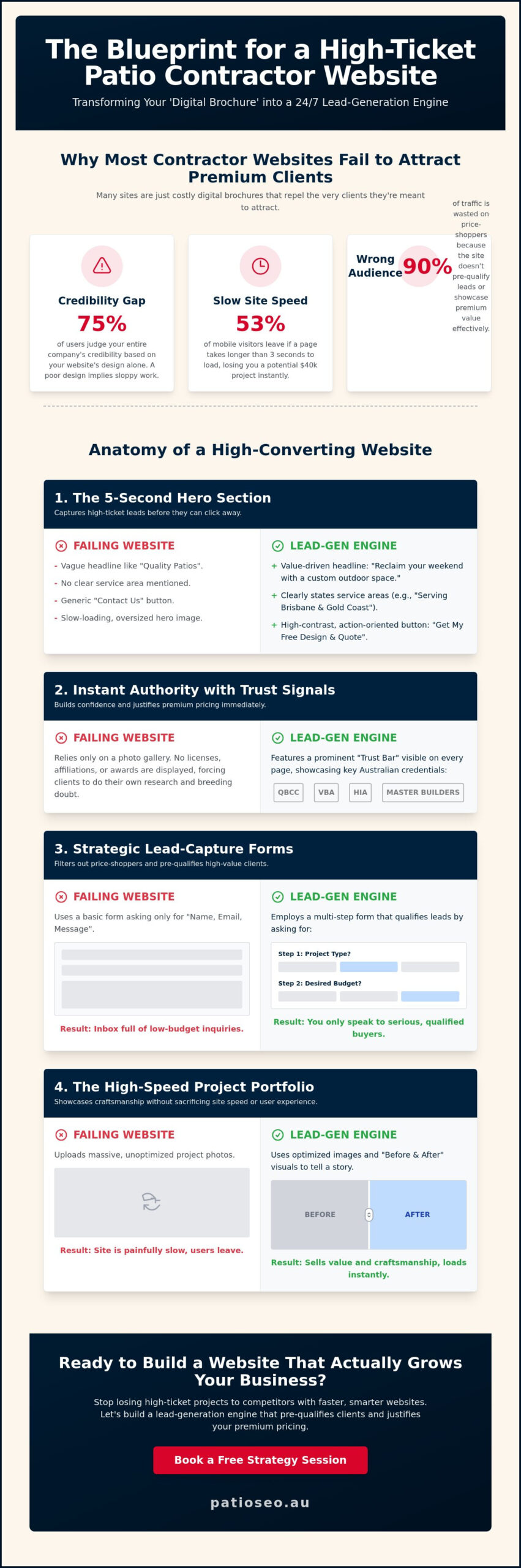
Many builders treat their online presence as a simple digital business card. They spend thousands on professional photography but zero on the strategy required to actually get those photos seen. This is the “Digital Brochure” trap. You might have a stunning site, but if it lacks a technical backbone, it stays invisible to the people who matter. Effective website design for patio contractors requires more than just a gallery; it needs a structure built on data and user intent. If you don’t understand what is lead generation in a digital context, you’ll likely end up with a site that looks great but never rings the bell.
The Cost of a Poor User Experience (UX)
Your website’s performance directly impacts your bank account. Verified data shows that 53% of mobile website visits are abandoned if a page takes longer than three seconds to load. Patio contractors often fall into the trap of uploading massive, unoptimized project photos. While these images showcase your craftsmanship, they also kill your site speed. If a homeowner in Melbourne tries to view your portfolio on their phone and the images don’t load instantly, they’ll bounce back to the search results. That’s a potential $40,000 project lost to a competitor with a faster site. Poor UX creates a psychological barrier. If your website is clunky or has broken links, prospects assume your construction work will be just as sloppy.
Ignoring the Customer Journey
A high-ticket outdoor living project is a major investment. Expecting a visitor to click “Contact Us” the moment they land on your home page is unrealistic. Most prospects start in the research phase. They’re looking for design inspiration, pricing guidance, and proof of authority. If your site only offers a generic contact form and a few photos, you’re ignoring the early stages of the buyer’s journey. You need to provide value through education. Explain the council approval process or compare different roofing materials for the Australian climate. By positioning yourself as the expert early on, you build the trust necessary to justify premium pricing. Without this educational layer, your website design for patio contractors will only attract price-shoppers rather than serious, high-value clients.
The Anatomy of a High-Converting Website Design for Patio Contractors
A high-performing website design for patio contractors isn’t a happy accident. It’s a calculated blend of aesthetic portfolio displays, technical SEO, and conversion-focused copywriting. While competitors might tell you that a “pretty” site is enough, the data says otherwise. Your site must function as a pre-qualification filter. This means attracting high-ticket clients while simultaneously repelling time-wasters who are only looking for the cheapest quote. A lead-gen engine does the heavy lifting of selling your expertise before you even pick up the phone.
Your Hero Section has exactly five seconds to answer three critical questions. What do you build? Which areas do you serve? How does the prospect take the first step? If a visitor has to hunt for your service area or contact details, they’ll leave. Since 70% of mobile searches lead to an action within one hour, your mobile hero section must be even sharper than the desktop version. Use a clear, bold headline and a single, high-contrast button to guide them to your quote form.
Beyond the visuals, your site needs strategic lead-capture forms. Instead of a basic “Name and Email” box, use multi-step forms that ask about budget ranges and project timelines. This qualifies the lead before it hits your inbox, saving you hours of wasted site visits. Combine this with a “Trust Bar” featuring logos from the Master Builders Association or HIA to establish instant local authority. If your current site isn’t hitting these marks, you can book a strategy session to see where the leaks are.
The Essential Elements of the Homepage
Your homepage should sell a lifestyle, not just timber and screws. Instead of “We build patios,” your value proposition should be “Reclaim your weekend with a custom outdoor entertaining space.” This shifts the focus from cost to value. Direct your traffic immediately to high-value service pages through clear, bold buttons. This reduces friction and keeps the user moving toward a conversion. Ensure your “Trust Bar” is visible without scrolling, showcasing your local Australian credentials for immediate credibility.
Service Pages That Sell the Dream
Generic service pages are a missed opportunity. Create dedicated pages for “Insulated Patios,” “Timber Decking,” and “Outdoor Kitchens.” Each page should address specific local challenges. For example, highlight how your insulated roofing handles the 35-degree Brisbane summer or how your drainage solutions manage a Melbourne downpour. This level of detail builds topical authority and improves your organic visibility. For a deeper dive into the technical side of ranking these pages, read our guide on SEO for patio builders.
As the demand for multi-functional outdoor spaces grows, many builders are also incorporating backyard studios into their service mix. To understand how these modular units can be positioned as premium additions to your project list, check out Workpod and their innovative range of workspace solutions.
Portfolio Power: Building a Project Gallery That Sells
Most contractors treat their gallery like a digital dumping ground for blurry phone photos. This is a massive mistake. High-ticket leads look for craftsmanship and attention to detail before they ever request a quote. Effective website design for patio contractors must prioritize a gallery that acts as a silent salesperson. “Before and After” photos are your highest-converting assets because they provide immediate proof of transformation. They take a prospect from the “I have a problem” phase to “This is the solution” in a single glance. Since a Stanford University study found that 75% of users judge a company’s credibility based on its website design, your portfolio is essentially your resume.
Don’t just post a photo; give it context. Use the “Project Story” framework: Context, Challenge, Solution, and Result. Explain that a client in Coorparoo had an unusable west-facing backyard. Detail how your insulated roofing solution dropped the temperature by 10 degrees. This provides the narrative that justifies a premium price tag. You also need to tag these images with local keywords like “insulated patio installation in Brisbane.” This ensures you show up in Google Image searches, providing another path for leads to find your business.
Transforming Your Portfolio into a Lead Machine
Categorize your work by style so prospects can find exactly what they want. Whether it’s Modern, Rustic, or Hamptons, clear categories reduce the cognitive load on the visitor. Professional photography is non-negotiable for any build you want to sell for over $30,000. High-quality visuals prove you don’t cut corners. For inspiration on layout and structure, check out these contractor project gallery examples to see how the top 1% of builders present their work.
Interactive Elements and UX
Static images are the baseline, but interactive elements drive engagement. Implementing “Before/After” sliders allows users to physically interact with your work. This increases time-on-page, which is a key metric for ranking. As of February 2026, mobile devices account for 51.41% of global web traffic, so these interactive elements must be lightweight and fast. Don’t bury your reviews on a separate page. Place specific client testimonials directly on the relevant project page. Seeing a five-star review next to the exact deck you’re admiring creates a powerful trust signal. Short video walkthroughs are also essential, as they prove the structural quality and finish in a way that a still photo simply can’t.
Local Authority: Integrating SEO and Trust Signals for Australia
For an Australian builder, local search isn’t a luxury. It’s the lifeblood of your lead flow. High-performance website design for patio contractors must do more than look good; it must act as a beacon for local search engines. By embedding a verified Google Map and clearly defining your service areas, you provide Google with the geographical data needed to rank you for “near me” searches. This geographical relevance directly influences your Google Business Profile ranking. If your website and your GBP aren’t synced with consistent Name, Address, and Phone (NAP) data, you’re effectively invisible to homeowners in your own backyard.
Your website’s structure should include geo-targeted landing pages for every major suburb you serve. A builder in Brisbane shouldn’t just have one “Services” page. You need dedicated pages for “Patio Builders Chermside” or “Decking Contractors Indooroopilly.” These pages allow you to tailor your content to local council regulations and specific neighborhood styles, which improves both your search visibility and your conversion rates. When a prospect sees that you’ve completed projects in their specific street, the barrier to enquiry drops significantly.
Australian Trust Signals That Close Deals
Australian homeowners are notoriously skeptical. They want to know you’re legitimate before they invite you to their property. Displaying your QBCC license in Queensland or your VBA registration in Victoria isn’t just good practice; it’s a trust signal that closes deals. As of April 2026, the ACCC has ramped up enforcement against misleading representations in online advertising. Being transparent about your physical office location and providing clear, “no-nonsense” contact details builds the rapport necessary for high-ticket projects. Showcasing Australian-made materials and local community involvement further cements your status as a reliable local expert.
Technical SEO for the Patio Niche
The backend of your site must be as solid as the footings of your decks. Implementing local business schema markup helps search engines understand exactly what services you offer and where. This technical layer is a core component of the best patio builder websites currently dominating the market. Don’t overlook the basics. Ensuring your site uses HTTPS is critical for protecting client data and maintaining search visibility. If your technical foundation is shaky, your local rankings will eventually collapse under the weight of more optimized competitors. If you’re ready to fix these gaps, you should get a local authority audit today.
Scaling Your Outdoor Living Business with a Custom Website Strategy
Scaling your business requires a digital foundation that doesn’t buckle under the weight of increased traffic. While many builders start with a DIY builder costing roughly $200 to $600 per year, these platforms eventually become a bottleneck for growth. High-ticket expansion demands a custom website design for patio contractors that integrates directly with your business operations. A generic template cannot handle the sophisticated pre-qualification filters or the custom CRM integrations required to manage a high volume of enquiries. When the average cost per lead in the construction industry sits at $227, you can’t afford to let a single prospect slip through the cracks because of a manual data entry error or a broken contact form.
Ongoing Conversion Rate Optimisation (CRO) is the real engine of scaling. It is the process of making small, data-backed adjustments to your site to ensure a higher percentage of visitors actually reach out for a quote. This is how you move from simply “getting leads” to dominating your local market. We build sites that cut through the noise by focusing on these ROI-driven metrics rather than vanity numbers like total page views. This approach ensures your site remains a high-performance sales tool that evolves with the 2026 digital landscape. We prioritize long-term stability over quick, unstable wins, giving you a site that works as hard as you do.
The ROI of Professional Design
Investing in a professional custom website, which typically ranges from $3,000 to $8,000 in 2026, represents a strategic business decision rather than a simple expense. You must weigh this cost against the revenue of a single high-end patio project. If a high-performing site secures just one extra $40,000 build that a “cheap” site would have lost, the return on investment is immediate. Success is measured by lead quality and the reduction in time spent on non-profitable quotes. A specialist agency understands the specific nuances of the outdoor living industry, ensuring your site speaks the language of a homeowner ready to invest in their property value.
Your Next Steps to Digital Dominance
Your first step is to audit your current site and identify where you are losing money today. Look for the leaks in your funnel, whether it is high bounce rates on mobile or a lack of clear calls to action. Once you identify these gaps, you can begin planning your 2026 growth strategy with a marketing for patio builders template. This structured path moves you from identifying pain points to implementing strategic solutions. Don’t let another season pass with a website that functions as a static brochure. If you are ready to build a site that actually works, let’s talk.
Secure Your Local Dominance in 2026
You’ve seen why the old “digital brochure” model fails and how a strategic hero section captures homeowner attention in under five seconds. A high-performance site isn’t just about pretty pictures; it’s about building a technical foundation that justifies your premium pricing. By prioritizing website design for patio contractors that includes geo-targeted landing pages and verified Australian trust signals, you stop chasing low-quality leads and start attracting serious homeowners ready to invest.
We specialize exclusively in the Australian outdoor living niche, delivering ROI-driven strategies that focus on high-ticket builds rather than vanity metrics. You get no-nonsense, transparent reporting that shows exactly how your site is contributing to your bottom line. It’s time to cut through the digital noise and turn your portfolio into a lead-generating machine. Get a Free Website Audit for Your Patio Business and see where your current site is leaking revenue. Your next $40,000 project is waiting for a site that works as hard as you do.
Frequently Asked Questions
How much should a patio contractor website cost in 2026?
In 2026, a professional lead-generating website for a contractor typically costs between $2,500 and $6,000. If you want a custom, high-performance sales engine with 5 to 10 pages, expect to invest between $3,000 and $8,000. These figures reflect the technical requirements needed to compete in the current Australian market. While DIY builders cost only $200 to $600 per year, they often lack the conversion features required to justify premium project pricing.
Do I really need a custom website or is a template enough?
A custom website design for patio contractors is essential if you want to move beyond basic visibility and start pre-qualifying leads. Templates are often bloated with unnecessary code that slows down your load time. This is a major issue since 53% of mobile users leave if a site takes over three seconds to load. Custom builds allow us to create specific lead-capture forms that filter out bargain hunters before they waste your time.
How long does it take to see leads from a new website design?
You should expect to see an improvement in lead quality almost immediately after launching a conversion-optimized design. While organic SEO growth typically takes three to six months to hit full stride, a professional layout improves your closing rate for existing traffic instantly. Since a Stanford University study found that 75% of users judge your credibility based on your site’s appearance, a modern design ensures you don’t lose the prospects who are already finding you.
What are the most important pages for a patio builder’s website?
The most critical pages include your home page, dedicated service pages for specific build types, and a high-speed project gallery. You also need geo-targeted landing pages for every major suburb you serve to capture “near me” search traffic. Don’t forget a clear “About Us” page that showcases your Australian building licenses and local team to establish immediate trust with skeptical homeowners. These pages work together to guide prospects through the decision-making process.
Should I include pricing on my website for patio builds?
Including “starting from” prices or budget ranges is a powerful way to pre-qualify leads and comply with Australian Consumer Law. As of April 2026, the ACCC requires all promotional information to be clear and not misleading. While you don’t need to give exact quotes, providing price context helps filter out clients whose budgets don’t align with your premium craftsmanship. This transparency saves you hours of fruitless site visits and builds early trust.
How often should I update my project gallery?
You should aim to update your project gallery at least once a month or immediately following the completion of a major build. Fresh imagery signals to both Google and potential clients that your business is active and in demand. Tagging these new photos with local keywords also improves your visibility in Google Image search. This is a growing source of traffic for the outdoor living industry that many competitors completely ignore.
What is the difference between a landscaping website and a patio website?
A patio website focuses on high-ticket structural builds and outdoor living spaces rather than general garden maintenance. While a landscaping site might cover lawn care or planting, website design for patio contractors prioritizes technical details like insulated roofing, drainage, and council approvals. This specificity allows you to target homeowners looking for major property improvements rather than simple yard work. It positions you as a specialist builder rather than a general gardener.