


Is your project gallery a digital dumping ground or a high-performance sales tool? Most Australian patio builders treat their portfolio like an afterthought, uploading raw photos and hoping for the best. It’s a massive missed opportunity. If your website doesn’t immediately justify your A$40,000 quotes, you’re losing ground to competitors who understand the math of a good layout. You know your work is worth a premium price, but a dated gallery makes you look like a budget operator. By studying effective contractor project gallery examples, you can stop guessing and start implementing a structure that actually converts.
I’m going to show you how to transform those static images into a high-converting asset that qualifies prospects before they even pick up the phone. This isn’t about vanity metrics or “pretty” pictures. It’s about building a portfolio that justifies your rates and boosts your local search visibility. We’ll break down the exact structure of a winning project page, from writing descriptions that rank on Google to selecting images that prove your expertise to high-ticket clients.
Key Takeaways
- Stop dumping generic photos and start using your gallery as a strategic conversion tool that turns casual browsers into high-ticket leads.
- Master the ‘Project Story’ framework to showcase technical expertise through a structured flow of problems, solutions, and tangible results.
- Review five distinct contractor project gallery examples to determine whether a deep-dive case study or a visual lookbook best suits your brand’s aesthetic.
- Optimise every image for local SEO by replacing generic filenames with geo-tagged data that signals your specific Australian service areas to Google.
- Discover why custom, SEO-first gallery builds outperform standard plugins by prioritising site speed and mobile performance to protect your ROI.
The Strategic Value of a Contractor Project Gallery in 2026
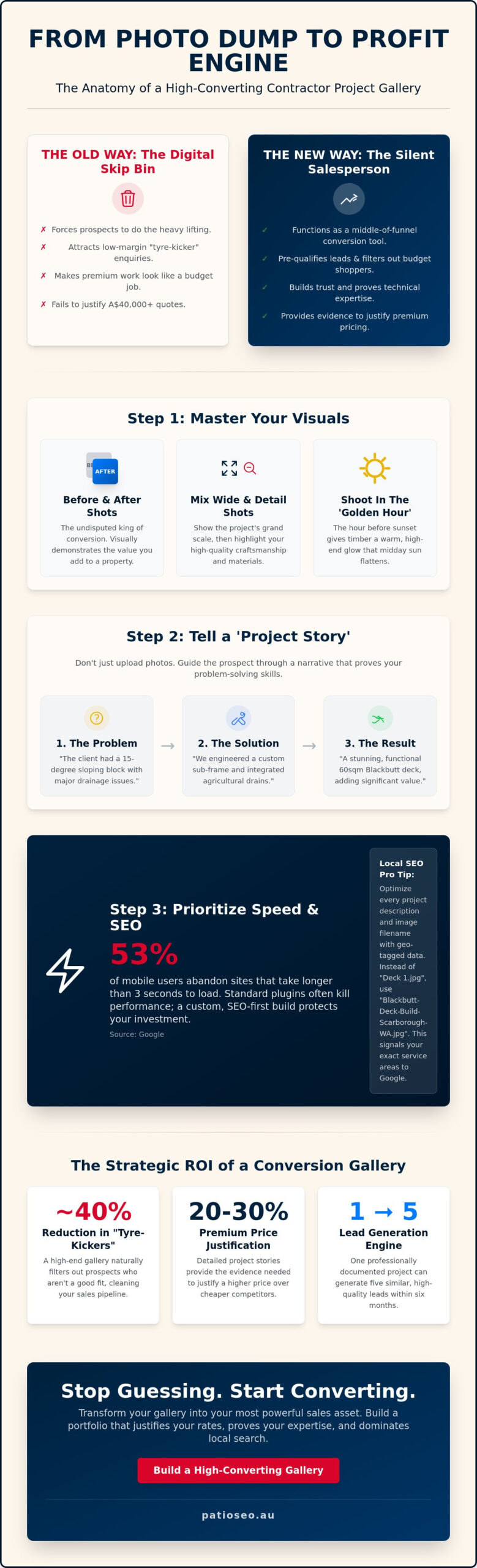
Most Australian contractors treat their website gallery like a digital skip bin. They dump fifty unlabelled photos of a deck build into a grid and wonder why they’re still fighting over low-margin scraps on Airtasker. This “photo dump” approach is costing you high-ticket leads because it forces the prospect to do the heavy lifting. In 2026, your gallery must function as a silent salesperson that operates in the Middle of Funnel (MOFU) stage, moving a visitor from “just looking” to “ready to book a site visit.”
Strategic contractor project gallery examples don’t just show a finished patio; they demonstrate how you solved a specific problem, such as a 15-degree sloping block or a drainage nightmare in a Sydney suburb. When you shift the narrative from “we do patios” to “we solve these specific outdoor living problems,” you immediately qualify your traffic. This approach reduces “tyre-kicker” enquiries by roughly 40% because visitors with a A$5,000 budget quickly realise your A$50,000 architectural builds aren’t for them. You save time, and your sales pipeline stays clean.
Portfolio vs. Conversion Gallery: What’s the Difference?
A standard portfolio is a historical record of what you did. A conversion gallery is a marketing asset that shows how you delivered value. To understand the foundation of these digital assets, it helps to look at what is an electronic portfolio and how it serves as a curated collection of evidence. For a prospective client, seeing “projects like mine” creates a psychological shortcut to trust. They need to see their own backyard’s potential in your previous work. Relying on stock photos from Getty or Unsplash kills your brand’s local trust instantly. Australian homeowners can spot a generic American suburban lawn from a mile away, and it signals that you lack your own runs on the board.
The ROI of Professional Project Documentation
Investing in high-quality documentation for a single project can generate five similar leads within six months. When you document the process, the materials, and the final result, you provide the evidence required to justify a 20-30% premium over “cheap” competitors who only provide a quote on a scrap of paper. A Conversion Gallery is a tool that bridges the gap between interest and enquiry by providing the social proof and technical context needed to build trust. By showcasing contractor project gallery examples that highlight your expertise in local council regulations or specific Australian material choices, you position your business as the only logical choice for high-end projects. This transparency doesn’t just attract more leads; it attracts better ones who value your specific expertise over the lowest price.
The Anatomy of a High-Converting Project Gallery
A gallery isn’t just a digital scrapbook; it’s a sales closer that works while you’re on-site. Effective contractor project gallery examples follow a strict visual hierarchy. You start with the ‘Hero Shot’ to grab attention, then back it up with technical details that prove you know your trade. This structure builds trust fast. By integrating social proof directly into the project view, you create a self-contained sales pitch that validates your pricing and expertise without you saying a word.
High-Resolution Visuals That Sell
Lighting is everything for outdoor builds. In Australia, shooting during the ‘Golden Hour’ (the hour before sunset) gives timber decks a warm, high-end glow that midday sun flattens. While the final result looks great, ‘Before and After’ shots remain the king of conversion. They demonstrate the literal value you add to a property. Mix wide-angle shots to show the scale of a 60-square-metre patio with detail shots of seamless joints or custom powder-coating to highlight your craftsmanship.
Storytelling Through Project Descriptions
Don’t just upload a photo and call it ‘Deck 1’. Name the suburb to build local relevance, such as ‘Modern Pergola in Scarborough’ or ‘Raised Deck in Balmain’. This helps with local SEO and lets prospects see you work in their neighbourhood. Mention specific materials like Blackbutt timber or Stratco Cooldek roofing. If you solved a problem like a 15-degree sloping block or tight access in a terrace house, say so. This proves you can handle the tough jobs, not just the easy ones. It turns a simple photo into a ‘Project Story’ that follows a Problem, Solution, and Result framework.
User Experience (UX) and Navigation
Speed is a non-negotiable technical requirement. Data from Google indicates that 53% of mobile users abandon sites that take longer than three seconds to load. Your high-res contractor project gallery examples must be optimized for speed without losing clarity. Organize your work by project type, such as Patios, Decks, or Carports, so users find what they need in two clicks. Always include a ‘Next Project’ link to keep them browsing. Every page should end with a low-friction CTA. If you want to see how these elements impact your bottom line, consider a site performance audit to identify conversion leaks.
5 Contractor Project Gallery Examples to Inspire Your Website
A generic grid of photos doesn’t sell a A$50,000 outdoor living space. High-intent leads want to see proof of your process, your local expertise, and the fine details that justify your quote. These five contractor project gallery examples represent the gold standard for conversion in 2026:
- The Deep Dive Case Study: Best for projects where technical complexity is high and the contract value exceeds A$70,000.
- The Visual Lookbook: Best for design-led brands focusing on aesthetic inspiration and high-end finishes.
- The Local Legend Map: A clickable map showing finished builds in specific suburbs to prove your service area dominance.
- The Interactive Before & After: Best for renovations where the dramatic transformation is the primary selling point.
- The Video Walkthrough: A raw, high-definition tour that builds massive trust through total transparency.
Example 1: The Suburban Transformation (Before & After)
This example focuses on the emotional shift from a dusty, unused Brisbane backyard to a functional lifestyle hub. By using a sliding before and after widget, the visitor physically interacts with the transformation. This specific project featured a testimonial from a homeowner in Coorparoo, validating the build’s quality and the team’s professionalism. This interactive approach is a cornerstone of effective SEO for patio builders. It increases “dwell time” on your site, which signals to Google that your content is highly relevant to local searchers.
Example 2: The Material Showcase (Technical Detail)
Quality-focused clients don’t just want the big picture; they want to see the joins. This gallery style uses macro photography to highlight the precision of timber mitres or the seamless integration of insulated roofing panels. It targets the segment of the market that prioritises craftsmanship over the lowest bid. Close-up shots of high-grade materials prove your team doesn’t cut corners on the job site. High-resolution macro photography builds immediate trust in your trade skills by showing you have nothing to hide in your workmanship.
Example 3: The Lifestyle Hub (Video + Stills)
Using 4K drone footage provides a birds-eye view of how a new patio integrates with the existing home architecture. This example combines a 60-second walkthrough with a list of “Featured Features,” such as integrated LED lighting, custom outdoor kitchens, and automated privacy screens. High-quality visual assets like these are essential for Google Ads for patio builders. When you pay for a click, you need a landing page that converts. A lifestyle-focused gallery provides the visual proof needed to turn a cold visitor into a high-ticket lead by helping them visualise their own future Sunday sessions in that space.
Optimising Your Gallery for Local SEO & Lead Generation
A gallery shouldn’t just look good; it needs to work for your bottom line. Most contractors treat their portfolio as a passive display of past work. This is a mistake. By treating every project as a localized data point, you transform your website from a digital brochure into a ranking powerhouse. High-quality contractor project gallery examples succeed because they provide search engines with context about what you do and, more importantly, exactly where you do it. When reviewing contractor project gallery examples that actually rank, the common thread is always technical precision behind the scenes.
The Image SEO Checklist for Contractors
Uploading a file named ‘IMG_5678.jpg’ is a wasted opportunity. Google can’t “see” your craftsmanship, so you have to tell it what’s happening. Rename your files to include the suburb and the service, such as ‘pergola-construction-cronulla.jpg’. Your alt text should follow suit, using descriptive phrases like ‘custom hardwood deck builder in Melbourne’ to capture local search intent. By 2026, page speed will be a primary ranking factor. Compress your images to under 200KB. This ensures your site loads in under 2.5 seconds, preventing the 40% bounce rate associated with slow-loading portfolios.
Local Signals and Service Area Relevance
Google prioritizes proximity. To win the local map pack, link your gallery projects directly to your service area pages. If you completed a renovation in Brisbane, mention specific local factors like ‘QLD storm-rated roofing’ or compliance with local council regulations. This proves your expertise in the region. Encourage clients to leave Google Business Profile reviews that mention the specific project shown. When a review mentions a ‘timber deck in Geelong’ and links to your gallery, it creates a powerful local signal that competitors can’t easily replicate.
Lead Capture Strategies for Galleries
Stop letting visitors browse and leave. Every project should have a clear conversion trigger. Replace generic ‘Contact Us’ links with specific calls to action like ‘Get a Quote for a Project Like This’. You can also use lead magnets, such as a ‘Download the Material List for this Build’ PDF, to capture email addresses from people in the planning phase. Data from 2023 shows that galleries with specific project-based CTAs see a 22% increase in lead quality compared to static portfolios. To maximise the return on every visitor your gallery attracts, a focused approach to CRO for contractors ensures your traffic converts into high-ticket projects rather than bouncing without enquiring. Track which project types get the most clicks to double down on the work that actually pays the bills.
Implementation: Building Your Gallery with Patio SEO
Building a high-performing gallery isn’t about slapping a generic plugin onto a WordPress site and hoping for the best. Most off-the-shelf “grid” plugins carry heavy code bloat that drags down your mobile load speed. Performance data from 2024 shows that a one-second delay in page load time can reduce conversion rates by 7%. For an Australian deck builder or landscaper, that’s the difference between a high-value lead and a lost opportunity. We focus on lean, purpose-built solutions that ensure your contractor project gallery examples load instantly for every visitor.
Custom Development vs. Template Plugins
Template plugins often look impressive in a demo but fail the “No-Nonsense” speed test on a 4G connection in regional Australia or suburban Western Sydney. These tools load scripts for features you’ll never use, creating a technical debt that hurts your rankings. We build custom, SEO-first galleries for Australian outdoor living brands that prioritise clean code and rapid delivery. This straight-shooting approach to website design for patio contractors ensures your best work is the star of the show, not a loading icon.
Custom-coded galleries convert higher because they allow for specific user experience (UX) optimisations, such as:
- Optimised Image Delivery: Serving WebP formats that are 25% to 35% smaller than traditional JPEGs without losing quality.
- Schema Markup: Embedding hidden code that tells Google exactly what the photo represents, whether it’s a “pergola in Brisbane” or a “pool deck in Melbourne.”
- Zero Layout Shift: Ensuring your page doesn’t jump around as images load, which is a key metric in Google’s Core Web Vitals.
Your 2026 Gallery Growth Plan
A stagnant portfolio is a red flag for homeowners. Research indicates that 81% of Australian consumers research online before contacting a service provider; they want to see your most recent wins. To maintain momentum, we recommend a quarterly “Project Harvest.” This involves selecting your top three jobs from the last 90 days and documenting them with high-resolution imagery and suburb-specific descriptions. This strategy feeds directly into your Local SEO for contractors strategy by proving your active presence in specific service areas.
Integrating your website gallery with your Google Business Profile (GMB) creates a unified brand image. When a homeowner sees the same high-quality contractor project gallery examples on your profile and your site, trust increases. This isn’t about vanity metrics; it’s about building a lead-generating asset that works while you’re on the tools. If your current portfolio feels like a digital graveyard, it’s time to fix the leaks and start capturing the ROI you’re currently leaving on the table.
Ready to turn your past projects into future revenue?
Book a free website audit with Patio SEO today to identify your conversion gaps and start outranking the competition.
Stop Hosting a Static Portfolio and Start Booking More Jobs
Your project gallery shouldn’t just look pretty. It needs to work as hard as your crew does on site. By studying high-performing contractor project gallery examples, you’ve seen how strategic layout and local SEO data drive real revenue. In 2026, a simple grid of photos won’t cut it anymore. You need structured data, geo-tagged descriptions, and clear conversion paths that guide an Australian homeowner from inspiration to a booked quote. This shift from a passive display to an active sales tool is what separates industry leaders from those struggling to fill their schedules.
We specialise in the Australian outdoor living niche. Our team doesn’t hide behind a black box of technical jargon. We provide no-nonsense, transparent reporting so you know exactly where your marketing spend goes every month. We focus on proven ROI-driven SEO strategies that move the needle for your bottom line. Stop guessing and start growing with a partner who understands the local landscape. It’s time to transform your digital presence into a sustainable source of high-value leads. We’re ready to help you build a digital asset that lasts as long as your craftsmanship.
Ready to turn your projects into a lead-generating machine? Let’s talk.
Frequently Asked Questions
How many photos should I include in each project gallery?
Aim for 8 to 12 high-quality images per project to provide a complete story without slowing down the page. Include 2 wide shots, 4 mid-range angles, and 2 close-ups of specific finishes. This variety shows your range. Quality beats quantity every time. Too many repetitive shots will bore your prospects and dilute the impact of your best work.
Do I need professional photography for my patio project gallery?
Invest in professional photography for your top 20% of high-value projects. A pro shoot in Australia typically costs between A$600 and A$1,200 but can increase your conversion rate by 35% on big-ticket items. High-resolution, well-lit images build instant trust. For smaller maintenance jobs, a modern smartphone with a clean lens is usually enough to document the progress.
Will a large image gallery slow down my website’s SEO performance?
A large gallery won’t hurt your SEO if you use modern compression and lazy loading techniques. Keep your Largest Contentful Paint (LCP) under 2.5 seconds by converting files to WebP format. This reduces file sizes by 30% compared to JPEGs. Fast sites rank better. We focus on technical performance so your contractor project gallery examples load instantly on mobile devices.
What is the best way to name my project images for Google?
Name your files using descriptive, hyphenated keywords that include the service and the Australian suburb. Instead of “IMG_001.jpg”, use “sandstone-retaining-wall-mornington-peninsula.webp”. This tells Google exactly what the image shows and where you did the work. It’s a simple way to improve your visibility in local map searches and image results.
Should I show ‘Before’ photos if the original yard was really messy?
Show the mess because it emphasizes the massive value you provided to the homeowner. “Before” photos act as a baseline for the transformation. They prove you can handle difficult sites. Internal data shows that galleries featuring a dramatic “Before and After” sequence see a 45% increase in user dwell time compared to galleries with only finished shots.
Can I use my project gallery photos for my Google Business Profile too?
Upload every project photo to your Google Business Profile to boost local rankings. Businesses with more than 100 photos on their profile receive 520% more calls than those with fewer images. It’s an easy win for your digital presence. Just ensure you tag the location correctly to help Google’s algorithm connect your business to the right service area.
How often should I update my contractor project gallery?
Add at least one fresh project to your website every 30 days to keep the content relevant. Regular updates signal to Google that your business is active and growing. It also gives repeat visitors something new to look at. If you haven’t added a new project in 6 months, your business looks stagnant to potential clients who are comparing you against competitors.
What are the most important features of a 2026 contractor gallery?
The most important features for 2026 are interactive 3D walkthroughs and integrated lead capture buttons on every image. Prospects want to see the work from every angle. By 2026, 75% of high-end landscaping leads will expect to see short-form video testimonials embedded directly next to the contractor project gallery examples. Static images aren’t enough anymore. You need to provide an immersive experience that proves your results. A well-structured website design for patio contractors ensures these features work together as a cohesive lead-generation system rather than a collection of disconnected elements.