


Most Australian patio builders are currently overpaying for leads by 35% because they follow generic advice from agencies that don’t know a gable roof from a skillion. If you feel like your marketing spend is a black hole rather than a growth engine, you aren’t alone. It’s frustrating to see your dashboard light up with clicks that never turn into a signed contract. You’re likely tired of subsidising Google’s profits while your own margins get squeezed by rising operational costs in 2026.
We’re here to cut through the noise. You deserve a contractor google ads budget built on hard data, not hopeful guesses. This guide provides the exact formula to set a budget that generates high-ticket leads without wasting a cent on “junk” traffic. We will break down the 2026 Australian market conditions, show you how to calculate spend based on your specific revenue targets, and give you the confidence to treat your marketing as a predictable investment rather than a gamble. It is time to stop guessing and start growing with a lead pipeline that actually delivers.
Key Takeaways
- Master the “Reverse-Engineering” formula to link your ad spend directly to high-ticket project values and gross margins for maximum ROI.
- Determine a competitive contractor google ads budget tailored for the Australian market, distinguishing between initial test phases and aggressive growth targets.
- Navigate local cost-per-click variations across major hubs like Sydney and Melbourne while adjusting your spend for the Australian “Summer Rush.”
- Prioritize conversion quality by pairing your budget with a high-performing website to avoid wasting thousands on low-intent traffic.
- Eliminate billing confusion by separating direct ad spend from management fees, ensuring full transparency in your digital marketing investment.
The Reality of Contractor Google Ads Budgets in 2026
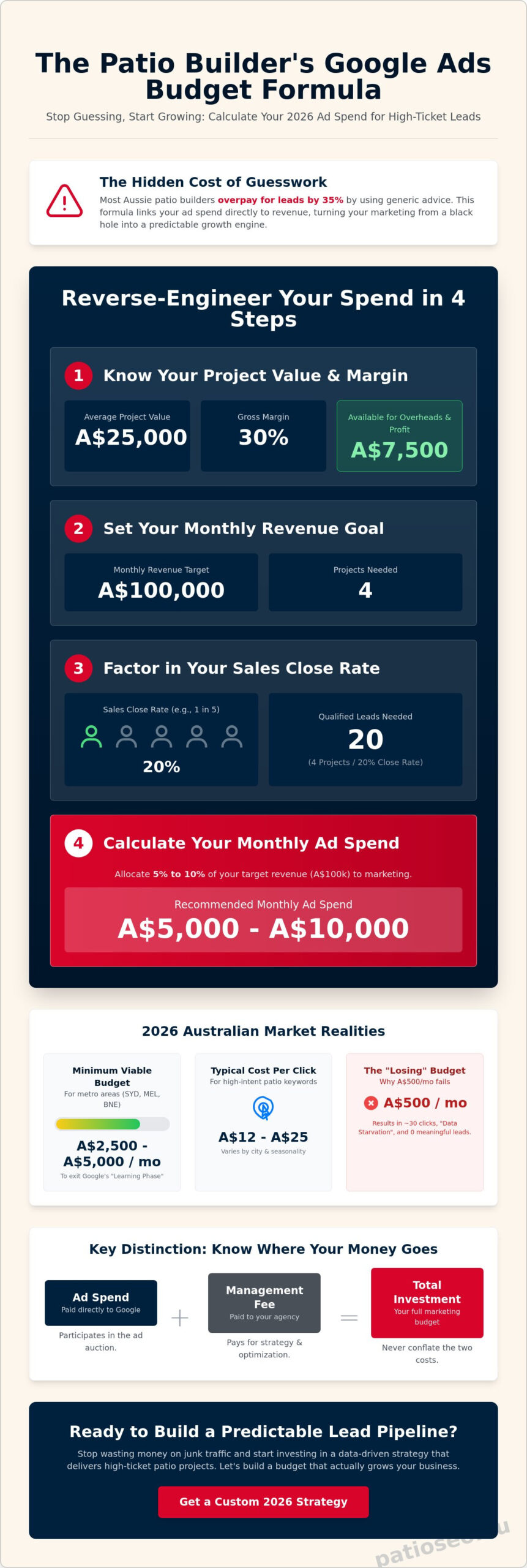
Setting a contractor google ads budget for 2026 requires a clear distinction between two separate costs. Your “Ad Spend” is the capital paid directly to Google to participate in the auction, while “Management Fees” are what you pay an agency to optimize those campaigns. Conflating these two is a common mistake that leads to underfunded campaigns and poor ROI. In the Australian market, Online advertising has become more competitive, meaning a “daily coffee budget” of A$5 or A$10 no longer works for high-ticket outdoor living projects. If you are chasing A$40,000 patio builds, you cannot expect to win with a budget designed for a local lawnmower.
Google’s algorithm relies on the “Learning Phase” to understand which users are most likely to convert. This phase requires data. If your budget is too thin, your ads won’t trigger enough impressions to gather that data, leaving your account stuck in a permanent state of underperformance. For 2026, Australian benchmarks for patio and deck construction suggest a minimum entry point of A$2,500 to A$5,000 in monthly ad spend for metropolitan areas like Brisbane, Sydney, or Melbourne to remain competitive in the auction.
Why Guesswork is Killing Your Lead Flow
Underfunding your account is the fastest way to lose money. A budget of A$500 per month in a high-competition niche often results in zero meaningful data because you aren’t winning enough auctions to see patterns. When your budget is low, Google’s AI struggles to identify which keywords actually lead to phone calls. This leads to “impression share loss,” where your ads are hidden for 80% of the day because you’ve already spent your tiny daily limit by 9:00 AM.
- Data Starvation: Low budgets prevent the algorithm from testing different headlines and audiences.
- Auction Suppression: Google prioritizes accounts with a history of consistent, healthy spending.
- High CPCs: In 2026, patio-related clicks in Australia can range from A$12 to A$25, meaning a A$500 budget only buys about 30 clicks a month.
To successfully exit the learning phase and achieve stable performance, your daily budget must be at least five to ten times your target cost-per-acquisition.
Patio vs. General Tradie Budgets
A deck builder needs a fundamentally different contractor google ads budget than an emergency plumber or an electrician. A plumber might spend A$50 to acquire a A$300 job. However, for a patio builder, a single lead might cost A$150, but the resulting project value is A$35,000. This high-ticket nature means you must be comfortable with a higher Cost Per Acquisition (CPA) because the return on investment is exponentially larger.
Successful builders in 2026 view their ad spend as a percentage of their revenue goals rather than an arbitrary monthly expense. Transparency is key here; you need to know exactly how much you are willing to pay for a qualified lead that turns into a signed contract. For a deeper dive into these specific metrics, see our guide on Google Ads for patio builders. We focus on high-intent keywords that skip the “tyre-kickers” and target homeowners ready to invest in their outdoor space. It’s about buying the right traffic, not just the cheapest traffic.
The Contractor ROI Formula: Reverse-Engineering Your Spend
Most Australian tradies set their contractor google ads budget by looking at what is left in the bank account at the end of the month. This approach is reactive and limits your growth. To build a sustainable lead machine, you must work backwards from your revenue goals. Stop guessing and start calculating based on three core metrics.
First, identify your Average Project Value (APV) and your gross margin. If a standard patio installation averages A$25,000 and your margin is 30%, you have A$7,500 to cover overheads, marketing, and profit. Second, determine your sales close rate. If you sign one contract for every five qualified leads, your close rate is 20%. Finally, calculate the volume of leads required to hit your monthly revenue targets. If you want A$100,000 in new monthly contracts, you need four sales, which requires twenty qualified leads.
The “Straight-Shooter” rule for established businesses is to allocate 5-10% of your target revenue toward marketing. While the U.S. Small Business Administration provides similar benchmarks for small businesses, Australian contractors often find the 8% mark is the “sweet spot” for aggressive growth without overextending cash flow. Deciding on a contractor google ads budget using these percentages ensures your spend stays proportional to your actual business capacity.
Calculating Your Target Cost Per Lead
Tracking your lead-to-sale conversion rate is the only way to prove your marketing works. In the outdoor living niche, there is a massive difference between a “click” and a “qualified lead.” A click is someone looking for inspiration on Pinterest. A lead is a homeowner in your service area who has requested a quote. Aim for a 3:1 or 4:1 ROI as your baseline. If a project nets you A$8,000 in gross profit, spending A$2,000 to acquire that customer is a logical, profitable move. You can see how these numbers apply to your specific region by reviewing our performance benchmarks.
Budgeting for High-Ticket vs. Small Repairs
Your bid strategy must reflect project profitability. A A$30,000 patio project justifies a much higher Cost Per Lead (CPL) than a A$500 deck repair. If you bid the same amount for “deck repair” as you do for “custom patio builder,” you will burn through your budget on low-margin work. “Cheap leads” are often the most expensive because they waste your time in the quoting phase. Focus your spend on high-intent, high-value keywords. This ensures your team spends time on sites that actually move the needle for your bottom line. Understanding the full scope of google ads management for contractors is essential to ensuring every dollar you invest targets homeowners ready to commit to premium projects rather than price-shoppers seeking a quick repair. For deck builders specifically, pairing your budget strategy with ad copy for deck builders that filters out low-budget enquiries is one of the most effective ways to protect your margins and attract clients who are ready to invest in a premium build.
Starting Small vs. Scaling Fast: Which Strategy Fits You?
Choosing your contractor google ads budget isn’t a set and forget decision. You’re either testing the waters to find what works or you’re looking to dominate your local market. For most Australian contractors, the “Test & Learn” phase requires a monthly spend between A$1,500 and A$2,500. This range provides enough “fuel” for the Google algorithm to identify which search terms actually lead to phone calls rather than just tyre-kickers. You’re essentially buying data during these first few months to see which suburbs and services yield the highest profit margins.
If your business already has a solid sales process and the capacity for more projects, an “Aggressive Growth” strategy involves pushing past A$5,000 AUD per month. At this level, you’ll likely see a “Limited by Budget” warning in your Google Ads dashboard. This status is a clear sign you’re losing money to competitors because your ads stop showing before the day is over. Following Small Business Administration recommendations, viewing this spend as a strategic investment rather than an overhead is vital for long-term stability. The smartest move is to re-invest a fixed percentage of profits from every closed job back into your ad account to compound your growth.
The 90-Day Test Budget Framework
Don’t judge your ROI in the first 30 days. The first month is about calibration; the second month is about refinement; and only by the third month do you see the true performance of your contractor google ads budget. You need consistent spend to move past the “learning phase” where Google’s AI tests different bidding strategies. A minimum viable data set for a new campaign consists of at least 100 high-intent clicks per core service category to statistically validate conversion rates. This data tells you exactly what a lead costs in your specific city.
Knowing When to Scale Your Spend
Scaling isn’t just about throwing more money at the screen. You should only increase your budget when you’ve identified “winning” keywords that consistently produce a low cost per acquisition. However, be aware of the “Diminishing Returns” trap. Every local market has a ceiling where spending more doesn’t result in more leads because you’ve already captured the available search volume. To combat this, smart contractors use SEO for patio builders to build organic authority. This hybrid approach lowers your overall blended lead cost by capturing “free” traffic alongside your paid ads, ensuring you don’t overpay for growth as you scale.
Australian Market Factors: Why Location and Seasonality Matter
The Australian landscape dictates your contractor google ads budget more than any global algorithm ever will. A lead in Sydney’s Eastern Suburbs or Melbourne’s inner north carries a vastly different price tag than one in regional Queensland. In hyper-competitive metro hubs, you are often bidding against dozens of established firms for the same limited search volume. This density pushes Click-Per-Cost (CPC) rates higher, requiring a more aggressive daily spend to maintain visibility. You aren’t just competing with other patio builders; you’re fighting for digital real estate against solar companies and general renovators who bid on similar “home improvement” keywords.
Regional Cost Variations
Location targeting is where most budgets bleed out. Internal data indicates that Brisbane patio leads often cost 30% more than Toowoomba leads simply because of bidder density. If you operate in a major city, your budget must account for this premium. You can protect your margins by using “Negative Locations.” This stops you from paying for clicks in suburbs outside your service radius or in areas where council regulations make builds difficult. Focus your spend on high-value postcodes where property equity is high and homeowners are more likely to commit to premium projects. It’s about spending smarter, not just spending more.
The Seasonality Strategy
Stopping your ads when the temperature drops is a tactical error. While many contractors kill their spend in June, smart operators pivot their strategy. Winter is for the “Planning Phase.” Use this time to capture homeowners researching designs and seeking council approvals. This ensures your pipeline is full when the “New Year, New Patio” surge hits in January and February. During these peak months, search volume typically spikes by 40% or more. You should plan to scale your contractor google ads budget by at least 20% during the late spring to capture this intent before your competitors wake up.
Australian building regulations and local council lead times also impact your budgeting logic. If current approval wait times are sitting at 10 weeks, you need to ramp up your ad spend 12 to 14 weeks before you want those jobs on the tools. Managing cash flow during peak construction months is easier when you have a predictable stream of leads arriving via a well-calibrated campaign. We help you cut through the noise with a bespoke Google Ads strategy that prioritizes your bottom line over vanity metrics.
Success in the Australian market requires a pragmatic approach to data. You must account for the 8-12 week lead times common in our industry. If you want your teams busy in December, your peak advertising activity needs to happen in August and September. This forward-thinking alignment of budget and building cycles is what separates profitable contractors from those who are constantly chasing their tail.
Maximising Your Budget: Quality Over Quantity
Throwing money at a broken bucket won’t fill it any faster. In the Australian construction market, a contractor google ads budget of A$2,000 paired with a high-converting landing page consistently outperforms a A$5,000 spend that directs traffic to a generic, slow-loading homepage. Success in 2026 isn’t about outspending the big players; it’s about out-thinking them through sheer efficiency.
We protect your daily spend by using aggressive negative keyword lists. This ensures you aren’t paying for “DIY patio kits” or “patio cleaning” searches when you only build custom outdoor living spaces. Every dollar saved on irrelevant clicks is a dollar redirected toward a homeowner ready to sign a contract. At Patio SEO, our management style is transparent. We don’t hide behind “black box” metrics like impressions. We focus on booked projects and actual revenue, ensuring your marketing spend acts as a growth engine rather than a monthly overhead.
The Conversion Rate Factor
Improving your landing page can effectively double your results without increasing your ad spend. If your current site converts at 3% and we move that to 6% through Conversion Rate Optimisation (CRO), you’ve just halved your cost per lead. It’s the most direct way to stretch a contractor google ads budget further. Use this no-nonsense checklist for your patio building landing page:
- High-Resolution Local Work: Use real photos of projects you’ve finished in Australian suburbs, not stock images.
- Lead Qualification Forms: Ask for project size and budget upfront. This saves your sales staff hours of time by filtering out “tyre kickers” before they hit your inbox.
- Social Proof: Display HIA or Master Builders logos alongside recent Google reviews.
- Clear Call to Action: A prominent “Request a Site Measure” button that stays visible as the user scrolls.
Getting a Professional Ad Audit
Most accounts we audit for the first time contain at least 20% “waste.” This usually comes from broad-match keywords that trigger your ads for irrelevant searches or targeting the wrong geographic radius. Generalist agencies often miss these nuances because they don’t understand the specific intent of a homeowner looking for a patio builder versus someone looking for a cheap pergola kit.
Niche-specific management ensures your ads appear only when the intent is high. We look for the “leaks” in your account where money is draining away on low-quality traffic. By tightening these settings, we often find enough hidden budget to fund an entirely new campaign without asking you for another cent. Stop guessing and start measuring with data that actually impacts your bottom line.
Ready to stop wasting spend? Book a free Google Ads budget review with Patio SEO and let’s find the 20% waste in your account.
Stop Guessing and Start Scaling Your Results
Setting a successful contractor google ads budget for 2026 isn’t about picking a random figure. It relies on reverse-engineering your revenue goals and understanding that high-intent leads beat raw click volume every time. In the Australian market, seasonality dictates your strategy. You need to scale your spend when homeowners are actively looking to build, ensuring your A$ works hardest when demand peaks.
Patio SEO cuts through the noise of traditional marketing. We’re an ROI-driven Australian agency specialized in the outdoor living niche. We provide transparent, no-nonsense reporting that connects your spend directly to your bottom line. We don’t hide behind technical jargon or vanity metrics. We focus on the data that grows your business. You deserve a partner who understands the grit of the construction industry and the precision of digital performance.
Get a Custom Google Ads Budget Plan for Your Patio Business
It’s time to stop wasting money on clicks that go nowhere and start building a lead machine that lasts.
Frequently Asked Questions
What is the minimum Google Ads budget for a patio contractor?
For an Australian patio contractor, a minimum starting budget of A$1,500 to A$2,500 per month is necessary to gather enough data for optimization. Spending less often results in your ads not appearing during peak search times, which hands leads directly to your competitors. This range allows for a testing phase where we identify which high-intent keywords actually turn into signed contracts for your business.
How much does a click cost for deck builders in Australia?
Deck builders in Australia typically see a cost-per-click ranging from A$4.50 to A$12.00 depending on the specific region. In high-competition markets like Sydney or Melbourne, prices often sit at the higher end of that scale. We track these benchmarks to ensure your contractor google ads budget isn’t being drained by overbidding on low-conversion terms while maintaining a competitive position for premium deck projects.
Should I spend more on Google Ads or SEO first?
Start with Google Ads if you need leads this week; invest in SEO if you want to lower your lead costs over the next 12 months. Most successful contractors split their investment, using 70% of their initial marketing spend on Ads to generate immediate revenue. This cash flow then funds the organic growth strategy, which eventually provides a more sustainable, lower-cost source of jobs as your rankings improve.
How long does it take to see leads from a new Google Ads budget?
You can expect to see traffic hitting your website within 24 hours of a campaign launch. However, the first 30 days are a learning period where the algorithm settles and we refine the targeting. By the second month, lead quality usually stabilizes as we exclude tyre-kickers and refine your contractor google ads budget toward the most profitable postcodes. Real results come from the data we collect in those initial four weeks.
Can I run Google Ads on a $500 monthly budget?
Running a campaign on A$500 a month is possible but rarely profitable for Australian contractors. With average click costs around A$6.00, that budget only buys roughly 83 clicks per month, or less than three clicks per day. You won’t generate enough data to optimize the campaign effectively. It’s better to save that money until you can commit to a more competitive daily spend that delivers consistent volume.
Do I need to increase my budget for mobile users?
You don’t necessarily need a separate budget, but you must allocate the majority of your spend to mobile devices. Current Australian search data shows that 65% to 75% of home improvement queries happen on smartphones. We focus your spend on click-to-call extensions and mobile-fast landing pages. This ensures your budget goes toward users who are ready to book a site visit immediately from their phone.
What happens to my budget if I don’t use it all in one month?
Google Ads operates on a pay-per-click basis, so you only pay for actual traffic received. If there’s a dip in search volume or we pause ads during a rainy week, any unspent portion of your monthly limit stays in your pocket. It doesn’t disappear at the end of the month. This transparency allows us to scale your spending up or down based on your current crew capacity and local weather conditions.
How do I know if my Google Ads budget is being wasted?
Waste is visible in your Search Terms Report, where you’ll see if you’re paying for irrelevant clicks like DIY patio repairs. If your conversion rate is below 5% or your cost-per-lead exceeds your profit margin, your budget is being mismanaged. We provide transparent reporting that links every dollar spent to a specific lead, so you can see exactly which ads are building your business and which are just noise.