

Your website is likely your most expensive underperformer. While the 2024 industry average conversion rate for home services sits at just 6.64%, many Australian tradies are watching their Google Ads budget vanish with nothing to show but a few tyre-kickers asking for free advice. It’s frustrating to pay for clicks that don’t turn into high-value contracts. You already know that simply having a digital brochure isn’t enough to stay competitive in 2026. You need a platform that actually closes the deal while you’re out on the tools. This is where conversion rate optimisation for trade businesses becomes your most powerful lead generation tool.
We’re here to stop the bleed. This guide explains how to transform your current traffic into a steady stream of premium quotes without increasing your marketing spend by a single dollar. You’ll learn the exact technical shifts and psychological triggers that move a prospect from just looking to booking a site visit. We’re moving past the brochure era and showing you how to build a website that works as hard as your crew does. From reducing your cost-per-lead to filtering for big projects, this is your no-nonsense roadmap to better ROI.
Key Takeaways
- Stop burning your marketing budget on traffic that doesn’t convert; learn why 1,000 visitors mean nothing if they aren’t picking up the phone.
- Identify the hidden “friction points” on your site, like slow load speeds and buried contact details, that are quietly driving potential customers to the competition.
- Apply a data-driven 5-step framework for conversion rate optimisation for trade businesses to replace guesswork with a steady stream of high-value quotes.
- Future-proof your digital presence with 2026 tactics like “Click to WhatsApp” and high-converting project galleries that build immediate trust and capture leads instantly.
- Shift your focus from vanity metrics to real-world revenue by building a lead-generation machine designed to scale your trade business to A$2M and beyond.
Why Traffic Doesn’t Equal Revenue: CRO for Trade Businesses
Many tradies think more traffic is the only way to grow. They pour thousands into Google Ads or SEO, watching their visitor count climb while their phone stays silent. This disconnect is the “Conversion Gap.” In the Australian outdoor living industry, where a single patio or deck project often exceeds A$25,000, losing a lead because your website is confusing isn’t just a mistake; it’s a massive revenue leak. What is Conversion Rate Optimization? At its core, conversion rate optimisation for trade businesses is the process of fine-tuning your website so a higher percentage of those visitors actually pick up the phone or fill out a quote form.
SEO gets people to your front door. CRO makes them walk in and ask for a price. If you have 1,000 visitors and zero calls, the traffic source isn’t the problem. The structural failure lies within the user experience on your site. You don’t need more people; you need a better bucket. Most trade websites in Australia act as static digital brochures that fail to answer the one question every homeowner has: “Can I trust you with my backyard?”
The Math of Growth: Why 2% is Better Than 1%
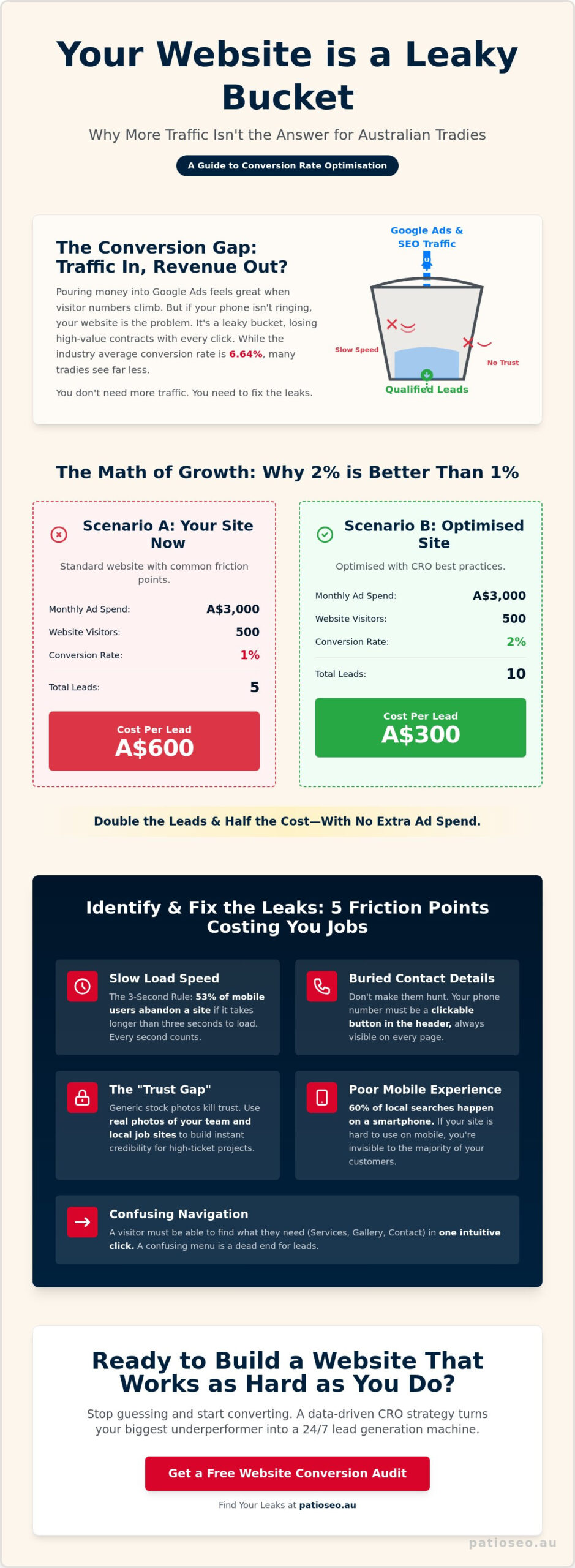
Doubling your business doesn’t always require doubling your marketing spend. Imagine you spend A$3,000 per month on Google Ads to generate 500 visitors. At a 1% conversion rate, you get 5 leads at a cost of A$600 per lead. By improving your site’s layout and trust signals to reach a 2% conversion rate, you get 10 leads for that same A$3,000 spend. Your lead cost drops to A$300 instantly. Trade marketing is a leaky bucket where every hole you plug translates directly into more profit without increasing your ad budget.
Micro vs. Macro Conversions for Contractors
We track two types of actions to understand where your leads are dropping off. Macro conversions are the big wins, like a direct click-to-call or a completed “Request a Quote” form. Micro conversions are the smaller steps people take before they’re ready to commit. These include viewing a project gallery for more than 60 seconds, clicking your GMB map link, or downloading a patio design guide.
Tracking these smaller actions reveals exactly where potential customers lose interest. If 45% of visitors look at your gallery but only 1% hit the contact page, your portfolio isn’t doing the heavy lifting it should. Effective conversion rate optimisation for trade businesses uses this data to bridge the gap between curiosity and a signed contract. It turns your website from a passive expense into an active salesperson that works 24/7.
Identifying Friction: Why Your Tradie Website is Leaking Leads
Most business owners tell us their website looks fine. Looking fine doesn’t pay the bills. If your traffic is high but your phone isn’t ringing, you have a friction problem. High friction happens when a visitor wants to hire you but your website makes it difficult to do so. Effective conversion rate optimisation for trade businesses focuses on the overall user experience, ensuring every click feels intuitive rather than like a chore.
Friction often hides in plain sight. It’s the three second lag in page loading that causes 53% of mobile users to abandon a site. It’s the phone number buried at the bottom of a “Contact Us” page instead of being clickable at the top. For high-ticket trades like roofing or solar, a “Trust Gap” exists. Homeowners are hesitant to hand over personal details for an A$10,000 job if the site feels outdated or anonymous. In an Australian market where 60% of local searches happen on a smartphone while someone is standing in a leaky kitchen, mobile responsiveness isn’t a luxury; it’s your primary storefront.
The 3-Second Rule for Local Trades
You have three seconds to answer two questions: What do you do? Where do you do it? If a visitor has to scroll to find out you serve Scarborough or Melbourne, they’re gone. Generic stock photos of American suburban houses create instant distrust. Real photos of your team on local job sites build immediate rapport. Confusing navigation kills the user’s intent to buy. Keep your menu simple so they can find your services and your proof of work without thinking. A quick audit of your current layout is the first step toward better digital performance.
Form Fatigue and the Barrier to Entry
Long quote forms are lead killers. Asking for a full street address, project budget, and a detailed description in 12 mandatory fields creates massive psychological resistance. Most visitors prefer a low-commitment first step. They want to know you’re available and capable before they spend ten minutes typing on a tiny screen.
- Simple Contact Forms: Name, phone, and suburb. This lowers the barrier and gets the conversation started.
- Complex Project Builders: These often lead to “form fatigue” where the user quits halfway through.
- The SMS Option: Offering a “Text us a photo of the job” button often converts 30% better than a standard web form for emergency repairs.
Smart conversion rate optimisation for trade businesses replaces these hurdles with bridges. By reducing the number of fields and focusing on the immediate needs of the homeowner, you turn a passive browser into a hot lead. Stop asking for a marriage proposal on the first date; just aim for the phone call.
The 5-Step Framework for Optimising a Trade Website
Stop guessing what your customers want. Effective conversion rate optimisation for trade businesses relies on a repeatable, data-backed cycle that turns a quiet website into a lead-generating machine. We don’t rely on “gut feelings” at Patio SEO; we rely on what the numbers tell us. If your site isn’t converting, there’s a specific reason why, and this framework helps us find it.
- Step 1: Data Collection. We use tools like heatmaps and scroll maps to see exactly where your visitors get stuck. If 55% of your users drop off before seeing your gallery, we know your page layout is killing your sales.
- Step 2: Hypothesis. We identify one specific element to change based on the data. For example, we might hypothesise that changing a “Submit” button to a high-contrast “Get My Free Quote” button will increase clicks by 15%.
- Step 3: Testing. We run A/B tests. This involves showing version A to half your visitors and version B to the other half. This identifies the winner without risking your existing lead flow.
- Step 4: Analysis. We look at the results. We don’t just care about clicks; we care about whether those clicks turned into A$5,000 or A$50,000 project enquiries.
- Step 5: Implementation. We make the winning version permanent. Once that friction point is gone, we move to the next one. It’s a process of continuous improvement.
The “Above the Fold” Checklist
The top section of your website is your most valuable digital real estate. You have roughly 3 seconds to convince a homeowner you’re the right choice. Your Unique Value Proposition (UVP) must be clear. Instead of “We build patios,” try “Custom Patios Built for the QLD Sun in 14 Days.” Ensure your phone number is a click-to-call button that stays visible as the user scrolls. Finally, place your 4.8-star Google rating right next to your main heading. This immediate social proof reduces bounce rates by providing instant credibility.
A/B Testing for Beginners
You don’t need a degree in data science to start testing. Begin with your call-to-action (CTA) text. “Check Availability” often feels less high-pressure than “Get a Quote,” which can increase initial engagement by 10% or more. Next, test your hero image. A professional shot of a completed project might look great, but a photo of your actual team in high-vis gear often builds more trust. Use Google Tag Manager to track these button clicks accurately. It gives you a clear view of which version is actually putting money in your pocket.
Turning Clicks into Quotes: Practical CRO Tactics for 2026
High traffic is a vanity metric if your phone isn’t ringing. Conversion rate optimisation for trade businesses in 2026 requires more than a simple contact form. You need to bridge the gap between a visitor “just looking” and a homeowner ready to “get a quote.” Start by offering instant gratification. Implementing a “Click to WhatsApp” or live chat feature can increase lead volume by up to 27% because it removes the friction of a formal email. People want answers in minutes, not days.
Local trust is your biggest asset. Avoid generic service pages that could apply to any city. Instead, build geo-specific landing pages like “Patio Builders in Scarborough” or “Decking Experts in Chermside.” When a homeowner sees their own suburb mentioned, their trust levels spike. It proves you are active in their area and understand local council regulations or climate needs. This isn’t just about SEO; it’s about being the local authority.
Humanise your business to stand out from the sea of faceless contractors. Use video testimonials where clients show off their finished projects. A video captures the tone of voice and genuine satisfaction that a written quote simply cannot replicate. It builds authority and makes the prospect feel like they already know the quality of your work.
The Power of the Project Gallery
Stop treating your gallery like a digital scrapbook. A high-converting gallery functions as a collection of mini case studies. Use “Before & After” sliders to show the literal transformation you provide. Include the project duration, such as “Completed in 12 days,” to set realistic expectations for your leads. For deeper technical guidance on layout, see How to Build a High-Converting Project Gallery. Always optimise your image alt-text with descriptive, keyword-rich language. This helps Google index your work and ensures your site remains accessible to all users.
Social Proof that Actually Sells
A dedicated “Testimonials” page is often ignored. Instead, sprinkle your best reviews throughout the entire conversion path. Place a five-star review right next to your “Request a Quote” button to provide that final nudge of confidence. It’s about placing the right proof at the right moment of the decision-making process.
Industry credentials are non-negotiable for trust in the Australian market. Proudly display badges from the Housing Industry Association (HIA) or Master Builders. These logos act as a shorthand for professional standards and reliability. Understanding how SEO for Patio Builders in 2026 aligns with these trust signals ensures you aren’t just visible, but also credible. Effective conversion rate optimisation for trade businesses turns that credibility into consistent revenue.
Ready to turn your website into a lead-generation machine? Partner with Patio SEO for a results-driven strategy.
Scaling Your Business with Patio SEO’s CRO Strategy
Scaling a patio business to A$2M and beyond requires more than just a steady stream of traffic. It demands a system that treats every visitor as a potential high-ticket contract. At Patio SEO, we view conversion rate optimisation for trade businesses as the engine room of your growth. We don’t build digital brochures that sit idle; we build lead-generation machines designed to work as hard as your best site foreman. If you’re spending A$5,000 a month on marketing but your website leaks leads, you’re effectively throwing your profit margin into the skip bin.
Our approach centers on the reality of the 2026 digital landscape. Homeowners are more sceptical and have higher expectations for mobile performance and instant information. We integrate targeted traffic from Google Ads for Patio Builders with aggressive on-page CRO. This ensures that when a homeowner searches for a premium outdoor living space, they don’t just find your business; they find a compelling reason to request a quote immediately. We focus on the data that matters, such as cost-per-lead and lead-to-contract ratios, rather than vanity metrics like “likes” or “impressions.”
Bespoke Strategies vs. Cookie-Cutter Templates
Generic marketing agencies often fail trade businesses because they use the same “one-size-fits-all” template for a local cafe as they do for a specialist builder. A A$40,000 pergola project has a vastly different sales cycle than a A$40 lunch order. We understand the nuances of “pergola leads” versus general “marketing leads.” High-ticket trades require specific trust signals, such as warranty transparency, local council approval expertise, and high-resolution project galleries that load in under 1.8 seconds. 2024 industry data shows that websites tailored to a specific trade niche convert at a 35% higher rate than generic templates. We invite you to a no-nonsense website audit to identify exactly where your current site is failing to close the deal.
Your Next Steps to a Higher ROI
You can improve your results today by making one simple change: fix your mobile “Call Now” button. Ensure it’s a sticky element that follows the user as they scroll. Internal testing shows this single adjustment can increase mobile enquiries by up to 22% for Australian patio builders. Long-term success, however, comes from a data-driven partnership that constantly tests and refines your user experience. We cut through the digital noise to provide a clear path to sustainable revenue growth. Stop guessing why your phone isn’t ringing and start using a strategy built for the Australian trade industry. Book your free strategy session with Patio SEO today and let’s turn your website into your most profitable asset.
Turn Your Website Into a High-Performance Lead Machine
Driving traffic to a broken website is like pouring water into a leaky bucket. You’re wasting your marketing budget and handing jobs to your competitors. Effective conversion rate optimisation for trade businesses isn’t about guesswork. It’s about using a proven 5-step framework to remove technical friction and make it easy for customers to book a quote. We specialise in the Australian outdoor living niche, so we know exactly where your site is likely losing money.
We don’t hide behind “black box” mysteries or vanity metrics. Our no-nonsense approach focuses on the data that actually grows your bank balance. Every technical fix or design tweak serves a single purpose: turning more clicks into profitable quotes. You’ve built a solid reputation on the tools; now it’s time to make your digital presence work just as hard as you do.
Stop wasting leads and start scaling; get your free CRO audit from Patio SEO.
Your business is ready for the next level of growth, and we’re here to help you reach it.
Frequently Asked Questions
What is a good conversion rate for a trade business website?
A healthy conversion rate for an Australian trade business typically sits between 3% and 5% for organic traffic. If your site reaches these numbers, you’re performing well, but top-tier contractors often see rates exceeding 10% on dedicated service pages. We track these metrics closely because every percentage point increase directly lowers your cost per lead. It’s about making your existing traffic work harder for your bottom line.
How long does it take to see results from CRO?
You’ll often see initial lead increases within the first 30 days of implementing quick-win changes like click-to-call buttons. For statistically significant results that drive long-term growth, allow a 90 day window to collect and analyse user data. This timeframe ensures we’re making decisions based on real Australian customer behaviour rather than guesswork. Sustainable conversion rate optimisation for trade businesses requires this data-led approach to ensure the leads keep coming.
Do I need a new website to start conversion rate optimisation?
You don’t need a total website overhaul to start seeing better results from your traffic. Most trade websites benefit more from targeted technical adjustments to existing layouts, such as improving mobile load speeds or refining contact forms. We look at your current site and fix the specific bottlenecks that are stopping visitors from calling you. If your current platform is fundamentally broken or over 5 years old, we’ll tell you straight.
Is CRO more important than SEO for a local contractor?
Neither is more important because they serve two different parts of your sales funnel. SEO brings 500 local visitors to your site, but CRO ensures those 500 people actually book a quote. If you pay for SEO without fixing your conversion path, you’re essentially pouring water into a leaky bucket. We treat them as a combined strategy to maximise your return on investment and ensure no lead is wasted.
How much does conversion rate optimisation cost for a small business?
Industry data suggests that professional CRO audits for small Australian businesses typically start around A$1,500 for a one-off project. Ongoing monthly optimisations vary based on the volume of traffic and the complexity of the testing required. While we don’t provide fixed fees without a site review, the investment is always measured against the reduction in your lead acquisition costs. Every dollar spent should clear the path for a bigger payday.
Can I do CRO myself or do I need an agency?
You can handle basic tasks like adding a clear phone number to your header, but complex data analysis usually requires a specialist. Professional agencies use heatmaps and A/B testing software to see exactly where users drop off. Doing it yourself often leads to opinion-based changes which can accidentally hurt your sales. We take the guesswork out of the process by using hard data from your actual visitors to drive results.
What tools do I need to track my website conversions?
You need Google Analytics 4 and Google Tag Manager as your foundation for tracking every form submission and phone click. Adding a heatmap tool like Hotjar or Microsoft Clarity allows you to watch 100 percent of user sessions to identify where they get stuck. These tools provide the transparency you need to see exactly how your marketing budget is performing. It’s about having a clear, data-backed view of your digital storefront.
Will CRO help if I am already running Google Ads?
Conversion rate optimisation for trade businesses is the most effective way to boost your Google Ads performance. If you increase your conversion rate from 2% to 4%, you effectively cut your cost per lead in half without spending an extra cent on ads. It makes your paid traffic twice as profitable immediately. We stop the waste in your ad spend by ensuring your landing pages are built to convert every click.