


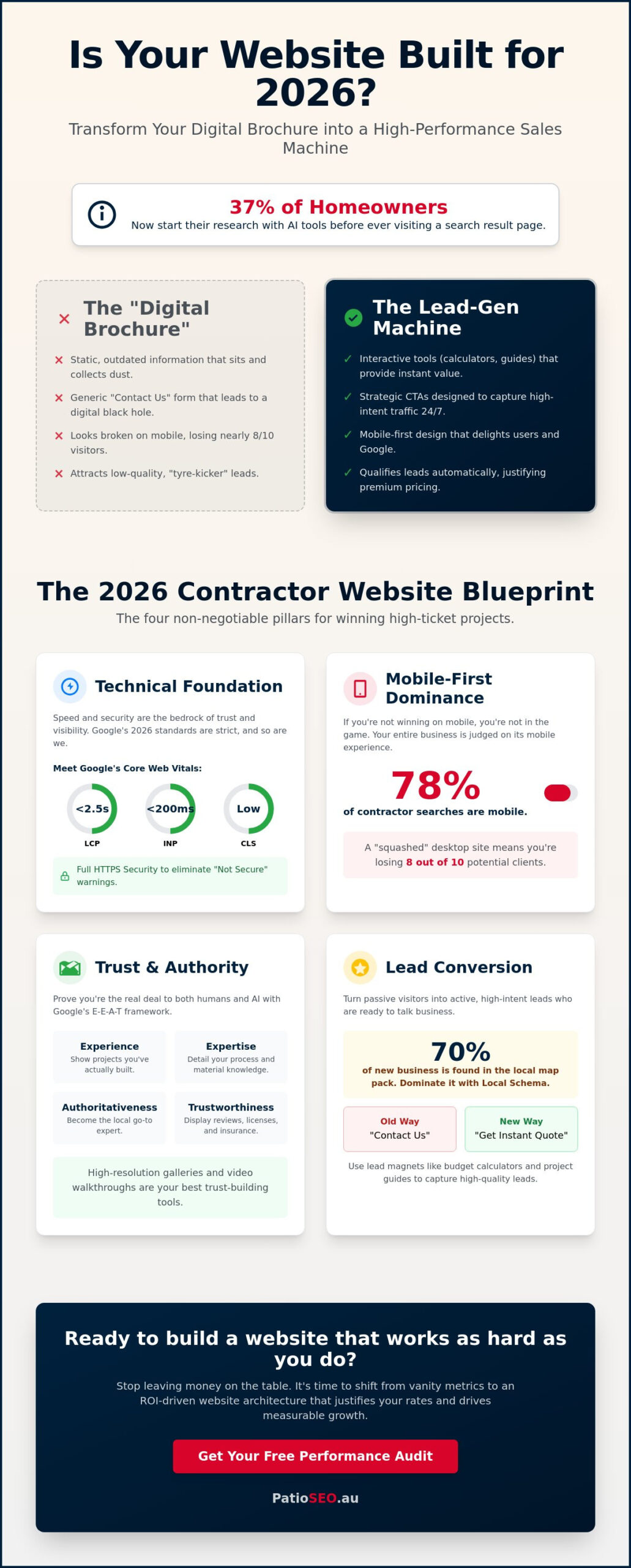
Up to 37% of homeowners now start their research for local services using AI tools like ChatGPT before they ever click a traditional search result. If your site still feels like a static digital brochure rather than a lead-generating machine, you’re essentially handing high-ticket patio and deck projects to your competitors. To win in this landscape, you must move beyond basic aesthetics and implement the specific contractor website must haves that satisfy both AI-search algorithms and human trust.
It’s frustrating to deal with low-quality “tyre-kicker” leads when you know your craftsmanship deserves premium pricing. We’re cutting through the noise to give you a clear, ROI-driven roadmap for your digital presence. You’ll discover how to master Google’s 2026 performance standards, leverage AI automation for 24/7 lead capture, and dominate the local map pack where up to 70% of new business is found. This is about turning your website into a hardworking partner that justifies your rates and scales your growth.
Key Takeaways
- Transition from a static digital brochure to a high-performance sales machine that meets the 2026 homeowner’s demand for instant transparency.
- Secure your local search ranking by implementing technical contractor website must haves like Core Web Vitals and a seamless mobile-first user experience.
- Build immediate authority with high-resolution galleries and video walkthroughs that bring your deck and patio projects to life for potential clients.
- Boost your lead volume by replacing generic “Contact Us” buttons with strategic CTAs and lead magnets designed to capture high-intent traffic.
- Shift your focus from vanity metrics to ROI-driven website architecture that justifies premium pricing and drives measurable revenue growth.
Why Your “Digital Brochure” Is Costing You Leads in 2026
Most contractors treat their website like a glorified business card. It’s got a logo, a few blurry photos, and a “Contact Us” page that leads to a digital black hole. In 2026, that’s a recipe for zero ROI. A static brochure site just sits there, while a “Lead-Gen Sales Machine” actively hunts for business. Transitioning your site into a conversion tool is one of the most critical contractor website must haves if you want to stop chasing small jobs and start landing high-ticket deck builds.
Homeowners don’t have the patience they used to. They want transparency and they want it now. Data shows that even a 1-second delay in page load can tank your conversion rates. If a visitor can’t find your service area, rough pricing, or proof of quality within ten seconds, they’re gone. They’ll head straight to the competitor who makes the information easy to find. This is why we focus on CRO for contractors as the bedrock of every site we build. It’s not about making things look “pretty”; it’s about removing the friction that stops a visitor from becoming a lead.
The Death of the “Contact for Quote” Gate
The days of hiding all your value behind a contact form are over. 2026 buyers are savvy. They’ve likely already used an AI tool to research deck materials and average costs before landing on your page. If you force them to “call for a quote” just to get basic information, you’ve lost them. High-performing sites now use self-selection tools. These might be interactive budget calculators or detailed project guides. By providing this upfront value, you ensure that the people who finally reach out are qualified, high-intent leads who already trust your expertise. We lean on fundamental web design principles to ensure these tools are intuitive and fast, keeping the user engaged rather than frustrated. Getting your contractor website must haves right means giving users enough info so only the serious clients pick up the phone.
Satisfying the AI-Search Algorithm
It’s not just humans reading your site anymore. AI-powered search engines are constantly crawling your content to see if you’re the real deal. They look for E-E-A-T: Experience, Expertise, Authoritativeness, and Trustworthiness. For a deck building business, E-E-A-T means your website must prove you’ve actually swung a hammer and managed complex council approvals, rather than just hosting stock photos of nice backyards. If the AI doesn’t see evidence of your hands-on experience and local authority, you won’t show up in the “Answer Engine” results that homeowners are increasingly using to find builders.
The Technical Foundation: 2026 Performance Must-Haves
78% of all contractor-related searches are now performed on mobile devices. If your site looks like a squashed desktop version on a smartphone, you’re losing nearly eight out of ten potential clients before they even see your work. In 2026, “mobile-friendly” is the bare minimum. You need a mobile-first architecture that prioritises thumb-friendly navigation and lightning-fast interactions. This is a core part of the contractor website must haves list because Google now judges your entire business based on the mobile experience.
Speed and stability aren’t just technical checkboxes; they’re revenue drivers. Google’s 2026 Core Web Vitals are the strict standard you must meet. Your Largest Contentful Paint (LCP) must be under 2.5 seconds, and your Interaction to Next Paint (INP) needs to stay below 200 milliseconds to ensure the site feels responsive. If your layout shifts while a user is trying to click a button, your Cumulative Layout Shift (CLS) score will tank, and so will your rankings. We ensure every site we build meets these Essential Elements of Construction Website Design to keep your bounce rates low and your visibility high.
Security is the final pillar of trust. A “Not Secure” warning in the browser bar is the ultimate trust-killer for someone looking to spend $50,000 on a new deck. Beyond HTTPS, we implement Local Schema Markup. This hidden code tells Google exactly which suburbs you serve and what projects you specialise in, helping you dominate the “map pack” which now generates 60 to 70% of leads for contractors. Getting these contractor website must haves right means your site works for you, not against you.
Hyper-Fast Loading Speeds
Patio builders often kill their own rankings by uploading massive, unoptimised high-res photos. While quality imagery is vital, heavy galleries lead to slow sites and frustrated users. A faster site directly translates to a higher ROI because users stay longer and engage more. You should optimise your contractor project gallery examples by using modern formats like WebP. This maintains crisp visuals without the performance hit that drives potential clients to your competitors.
Service Area Optimisation
Don’t just list your service areas in the footer and hope for the best. You need dedicated landing pages for every major suburb you serve across Queensland or Victoria. These pages should include properly integrated Google Maps that provide local context without dragging down your site speed. This level of detail makes it easier for local traffic to find you. If you’re unsure if your technical foundation is holding you back, a quick technical audit from our team can identify the bottlenecks costing you money.
Visual Proof: Building Trust Before the First Phone Call
98% of consumers read online reviews for local businesses before they ever pick up the phone. In the high-ticket world of patio and deck construction, visual proof is the currency of trust. You aren’t just selling a structure; you’re selling a lifestyle and the confidence that you won’t leave a half-finished mess in a client’s backyard. High-resolution galleries and authentic testimonials are essential contractor website must haves because they justify your premium pricing before a single word is spoken.
Static “before and after” photos are no longer enough to win the job in 2026. Homeowners want to see the “during” and the “experience.” Video walkthroughs allow potential clients to virtually step onto a finished deck, hearing the solid thud of quality timber and seeing the seamless transition from indoor to outdoor living. This level of transparency builds immediate rapport. It’s also vital to show the “Face of the Business.” Seeing your team in their high-vis, working on a site in Brisbane or Melbourne, humanises your brand and separates you from the faceless, low-quality lead aggregators that clutter the search results.
Integrating your Google Reviews directly onto your project pages is a power move. It tethers your visual work to real-world satisfaction. When a visitor sees a stunning insulated patio and immediately reads a five-star review from a homeowner in their own suburb, the barrier to enquiry vanishes. This alignment of visual excellence and social proof is what transforms a visitor into a high-intent lead.
The Anatomy of a High-Converting Gallery
A gallery shouldn’t be a dumping ground for every photo on your phone. You need curated project descriptions that explain the “why” behind the design. Did you solve a drainage issue? Did you use specific materials to handle the coastal salt air? Linking these galleries to specific services, like timber decking or outdoor kitchens, helps both the user and the search engine. For inspiration on layout and flow, look at some of the best patio builder websites currently dominating the Australian market. They use professional imagery to tell a story of transformation, not just a record of a build.
Social Proof and Reputation Signals
Reputation signals go beyond just reviews. Displaying industry association badges, such as Master Builders or HIA, provides a layer of professional protection that “tyre-kicker” competitors lack. Following SBA website design best practices, you should place these trust signals where they are most visible during the decision-making process. Case studies are your best weapon here. Instead of a simple caption, detail the homeowner’s problem, your strategic solution, and the ultimate ROI they received in terms of property value and lifestyle. Use real Australian locations to anchor your authority in the suburbs you actually serve. This level of detail proves you’re the local expert, making your site one of the most effective contractor website must haves for sustainable growth.
Conversion Elements: Turning Visitors into Quote Requests
Attracting traffic to your site is a waste of resources if those visitors leave without leaving a trace. In 2026, your conversion strategy must be as robust as your deck footings. Most contractor sites fail because they offer no middle ground between “just looking” and “book a quote.” By integrating high-intent conversion elements, you bridge that gap and capture leads that your competitors are ignoring. These contractor website must haves shift the focus from vanity metrics to actual revenue.
The “Contact Us” button is a relic of the past. It’s vague and carries the weight of a commitment many users aren’t ready for yet. One of the most effective ways to build a pipeline is through lead magnets. Offering a “2026 Patio Design Guide” or a “Decking Material Comparison” in exchange for an email address allows you to build a database of warm prospects. Since 85% of homeowners choose the first contractor who responds to an inquiry, having their contact details early gives you a massive head start in the race for the contract.
Speed of response is now a non-negotiable expectation. Research shows that websites using AI-powered chat see an average 15% increase in total lead volume. Crucially, about 40% of these conversions happen outside normal business hours. If a potential client in Sydney or Perth is browsing at 9:00 PM, an AI chatbot or a direct WhatsApp integration can capture their details while you’re off the clock. This isn’t just a fancy gadget; it’s a 24/7 sales assistant that ensures no high-ticket project slips through the cracks. If you’re ready to stop losing leads to slower competitors, it’s time to optimise your site for maximum conversion.
Transparency also drives conversion. A “Process” page that explains exactly how you move from a site visit to a finished build removes the fear of the unknown. When homeowners know what to expect regarding timelines and communication, they feel more comfortable reaching out. This clarity justifies your premium pricing by positioning you as a professional partner rather than just another tradie with a hammer.
The Action-Benefit CTA Framework
Your Call-to-Action (CTA) buttons need to do more than just exist. Instead of the generic “Submit,” use benefit-driven language like “Get My Free Deck Design Session.” Every page needs a primary CTA at the top and a secondary one at the bottom to catch users as they finish reading. Make sure these buttons are large and thumb-friendly for mobile users. A tiny link that’s hard to click on a smartphone is a fast way to kill your conversion rate.
Lead Qualification Forms
Not every lead is a good lead. To avoid wasting time on “tyre-kickers,” use multi-step forms that ask the right questions. By asking about project budget, desired start date, and material preferences, you filter out low-budget enquiries before they reach your inbox. Multi-step forms actually increase completion rates because they don’t overwhelm the user with twenty fields all at once. This ensures that the leads you do get are qualified and ready to invest in a high-quality outdoor living space.
How Patio SEO Builds High-Performance Contractor Sites
At Patio SEO, we don’t believe in digital “black boxes” or flashy vanity metrics that don’t pay the bills. We know that for a deck builder, a website isn’t a trophy; it’s a tool for generating high-ticket leads. Our “no-nonsense” approach to website design for patio contractors ensures that every technical decision we make is tied directly to your bottom line. We integrate high-speed hosting and the technical contractor website must haves discussed earlier to create a platform that outranks your local competitors and justifies your premium rates.
Generalist marketing agencies often try to use the same template for a plumber as they do for a high-end outdoor living specialist. That doesn’t work in 2026. A $50,000 patio build requires a different level of trust and visual storytelling than a $200 tap repair. We cut through the noise by focusing on what actually moves the needle: revenue and return on investment. By combining technical SEO, local GMB management, and conversion rate optimisation, we build a sustainable lead-generation machine that works as hard as you do on-site. We’re the partner that isn’t afraid to get our hands dirty with complex data to ensure your long-term stability.
Bespoke Strategy for Outdoor Living Pros
A patio builder needs to capture a specific “vibe” that resonates with homeowners dreaming of an Australian summer lifestyle. Our process involves deep-diving into your unique builds to ensure your site reflects the quality of your craftsmanship. We don’t just put up photos; we build an experience that highlights your specific contractor website must haves. If you aren’t sure if your current site is helping or hurting your growth, book a free strategy session with us. We’ll audit your digital presence and show you exactly where you’re leaving money on the table.
Sustainable Growth and Transparency
We value honesty over empty promises and flashy marketing hype. Our monthly reporting doesn’t just show you “impressions” or “clicks”; it shows you leads and revenue. We understand the Australian construction landscape, from the seasonal shifts in demand to the local competition in Queensland and Victoria. This local expertise allows us to build strategies that are both pragmatic and effective. Don’t settle for a digital brochure that costs you money every month. Get your ROI-driven website audit today and see how we can turn your site into your most profitable salesperson.
Build Your 2026 Lead-Gen Machine Today
The digital landscape for builders has shifted. A site that just looks good is no longer enough to win high-ticket deck and patio projects in a market driven by AI search and instant expectations. You’ve seen how technical speed, visual authority, and low-friction conversion tools work together to turn local traffic into revenue. Implementing these contractor website must haves is the difference between a site that costs you money and one that scales your business.
At Patio SEO, we cut through the noise with a no-nonsense Australian approach. We specialise exclusively in the outdoor living niche, focusing on high-ticket lead generation rather than vanity metrics. Our strategies are built on transparency and proven data. It’s time to stop guessing and start growing. Get Your Free ROI-Driven Website Audit today to see exactly how your site stacks up against the 2026 standards. We’re ready to help you dominate your local market and build a sustainable future for your contracting business.
Frequently Asked Questions
What is the most important feature of a contractor website in 2026?
The most important feature is the ability to convert traffic into qualified quote requests instantly. While aesthetics matter, a site that doesn’t capture lead data is just an expensive digital business card. In 2026, high-performing sites use interactive elements and instant communication tools like WhatsApp to engage homeowners immediately. This ensures your marketing spend translates into actual site visits and signed contracts.
How much should a professional contractor website cost to build?
A professional site is an investment in your sales pipeline rather than a simple one-time expense. Costs vary based on complexity, custom features, and the level of SEO integration required for your specific local market. While DIY builders are cheap, a custom-built solution designed for ROI typically pays for itself through the higher volume of premium leads it generates. Focus on the total value of the projects you’ll land, not just the upfront fee.
Do I really need a blog for my patio building business?
Yes, because a blog is a powerful tool for building local authority and satisfying Google’s E-E-A-T requirements. Writing about specific project challenges in your service area proves your expertise to both AI search engines and potential clients. It allows you to target long-tail keywords that your competitors are likely ignoring. This helps your site become a comprehensive resource for homeowners who are still in the research phase.
Why is my contractor website not showing up on Google?
Your site likely lacks the technical foundation or local relevance needed to outrank established competitors. Common issues include poor mobile performance, a lack of local schema markup, or a weak Google Business Profile integration. If you haven’t implemented the essential contractor website must haves, Google won’t trust your site enough to put it in the top results. A technical audit is usually the first step to identifying these bottlenecks.
How can I make my website load faster without deleting my project photos?
You can maintain high-quality visuals by using modern image formats like WebP and implementing “lazy loading” techniques. These methods ensure that your high-res deck photos only load as the user scrolls down, which keeps the initial page speed fast. Using a Content Delivery Network (CDN) also helps by serving your images from the server closest to your visitor. This keeps your Core Web Vitals scores in the green without sacrificing visual proof.
What is the difference between SEO and CRO for a contractor site?
SEO gets people to your site, while CRO gets them to pick up the phone and book a quote. Search Engine Optimisation focuses on visibility and ranking for relevant terms like “deck builders near me” or “patio installers.” Conversion Rate Optimisation is about the user journey once they arrive, ensuring your CTAs and layout drive them toward a quote request. You need both to ensure your digital presence actually generates revenue.
Should I use a website builder like Wix or a custom WordPress site?
Custom WordPress sites are the gold standard for contractors who want full control over their SEO and long-term scalability. While builders like Wix are easy to start, they often lack the deep technical customisation required for advanced contractor website must haves like custom schema or high-speed performance tweaks. WordPress allows you to own your data and grow your site alongside your business without hitting a technical glass ceiling.
How do I get more Google Reviews to show up on my website?
Use an automated system to request reviews immediately after a project is completed and integrate a live feed on your site. Directly embedding your Google Business Profile reviews builds immediate trust through third-party verification. This social proof is far more effective than manually typing out testimonials, as visitors can see they are genuine. Making it easy for happy clients to leave feedback is the best way to build your online reputation quickly.